





Flix Stock interview experience Real time questions & tips from candidates to crack your interview
Associate machine learning engineer
Flix Stock


4 rounds | 4 Coding
problems
 Selected
 Interview preparation journey

Preparation
Duration: 6 months
Topics: Machine learning, deep learning, Computer vision, image processing, AI

Tip 1 : focus on maths
Tip 2 : Focus on intution
Application process
Where: Other
Eligibility: published Research paper, Good ML projects, 7 cgpa
Tip 1 : include project links
Tip 2 : must include research work and github link

Interview rounds
01
Round
Medium
Assignment
Duration2 Days
Interview date10 Jun 2022
Coding problem1
1. Assignment
Garments in the fashion domain can be of multiple shapes, sizes, and colors. Finding garments similar to each other is an important feature used by e-commerce websites to show recommendations to its users. We would like to find visually similar garments for any input garment from within a given dataset of garment images. Write a python solution to find the 10 most similar images to a query image from within a database of images
02
Round
Medium
Video Call
Duration60 Minutes
Interview date20 Jul 2022
Coding problem2
1. Integer To Roman Numeral
Easy
10m average time
90% success

0/40
Asked in companies



Given an integer ‘N’, the task is to find its corresponding Roman numeral.
Roman numerals are represented by seven different symbols: I, V, X, L, C, D and M.
Symbol      Value
  I           1
  V           5
  X           10
  L           50
  C           100
  D           500
  M           1000
Example :
2 is written as II in the roman numeral, just two one’s added together.
12 is written as XII, which is simply X(ten) + II(one+one).
The number 27 is written as XXVII, which is XX + V + II.

Roman numerals are usually written largest to smallest from left to right.
However, the numeral for four is not IIII. Instead, the number four is written as IV. Because the one is before the five we subtract it making four.
The same principle applies to the number nine, which is written as IX.

There are six instances where subtraction is used:

I can be placed before V (5) and X (10) to make 4 and 9.
X can be placed before L (50) and C (100) to make 40 and 90.
C can be placed before D (500) and M (1000) to make 400 and 900.
Problem approach
how we can take each place in the decimal system (times a power of 10) and add the numbers for our total number, similarly we can separately evaluate and then concatenate THOUS + HUNDS + TENS + ONES for the total roman numeral.
Furthermore, for any place X*2 = XX)
If the place is 4, the term is UNIT + HALF (Ex. 4 -> I + V = IV)
If the place is 5 or more, the term is HALF + UNIT (place-5) (Ex. 800 -> D + C * (8-5) = DCCC)
If the place is 9, the term is UNIT + NEXT_UNIT(Ex. 90 -> X + C = XC)
So, for all relevant powers of 10, we can go through the above 4 considerations, only changing our definitions of UNIT, HALF, and NEXT_UNIT. This reduces our written code while maintaining legibility.]
2. Populating Next Right Pointers In Each Node
Moderate
25m average time
75% success
0/80
Asked in companies



You have been given a complete binary tree of ‘N’ nodes. The nodes are numbered 1 to ‘N’.
You need to find the ‘next’ node that is immediately right in the level order form for each node in the given tree.
Note :
1. A complete binary tree is a binary tree in which nodes at all levels except the last level have two children and nodes at the last level have 0 children.
2. Node ‘U’ is said to be the next node of ‘V’ if and only if  ‘U’ is just next to ‘V’ in tree representation.
3. Particularly root node and rightmost nodes have ‘next’ node equal to ‘Null’
4. Each node of the binary tree has three-pointers, ‘left’, ‘right’, and ‘next’. Here ‘left’ and ‘right’ are the children of node and ‘next’ is one extra pointer that we need to update.
For Example :
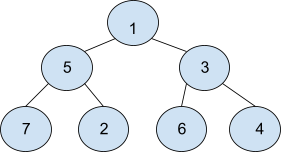
The‘next’ node for ‘1’ is ‘Null’, ‘2’ has ‘next’ node ‘6’, ‘5’ has ‘next’ node ‘3’, For the rest of the nodes check below.
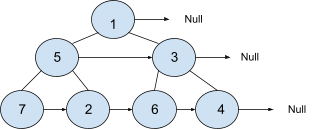
Problem approach
I used the level order traversal algorithm as my base and modifying it. The last if condition in the code handles the linking of nodes.
class Solution {
public Node connect(Node root) {
if (root == null) return root;
Queue queue = new ArrayDeque<>();
queue.add(root);
while (!queue.isEmpty()) {
int size = queue.size();
for (int i = 0; i < size; i++) {
Node curr = queue.remove();
if (curr.left != null) {
queue.add(curr.left);
}
if (curr.right != null) {
queue.add(curr.right);
}
if (i < size - 1) {
curr.next = (queue.peek() != null) ? queue.peek() : null;
}
}
}
return root;
}
}
03
Round
Easy
Telephonic
Duration90 Minutes
Interview date22 Jul 2022
Coding problem0
In depth Questions regarding Machine learning, Image processing and other fields in AI. What is image processing. How do you know about its accuracy.
04
Round
Easy
Video Call
Duration60 Minutes
Interview date22 Jul 2022
Coding problem1
Questions regarding your resume, work experience, non tech skills.
1. Basic HR Questions
What keeps you motivated?
Why should we hire you?


Here's your problem of the day 
Solving this problem will increase your chance to get selected in this company
Skill covered: Programming
How do you remove whitespace from the start of a string?
Choose another skill to practice
Similar interview experiences

SDE - 1
3 rounds | 7 problems
Interviewed by OYO
 Selected
6182 views

0 comments

0 upvotes
SDE - Intern
2 rounds | 3 problems
Interviewed by Amazon
Rejected
1565 views
0 comments
0 upvotes

SDE - 1
2 rounds | 5 problems
Interviewed by Meesho
Rejected
7245 views
0 comments
0 upvotes

SDE - 1
3 rounds | 9 problems
Interviewed by Salesforce
 Selected
 4552 views
0 comments
0 upvotes