





Gameskraft interview experience Real time questions & tips from candidates to crack your interview

SDE - 1
Gameskraft


5 rounds | 6 Coding
problems
 Selected
 Interview preparation journey

Journey
I come from a tier-3 college where on-campus placement opportunities are limited, so I applied to companies through off-campus opportunities. I’m grateful to Coding Ninjas for their helpful platform, which played a crucial role in my success in most of my interviews.
Application story
The recruiter reached out to me just two days after I applied for the role on LinkedIn. Hearing back so quickly from HR made me feel thrilled and optimistic about the opportunity.
Why selected/rejected for the role?
I was selected for this role because I was able to clear all the rounds of the interview process.
Preparation
Duration: 3 Months
Topics: Data Structure, Algorithms, OOPS, Operating System, System Design, ReactJS

Tip 1: Participate in online coding contests.
Tip 2: Work on projects.
Tip 3: Revise core computer science subjects.
Application process
Where: Linkedin
Eligibility: Nothing (Salary Package: 36 LPA)
Tip 1: Online Coding Profile: Include your online coding profile link to showcase your problem-solving skills and coding proficiency, especially if you've solved a substantial number of questions or achieved a high rank.
Tip 2: Strong Projects: Highlight impactful projects with concise descriptions that demonstrate your technical skills, problem-solving ability, and relevant technologies used. This adds depth to your experience and demonstrates hands-on expertise.

Interview rounds
01
Round
Hard
Video Call
Duration60 minutes
Interview date15 Aug 2024
Coding problem2
The first round had two hard-level coding challenges to solve within one hour, focusing on math, dynamic programming, graphs, and trees. As this was an elimination round, I was required to provide the most optimized solution for both problems. I solved both questions in 40 minutes and received a call from HR to proceed to the next round.
1. Merge Two Sorted Linked Lists
Moderate
15m average time
80% success

0/80
Asked in companies



You are given two sorted linked lists. You have to merge them to produce a combined sorted linked list. You need to return the head of the final linked list.
Note:
The given linked lists may or may not be null.
For example:
If the first list is: 1 -> 4 -> 5 -> NULL and the second list is: 2 -> 3 -> 5 -> NULL

The final list would be: 1 -> 2 -> 3 -> 4 -> 5 -> 5 -> NULL
Problem approach
Brute Force Method
Recursive Merge
Iterative Merge
In-Place Merge
2. Triplets in Binary Tree
Easy
15m average time
85% success
0/40
Asked in companies


You have been given a Binary Tree of integers and an integer 'X'. Find all the triplets in the tree whose sum is strictly greater than 'X'. The nodes in the triplet must hold the relationship of grandparent-parent-child.
For example:
For the given binary tree and X = 9
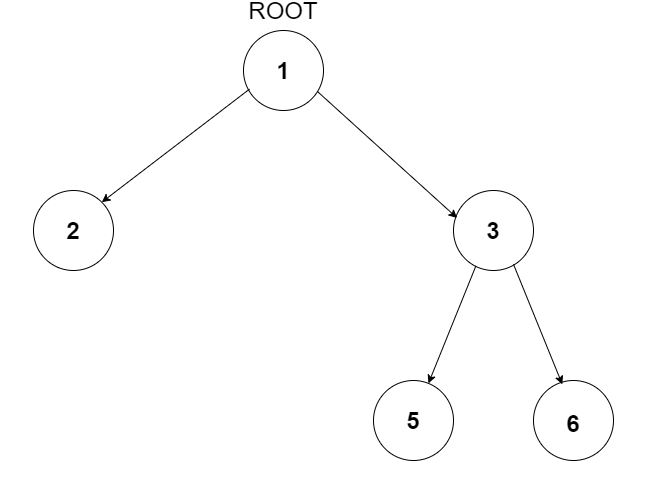
{1, 3, 6} is a valid triplet because 6 is a node whose parent is 3 and grand-parent is 1. Also, the sum of these nodes is 1 + 3 + 6 = 10 which is strictly greater than X = 9.
Problem approach
Steps involved in solving the problem:
Create an empty adjacency list ‘T’ to represent the tree structure. For each edge in the tree, add the corresponding vertices to each other’s adjacency lists to represent the connections.
Initialize the variable ‘ans’ to n * (n – 1) * (n – 2) / 6, which represents the total number of tuples (i, j, k) with 1 ≤ i < j < k ≤ N.
Initialize a vector ‘sz’ of size ‘n’, where each element is initialized to 1. This vector will be used to store the size of each subtree rooted at every vertex.
Define a recursive function ‘dfs’ that takes two parameters ‘v’ (current vertex) and ‘pre’ (the parent vertex). The purpose of this function is to calculate the size of each subtree rooted at each vertex and update the ‘ans’ variable accordingly.
Inside the ‘dfs’ function, iterate through the adjacent vertices of ‘v’ (excluding the parent vertex ‘pre’). For each adjacent vertex ‘c’, recursively call the ‘dfs’ function with ‘c’ as the current vertex and ‘v’ as the parent vertex.
Calculate the ‘sum1‘ and ‘sum2‘ values for the current vertex ‘v’ based on the sizes of its subtrees and update the ‘sz’ vector accordingly.
Decrement ‘ans’ by (sum1 * sum1 – sum2) >> 1. This step removes the tuples (i, j, k) that form a simple path containing all three vertices i, j, and k in the tree.
Call the ‘dfs’ function with the starting vertex as 0 (or any other appropriate starting vertex) and the parent vertex as -1 (or any other value indicating that there is no parent).
Finally, print the ‘ans’ value, which represents the number of tuples (i, j, k) that satisfy the condition of not having a simple path containing all three vertices i, j, and k in the tree.
02
Round
Easy
Video Call
Duration90 minutes
Interview date25 Aug 2024
Coding problem1
This round lasted 1.5 hours and was conducted with the Team Lead. It was the toughest round for me, focusing on JavaScript and ReactJS. I was asked medium-to-hard-level JavaScript questions and had to design something on the spot.
I managed to solve most of the tasks, and the next day, I received a call from HR for the third round.
1. System Design
I was asked to design the splitwise.
Problem approach
Tip 1: Clarify Requirements: Always ask clarifying questions to fully understand the problem and its constraints before designing.
Tip 2: Prioritize Scalability: Choose designs that can handle growing user bases, data volumes, and traffic patterns.
Tip 3: Explain Trade-offs: Clearly discuss the pros and cons of your design choices to showcase your understanding of flexibility and limitations.
03
Round
Easy
Video Call
Duration60 minutes
Interview date26 Aug 2024
Coding problem1
This round lasted about 1 hour with the Engineering Manager. The topics included JavaScript output, AWS, core web vitals, and optimization techniques. We had an amazing discussion, and I managed to answer most of the questions. After an hour, HR called me for the 4th round.
1. System Design
I was asked to design the cricbuzz and some questions related to JavaScript.
Problem approach
Clarify Requirements: Always ask clarifying questions to fully understand the problem and constraints before designing.
Prioritize Scalability: Choose designs that can handle increasing user bases, data volumes, and traffic patterns.
Explain Trade-offs: Discuss the pros and cons of your design choices to demonstrate your understanding of flexibility and limitations.
04
Round
Hard
Video Call
Duration60 minutes
Interview date27 Aug 2024
Coding problem1
This was a 40-minute round with the DOE of the company. We discussed my previous work experience and the best work I did at my last company. The interviewer was very knowledgeable, asking about APIs, network calls, Lighthouse LCP, and more. I was able to answer most of the questions, and after two days, I received a call from HR for the 5th round. ️
1. Technical Question
This was a 40-minute round with the DOE of the company. We discussed my previous work experience and the best work I did at my last company. The interviewer was very knowledgeable, asking about APIs, network calls, Lighthouse LCP, and more. I was able to answer most of the questions, and after two days, I received a call from HR for the 5th round.
05
Round
Easy
Video Call
Duration60 minutes
Interview date27 Aug 2024
Coding problem1
This 40-minute round focused on the tech stack used at the company, my previous work, and how well I would fit into the company culture. I did well in this round too, and shortly after, I was invited to the HR round.
1. Technical Question
This 40-minute round focused on the tech stack used at the company, my previous work, and how well I would fit into the company culture. I did well in this round too, and shortly after, I was invited to the HR round.


Here's your problem of the day 
Solving this problem will increase your chance to get selected in this company
Skill covered: Programming
How do you remove whitespace from the start of a string?
Choose another skill to practice
Similar interview experiences
SDE - 1
4 rounds | 5 problems
Interviewed by Gameskraft
 Selected
2871 views

0 comments

0 upvotes
SDE - 1
5 rounds | 10 problems
Interviewed by Gameskraft
 Selected
 6032 views
0 comments
0 upvotes
SDE - 1
3 rounds | 5 problems
Interviewed by Gameskraft
 Selected
 1944 views
0 comments
0 upvotes
SDE - 1
4 rounds | 10 problems
Interviewed by Gameskraft

Rejected
279 views
0 comments
0 upvotes
Companies with similar interview experiences
SDE - 1
5 rounds | 12 problems
Interviewed by Amazon
 Selected
 117552 views
24 comments
0 upvotes

SDE - 1
4 rounds | 5 problems
Interviewed by Microsoft
Selected 60143 views
5 comments
0 upvotes
SDE - 1
3 rounds | 7 problems
Interviewed by Amazon
 Selected
 36138 views
7 comments
0 upvotes