





Genpact private limited interview experience Real time questions & tips from candidates to crack your interview
Senior Software Engineer
Genpact private limited


3 rounds | 7 Coding
problems

 Selected
 Interview preparation journey

Journey
I think I will be more suitable to explain the contribution of coding ninja in my career. I started doing coding in Java by taking course from coding ninjas. Before this I was exploring different programming like python, c++ , java. So I choose java. After completing the course i started practicing on geeks for geeks and Leetcode. After this, I have made mini project. I have also taken in-house training on ML.
Application story
I have applied through Hackerrank.com. After applying my resume got shortlisted and I got test link. After test I got interview link for discussion round. After that I got mail.
Why selected/rejected for the role?
I got selected because I was not able to give properly optimize approach for coding questions and SQL query. I qualified for all the 3 rounds.
Preparation
Duration: 4 Months
Topics: Data Structures, CPP, Algorithms, PUZZLES, Operating systems, DBMS.

Tip 1 : Revise all the coding interview questions that you have solved so far in the last few days
Tip 2 : Practice writing the codes on paper with clarity
Tip 3 : Mention only those thing that you know in your CV and revise your projects nd everything you have mentioned on your resume thoroughly.
Application process
Where: Campus
Eligibility: No eligibilty
Tip 1 : Do not even mention topics you have no idea about
Tip 2 : you should have some projects on resume and you should be able to explain clearly why you have chosen the particular project, what does it do, its functionality, outcomes and everything about each of the projects.
Tip 3 : Tailor your resume according to the needs/the role you are applying for

Interview rounds
01
Round
Medium
Online Coding Test
Duration120 Minutes
Interview date13 Apr 2022
Coding problem3
Three coding problems were asked
1. The Celebrity Problem
Moderate
30m average time
60% success

0/80
Asked in companies



There are ‘N’ people at a party. Each person has been assigned a unique id between 0 to 'N' - 1(both inclusive). A celebrity is a person who is known to everyone but does not know anyone at the party.
Given a helper function ‘knows(A, B)’, It will returns "true" if the person having id ‘A’ know the person having id ‘B’ in the party, "false" otherwise. Your task is to find out the celebrity at the party. Print the id of the celebrity, if there is no celebrity at the party then print -1.
Note:
1. The helper function ‘knows’ is already implemented for you.
2. ‘knows(A, B)’ returns "false", if A doesn't know B.
3. You should not implement helper function ‘knows’, or speculate about its implementation.
4. You should minimize the number of calls to function ‘knows(A, B)’.
5. There are at least 2 people at the party.
6. At most one celebrity will exist.
2. Ways To Express
Hard
15m average time
85% success
0/120
Asked in companies


You are given the number ‘N’. The task is to find the number of ways to represent ‘N’ as a sum of two or more consecutive natural numbers.
Example:
N = 9
‘9’ can be represented as:
2 + 3 + 4 = 9
4 + 5 = 9
The number of ways to represent ‘9’ as a sum of consecutive natural numbers is ‘2’. So, the answer is ‘2’.
Note:
1. The numbers used to represent ‘N’ should be natural numbers (Integers greater than equal to 1).
3. Pair Sum
Easy
15m average time
90% success
0/40
Asked in companies


You are given an integer array 'ARR' of size 'N' and an integer 'S'. Your task is to return the list of all pairs of elements such that each sum of elements of each pair equals 'S'.
Note:
Each pair should be sorted i.e the first value should be less than or equals to the second value.

Return the list of pairs sorted in non-decreasing order of their first value. In case if two pairs have the same first value, the pair with a smaller second value should come first.
02
Round
Medium
Video Call
Duration50 minutes
Interview date14 Apr 2022
Coding problem2
1. Technical Question
Explain linked list and operations on linked list
Problem approach
I explained all operations such as insertion, deletion etc
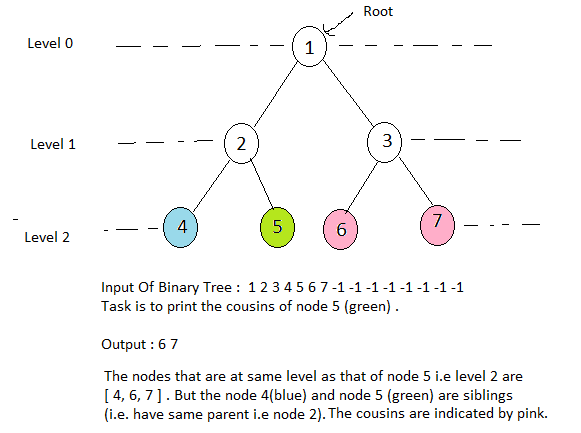
2. Cousins of Given Node in Binary Tree
Moderate
10m average time
90% success
0/80
Asked in companies



Given a binary tree of N nodes and a node of this tree, you need to return a list containing the values of the cousins of the given node in the given binary tree sorted by non-decreasing order of their values.
Note:
Two nodes of a binary tree are cousins if they have the same depth or level, but have different parents.

No two nodes in the given binary tree will have the same data values.
Example :
03
Round
Medium
Video Call
Duration45 minutes
Interview date14 Apr 2022
Coding problem2
1. Middle Of Linked List
Easy
20m average time
80% success
0/40
Asked in companies


Given a singly linked list of 'N' nodes. The objective is to determine the middle node of a singly linked list. However, if the list has an even number of nodes, we return the second middle node.
Note:
1. If the list is empty, the function immediately returns None because there is no middle node to find.
2. If the list has only one node, then the only node in the list is trivially the middle node, and the function returns that node.
2. Stack using queue
Moderate
25m average time
65% success
0/80
Asked in companies


Implement a Stack Data Structure specifically to store integer data using two Queues.
There should be two data members, both being Queues to store the data internally. You may use the inbuilt Queue.
Implement the following public functions :
1. Constructor:
It initializes the data members(queues) as required.

2. push(data) :
This function should take one argument of type integer. It pushes the element into the stack and returns nothing.

3. pop() :
It pops the element from the top of the stack and, in turn, returns the element being popped or deleted. In case the stack is empty, it returns -1.

4. top :
It returns the element being kept at the top of the stack. In case the stack is empty, it returns -1.

5. size() :
It returns the size of the stack at any given instance of time.

6. isEmpty() :
It returns a boolean value indicating whether the stack is empty or not.
Operations Performed on the Stack:
Query-1(Denoted by an integer 1): Pushes an integer data to the stack. (push function)

Query-2(Denoted by an integer 2): Pops the data kept at the top of the stack and returns it to the caller. (pop function)

Query-3(Denoted by an integer 3): Fetches and returns the data being kept at the top of the stack but doesn't remove it, unlike the pop function. (top function)

Query-4(Denoted by an integer 4): Returns the current size of the stack. (size function)

Query-5(Denoted by an integer 5): Returns a boolean value denoting whether the stack is empty or not. (isEmpty function)
Example
Operations:
1 5
1 10
2
3
4

Enqueue operation 1 5: We insert 5 at the back of the queue.
  Queue: [5]

Enqueue operation 1 10: We insert 10 at the back of the queue.
  Queue: [5, 10]

Dequeue operation 2: We remove the element from the front of the queue, which is 5, and print it.
  Output: 5
  Queue: [10]

Peek operation 3: We return the element present at the front of the queue, which is 10, without removing it.
  Output: 10
  Queue: [10]

IsEmpty operation 4: We check if the queue is empty.
  Output: False
  Queue: [10]


Here's your problem of the day 
Solving this problem will increase your chance to get selected in this company
Skill covered: Programming
How do you remove whitespace from the start of a string?
Choose another skill to practice
Similar interview experiences
Software Consultant
2 rounds | 2 problems
Interviewed by Genpact private limited
 Selected
2029 views

0 comments

0 upvotes
Frontend Developer
3 rounds | 7 problems
Interviewed by Genpact private limited
 Selected
 2028 views
0 comments
0 upvotes
SDE - 1
4 rounds | 8 problems
Interviewed by Amazon
Selected 11211 views
0 comments
0 upvotes
SDE - Intern
1 rounds | 3 problems
Interviewed by Amazon
Selected 4456 views
0 comments
0 upvotes
Companies with similar interview experiences

Senior Software Engineer
1 rounds | 6 problems
Interviewed by Arcesium
Rejected
4245 views
0 comments
0 upvotes

Senior Software Engineer
3 rounds | 3 problems
Interviewed by Ernst & Young (EY)
Selected 6312 views
0 comments
0 upvotes

Senior Software Engineer
3 rounds | 3 problems
Interviewed by HCL Technologies
 Selected
 3732 views
3 comments
0 upvotes