





Goldman Sachs interview experience Real time questions & tips from candidates to crack your interview

SDE - Intern
Goldman Sachs


3 rounds | 11 Coding
problems

 Selected
 Interview preparation journey

Journey
In the lockdown period, I started my journey to where I am today. Firstly I planned that I will start learning DSA from the first year but I could not. So i started from my third semester and along with DSA, I also learned development because that is what I wanted to be.
Application story
I was practising DSA on a regular day when I saw a small advertisement kind of on Leetcode. I opened it and I got to find that company is looking for SDE-intern for some freshers. I applied for the role and after some rounds i got selected.
Why selected/rejected for the role?
I think I was on point with my coding solutions to the questions asked in the interviews. I provided the optimal solutions and I was giving correct explanations to some theory questions asked.
Preparation
Duration: 12 Months
Topics: Data Structures and algorithms, OOPS, DBMS, Operating System, Puzzles, Aptitude, Maths(Probability, Permutations, Number Theory)

Tip 1 : Be thorough with data structures and algorithms. Avoid just switching between different coding platforms according to people's suggestion instead pick one and stick to it(Leetcode worked for me!).
Tip 2 : Do not miss out on core subjects (for GS ,OOPs and Operating systems especially).
Tip 3 : Keep giving mock interviews (take at least 2 -3 prior to real one) ,it helps a lot to prevent last-minute interview anxieties and makes you feel prepared and confident.
Application process
Where: Other
Eligibility: All 2022 engineering graduates were eligible.
Tip 1 : Choose the right format, it should reflect professionalism.Goldman Sachs blog suggests to arrange your resume with your educational information at the top,followed by your grade-point average,professional experience, projects and any special interests and activities or achievements.
Tip 2 : If you do not have any prior experience, solidify your projects section(3-4 is a good number).Articulate your project description in a precise and crisp format.
Tip 3 : Come up with three reasons why you should be picked for the job in accordance with job's description —these will be some of the top traits you’ll want to emphasize in your resume.
Tip 4 : Go through company's career blogs ,might give you relevant insights on what it expects then align your presentation in accordance with in.(Link to GS blog on resume tips:https://www.goldmansachs.com/careers/blog/posts/resume-tips-from-goldman-sachs.html )

Interview rounds
01
Round
Medium
Online Coding Interview
Duration90 minutes
Interview date20 Feb 2021
Coding problem0
This was 90 minutes long proctored test with morning/afternoon slots based on aptitude. It consisted of six sections with a total of 66 questions as follows:
1. Numerical Computation: 8 MCQs
2. Numerical Reasoning: 12 MCQs
3. Comprehension: 10 MCQs
4. Abstract Reasoning: 12 MCQs
5. Diagrammatic Reasoning: 12 MCQs
6. Logical Reasoning: 12 MCQs
The marking scheme was +5 and -2.
I attempted around 40 - 45 questions.
02
Round
Hard
Online Coding Interview
Duration135 minutes
Interview date20 Mar 2021
Coding problem3
The Technical Round was of 2 hours 15 minutes and was conducted on HackerRank. It comprised of 5 sections:
Programming – 30 minutes: 2 easy to medium level questions (1 of 20 marks other of 30).
Quantitative Aptitude – 25 minutes: 7 Math-related MCQs.
Computer Science – 20 minutes: 8 MCQs based on Computer Science subject topics like OOPs, OS, DBMS, DSA
Advanced Programming – 45 minutes: 1 question on advanced Data Structures (100 marks)
Tell me about Yourself – 15 minutes: 2 essay type questions
1. Counting Pairs
Moderate
35m average time
65% success

0/80
Asked in companies


You are given a positive integer N and an equation 1/X + 1/Y = 1/N
You need to determine the count of all possible positive integral solutions (X, Y) for the above equation.
Note:
1. X and Y should be greater than 0.
2. (X, Y) and (Y, X) are considered different solutions if X is not equal to Y, i.e. (X, Y) and (Y, X) will not be distinct if X=Y.
2. Level Order Traversal
Easy
15m average time
85% success
0/40
Asked in companies



You have been given a Binary Tree of integers. You are supposed to return the level order traversal of the given tree.
For example:
For the given binary tree
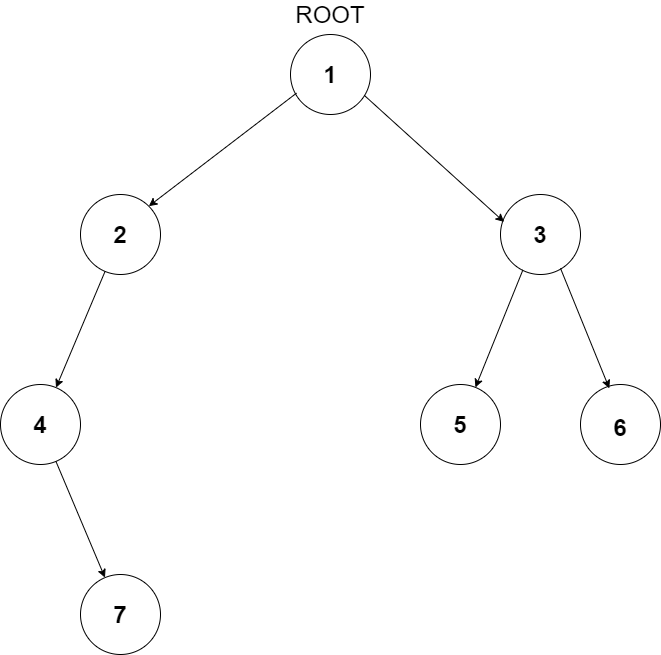
The level order traversal will be {1,2,3,4,5,6,7}.
3. Score After Flipping Matrix
Moderate
25m average time
75% success
0/80
Asked in companies

You are given a 2 - D matrix, ‘MAT’, which consists of only 0s and 1s. Every row of the matrix is interpreted as a binary number, and the sum of all these “binary number interpreted rows” is defined as the score of the matrix, ‘MAT’.
You have to maximize the score by making any number of passes where a pass consists of choosing any row or column, and toggling each value in that row or column, i.e., changing all 0s to 1s, and all 1s to 0s. Your task is to return the highest possible score of the matrix, ‘MAT’.
03
Round
Easy
Video Call
Duration11 hours
Interview date6 Apr 2021
Coding problem8
Finally, I was selected for the interview round which was conducted virtually over zoom.I had 4 rounds spanning over a period of almost 11 hours (10 AM- 9 PM) with breaks in between rounds, of course. As each of these rounds was an elimination round candidate had 1 to 4 rounds. In the end, we were 13 students left out of 65 students.
1. First Round
So the first round started with a tell me about yourself question, all the interviewers were pretty comforting and cooperative.
She went ahead and asked more about my teaching assistant's experience, challenges faced and some behavioural question around it. After that I had to code a medium hashmap question and the round ended with an easy puzzle linked below. It went around 40 minutes long.
2. Second Round
The second round again started with me introducing myself and I was asked out of all companies, Why Goldman Sachs? These are pretty standard question one must prepare. Further, he asked me if I had checked today's stocks prices of GS, which I had not and I stated it clearly. He then asked that as GS is a very diverse firm how would I tackle arguments or discrimination faced on the basis of gender/colour/race/culture. Then he shared with me the code pair link and asked two medium-hard level DP question linked below. I was able to solve one of them completely and the other one partially. This round went around 45 to 50 minutes long.
3. Third Round
In the third round, I was asked to brief any of my three projects mentioned within 10 15 minutes. She put some general questions in between but didn't cross-question much on it. As I had a project related to sorting I was asked questions on merge sort, quick sort, radix sort, their use cases time complexities.As I had used both c++ and java she asked me about their differences and then drifted towards OOPs.I was asked to explain some concepts of oops and state real-life examples where OOPs was implemented, then she asked about polymorphism, run time polymorphism , virtual functions/classes etc.
She then asked a coding question based on anagrams, question similar to it have been linked below.
This round again ended with a puzzle where I had to find a minimum number of races to be conducted to find the top three fastest horses out of 36 horses where only 6 horses can run on a track at once.
4. Fourth Round
The final was more of a behavioural round but with a really tricky question based on a matrix. He asked me to introduce myself , how I manage time being from electronics background, my incline towards computer science,Why Goldman Sachs and how does Goldman Sachs makes money. This was a pretty shorter round which ended with a logical question on matrix explained below.(I wasn't supposed to code it).
After each round they ask if you have a question for them so be prepared with that.
I wasn't asked a single question around core subjects like OS,DBMS,Computer networks but other candidates were asked about it.
5. Regular Expression Match
Easy
10m average time
90% success
0/40
Asked in companies



Given a string ‘str’ and a string ‘pat’. The string s has some wildcard characters i.e ‘?’ and ‘*’.
If any character is a ‘?’ we can replace that character with any other character.

If a character is a * we can replace * with any sequence of characters including the empty sequence.
Your task is to determine if it is possible that we can make ‘str' = 'pat’ using appropriate conversions in ‘str’.
For example:
Let str = “abc?" and pat= “abcd”

We return true as ‘?’ can be replaced with ‘d’ and this makes ‘str’ and ‘pat’ same.
6. Basic Aptitude Questions
There are 2 trees in a garden (tree "A" and "B") and on both trees are some birds.
The birds of tree A say to the birds of tree B that if one of you comes to our tree, then our population will be the double of yours.
Then the birds of tree B tell to the birds of tree A that if one of you comes here, then our population will be equal to that of yours. How many birds in each tree?
7. Fastest Horse
Moderate
25m average time
75% success
0/80
Asked in companies


There are ‘N’ horses running in ‘N’ different lanes numbered from 1 to ‘N’. You are given an array “FINISHTIME” containing ‘N’ integers where “FINISHTIME[i]” represents the time taken by the ith horse to complete the race.
You are now given ‘Q’ queries, each containing two integers each, ‘L’ and ‘R’. For each query, return the time taken by the fastest horse amongst the horses with numbers {L, L + 1, L + 2, …., R - 1, R} to complete the race.
Note:
The fastest horse is the one that takes the minimum time to finish the race.
8. Group Anagrams Together
Moderate
0/80
Asked in companies
You have been given an array/list of strings 'STR_LIST'. You are supposed to return the strings as groups of anagrams such that strings belonging to a particular group are anagrams of one another.
Note :
An Anagram is a word or phrase formed by rearranging the letters of a different word or phrase. We can generalize this in string processing by saying that an anagram of a string is another string with the same quantity of each character in it, in any order.
Example:
{ “abc”, “ged”, “dge”, “bac” }
In the above example the array should be divided into 2 groups. The first group consists of { “abc”, “bac” } and the second group consists of { “ged”, “dge” }.


Here's your problem of the day 
Solving this problem will increase your chance to get selected in this company
Skill covered: Programming
How do you remove whitespace from the start of a string?
Choose another skill to practice
Similar interview experiences
SDE - Intern
3 rounds | 5 problems
Interviewed by Goldman Sachs
 Selected
2657 views

0 comments

0 upvotes
SDE - Intern
2 rounds | 4 problems
Interviewed by Goldman Sachs
 Selected
 1134 views
1 comments
0 upvotes
SDE - Intern
4 rounds | 7 problems
Interviewed by Goldman Sachs
Selected 935 views
0 comments
0 upvotes
SDE - Intern
3 rounds | 14 problems
Interviewed by Goldman Sachs

Rejected
919 views
0 comments
0 upvotes
Companies with similar interview experiences
SDE - Intern
3 rounds | 6 problems
Interviewed by Amazon

Rejected
16213 views
4 comments
0 upvotes
SDE - Intern
4 rounds | 7 problems
Interviewed by Microsoft
 Selected
 16224 views
1 comments
0 upvotes
SDE - Intern
2 rounds | 4 problems
Interviewed by Amazon
Selected 10541 views
2 comments
0 upvotes