





Goldman Sachs interview experience Real time questions & tips from candidates to crack your interview

SDE - Intern
Goldman Sachs


4 rounds | 6 Coding
problems

 Selected
 Interview preparation journey

Preparation
Duration: 5 months
Topics: Data Structures, Algorithms, Database, System Design, Operating Systemsmajor data structure topics like Arrays, Stacks, Queues, Linked List, Trees, Graphs, backtracking, Dynamic Programming. After reading each topic, I tried to practice maximum questions on the concerned topic from Coding Ninjas, geeksforgeeks, Hackerrank and when stuck on a question, I preferred watching solution videos provided by Coding Ninjas.

Tip 1 : Practice DP based questions as much as you can. Also, be confident during the interview about your solution. For practice, you can prefer Coding Ninjas and Geeks For Geeks.
Tip 2 : They do not judge you upon the number of internships you have done or the number of projects you have made. A single ,good-quality project is sufficient, provided you have in-depth knowledge about it. What matters to them is how efficient learner you are, how good is your problem-solving skill and also how confident you are with your answers.
Tip 3 : Practice topic -wise questions, participate in lots of coding contests, watch lots of Youtube solutions even after you could solve a question, because you may find a different approach that is efficient than yours and watching video solutions is always a better option than just reading the solution , as it gives a clear and deeper understanding of the logic's . Also pray hard along with your preparation.
Application process
Where: Campus
Eligibility: No criteria
Tip 1 : Keep it short. Mention the academic and professional projects you've done. Add your educational details properly with percentage or CGPA obtained.
Tip 2 : Keep your resume short and clear. Mention your projects and internships with a brief description and year of completion. Mention coding languages are known to you, or other technical skills that you are good at. Do not mention anything that you are not good at. Highlight the topics that you are really good at.
Tip 3 : Be very honest and figure out only those things in your resume that you really know. Anything extra or unknown may have a negative impact upon your interview if asked by the interviewer.

Interview rounds
01
Round
Easy
Online Coding Test
Duration120 minutes
Interview date5 Jan 2021
Coding problem2
This round was held in the evening at 6 o'clock on Hackerrank. It had coding questions: easy, medium, and hard level and MCQ's ( 1 minute for each MCQ). Negative marking was also there
1. Word Search
Easy
23m average time

0/40
Asked in companies


You have been given a column title as appears in an Excel sheet, return its corresponding column number.
For example:
A -> 1
B -> 2
C -> 3
...
Z -> 26
AA -> 27
AB -> 28
...
2. Climbing the leaderboard
Moderate
15m average time
80% success
0/80
Asked in companies


Given a leaderboard of a game with the following ranking pattern:
The player with the highest score is ranked number 1 on the leaderboard.
Players who have equal scores receive the same ranking number, and the next player(s) receive the immediately following ranking number.
You are given game scores of a player of ‘M’ rounds. Your task is to return the position obtained in each round.
Note:
The leaderboard scores are in descending order.
The game scores are given in ascending order.
02
Round
Easy
Video Call
Duration30 minutes
Interview date13 Jan 2021
Coding problem2
This was an interview round ( technical round) that was held on video-call and a coding platform was also shared. The interviewer was very friendly with me . She was praising me on every solution that I provided.
1. Flatten The Multi-Level Linked List
Easy
0/40
Asked in companies


You are given a multi-level linked list of N nodes, each node has a next and child pointer which may or may not point to a separate node. Flatten the multi-level linked list into a singly linked list. You need to return the head of the updated linked list.
Example
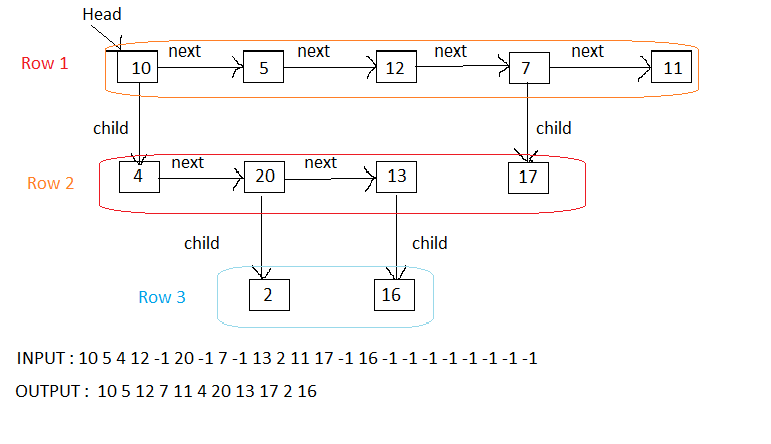
Flatten :
All the different rows are merged into a single row.
2. The Celebrity Problem
Moderate
30m average time
60% success
0/80
Asked in companies



There are ‘N’ people at a party. Each person has been assigned a unique id between 0 to 'N' - 1(both inclusive). A celebrity is a person who is known to everyone but does not know anyone at the party.
Given a helper function ‘knows(A, B)’, It will returns "true" if the person having id ‘A’ know the person having id ‘B’ in the party, "false" otherwise. Your task is to find out the celebrity at the party. Print the id of the celebrity, if there is no celebrity at the party then print -1.
Note:
1. The helper function ‘knows’ is already implemented for you.
2. ‘knows(A, B)’ returns "false", if A doesn't know B.
3. You should not implement helper function ‘knows’, or speculate about its implementation.
4. You should minimize the number of calls to function ‘knows(A, B)’.
5. There are at least 2 people at the party.
6. At most one celebrity will exist.
03
Round
Easy
Video Call
Duration35 minutes
Interview date8 Jan 2021
Coding problem1
This was an interview round ( technical round) that was held on video-call and a coding platform was also shared. The interviewer was very friendly with me . She was praising me on every solution that I provided.
1. Design a hashset
Moderate
25m average time
65% success
0/80
Asked in companies


Design a HashSet without using any built-in hash table libraries.
Implement the following public functions :
1) Constructor: It initializes the data members as required.

2) add(value): It inserts an element into the HashSet. The function takes one argument which is the value that needs to be added and returns nothing

3) contains(value): It checks whether the element exists in the HashSet or not. The function takes one argument which is the value that needs to be searched for in the HashSet. The function returns true if the element exists, otherwise returns false.

4) remove(value): It removes an element from the HashSet. The function takes one argument which is the value that needs to be removed from the HashSet and returns the element which is being removed. If the element does not exist in the HashSet or if HashSet is empty, return -1.
Operations Performed on the HashSet:
Query-1 (Denoted by an integer 1)- Inserts an element in the HashSet

Query-2 (Denoted by an integer 2)- Returns a boolean value denoting whether the element is present in the HashSet or not.

Query-3 (Denoted by an integer 3)- Removes the element from the HashSet.
04
Round
Easy
HR Round
Duration20 minutes
Interview date12 Jan 2021
Coding problem1
Online HR+Technical Round .
1. HR Questions
What language do you code in ?
Situational Problem


Here's your problem of the day 
Solving this problem will increase your chance to get selected in this company
Skill covered: Programming
What does dict.keys() return?
Choose another skill to practice
Similar interview experiences
SDE - Intern
3 rounds | 5 problems
Interviewed by Goldman Sachs
 Selected
2663 views

0 comments

0 upvotes
SDE - Intern
3 rounds | 11 problems
Interviewed by Goldman Sachs
 Selected
 6138 views
0 comments
0 upvotes
SDE - Intern
2 rounds | 4 problems
Interviewed by Goldman Sachs
 Selected
 1136 views
1 comments
0 upvotes
SDE - Intern
4 rounds | 7 problems
Interviewed by Goldman Sachs
Selected 938 views
0 comments
0 upvotes
Companies with similar interview experiences

SDE - Intern
3 rounds | 6 problems
Interviewed by Amazon

Rejected
16228 views
4 comments
0 upvotes

SDE - Intern
4 rounds | 7 problems
Interviewed by Microsoft
 Selected
 16246 views
1 comments
0 upvotes
SDE - Intern
2 rounds | 4 problems
Interviewed by Amazon
Selected 10549 views
2 comments
0 upvotes