





Google inc interview experience Real time questions & tips from candidates to crack your interview

SDE - Intern
Google inc


2 rounds | 3 Coding
problems

 Selected
 Interview preparation journey

Journey
My coding journey started in the 12th grade. Computer Science was my additional subject, and I developed my interest in programming from there. I enrolled in a B.Tech program with a specialization in Computer Science Engineering to achieve my dream of working at Google. Now, after four years, I am at Google. It has been a great journey so far.
Application story
It was the peak placement season, and every student in their fourth year was eagerly awaiting company visits on campus. When I heard that Google would be visiting, it was a dream come true for me, as Google had always been my aspiration. By then, I was very confident in my skills, which greatly aided me during the interviews.
Why selected/rejected for the role?
I believe my skills and knowledge were up to the mark, making me a valuable candidate in their eyes. Additionally, my communication skills contributed to my overall profile.
Preparation
Duration: 2 months
Topics: Java, Data Structure, Algorithms, Dynamic Programming, STL

Tip 1: Participate in coding contests.
Tip 2: Practice as many questions as possible.
Tip 3: Work on good projects.
Application process
Where: Campus
Eligibility: 7 CGPA
Tip 1: Have some projects on your resume.
Tip 2: Do not include false information on your resume.

Interview rounds
01
Round
Medium
Online Coding Test
Duration70 minutes
Interview date11 Jan 2023
Coding problem2
1. Painter's Partition Problem
Moderate
25m average time
75% success

0/80
Asked in companies



Given an array/list of length ‘n’, where the array/list represents the boards and each element of the given array/list represents the length of each board. Some ‘k’ numbers of painters are available to paint these boards. Consider that each unit of a board takes 1 unit of time to paint.
You are supposed to return the area of the minimum time to get this job done of painting all the ‘n’ boards under a constraint that any painter will only paint the continuous sections of boards.
Example :
Input: arr = [2, 1, 5, 6, 2, 3], k = 2

Output: 11

Explanation:
First painter can paint boards 1 to 3 in 8 units of time and the second painter can paint boards 4-6 in 11 units of time. Thus both painters will paint all the boards in max(8,11) = 11 units of time. It can be shown that all the boards can't be painted in less than 11 units of time.
Problem approach
Heap concepts
2. Chocolate Problem
Moderate
15m average time
85% success
0/80
Asked in companies



Given an array/list of integer numbers 'CHOCOLATES' of size 'N', where each value of the array/list represents the number of chocolates in the packet. There are ‘M’ number of students and the task is to distribute the chocolate to their students. Distribute chocolate in such a way that:
1. Each student gets at least one packet of chocolate.
2. The difference between the maximum number of chocolate in a packet and the minimum number of chocolate in a packet given to the students is minimum.
Example :
Given 'N' : 5 (number of packets) and 'M' : 3 (number of students)
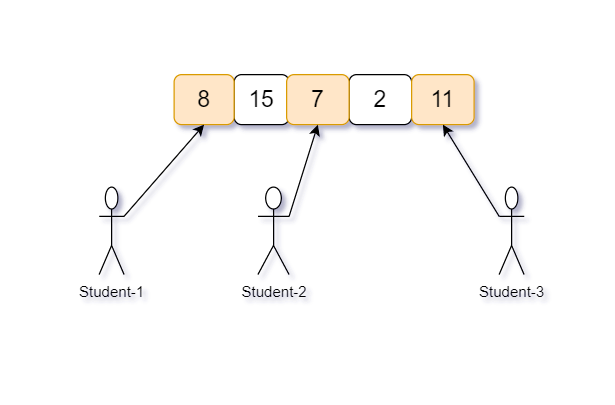
And chocolates in each packet is : {8, 11, 7, 15, 2}

All possible way to distribute 5 packets of chocolates among 3 students are -

( 8,15, 7 ) difference of maximum-minimum is ‘15 - 7’ = ‘8’
( 8, 15, 2 ) difference of maximum-minimum is ‘15 - 2’ = ‘13’
( 8, 15, 11 ) difference of maximum-minimum is ‘15 - 8’ = ‘7’
( 8, 7, 2 ) difference of maximum-minimum is ‘8 - 2’ = ‘6’
( 8, 7, 11 ) difference of maximum-minimum is ‘11 - 7’ = ‘4’
( 8, 2, 11 ) difference of maximum-minimum is ‘11 - 2’ = ‘9’
( 15, 7, 2 ) difference of maximum-minimum is ‘15 - 2’ = 13’
( 15, 7, 11 ) difference of maximum-minimum is ‘15 - 7’ = ‘8’
( 15, 2, 11 ) difference of maximum-minimum is ‘15 - 2’ = ‘13’
( 7, 2, 11 ) difference of maximum-minimum is ‘11 - 2’ = ‘9’

Hence there are 10 possible ways to distribute ‘5’ packets of chocolate among the ‘3’ students and difference of combination (8, 7, 11) is ‘maximum - minimum’ = ‘11 - 7’ = ‘4’ is minimum in all of the above.
Problem approach
Fractional knapsack algo.
02
Round
Easy
Face to Face
Duration40 minutes
Interview date11 Jan 2023
Coding problem1
1. Basic HR Questions
- Tell me about yourself.
- Why Google?
- Which Google product do you like the most? Why? Are there any competing products in the market?
- If I asked your current organization for feedback, what would they say? Focus on negative points.
- If you had to improve one technical and one behavioural aspect, which ones would you choose?
- Have you taken on any leadership roles, such as mentorship or organizing, in your previous organizations?
- How would you handle a situation where someone else received credit for your work?
- Can you describe a situation where your manager didn't agree with your idea, and how did you convince him/her?
- Why are you leaving before completing one year in your current role?
- What are your plans for the next two years, both technically and non-technically?
- Do you have any questions for me?


Here's your problem of the day 
Solving this problem will increase your chance to get selected in this company
Skill covered: Programming
How do you remove whitespace from the start of a string?
Choose another skill to practice
Similar interview experiences
SDE - Intern
2 rounds | 4 problems
Interviewed by Google inc

Rejected

3049 views

3 comments

0 upvotes
SDE - Intern
2 rounds | 4 problems
Interviewed by Google inc

Rejected
1465 views
0 comments
0 upvotes
SDE - Intern
3 rounds | 5 problems
Interviewed by Google inc

Rejected
1279 views
0 comments
0 upvotes
SDE - Intern
3 rounds | 5 problems
Interviewed by Google inc
Selected 1370 views
0 comments
0 upvotes
Companies with similar interview experiences

SDE - Intern
3 rounds | 6 problems
Interviewed by Amazon

Rejected
15605 views
4 comments
0 upvotes
SDE - Intern
4 rounds | 7 problems
Interviewed by Microsoft
 Selected
 15499 views
1 comments
0 upvotes
SDE - Intern
2 rounds | 4 problems
Interviewed by Amazon
Selected 10216 views
2 comments
0 upvotes