





Grab interview experience Real time questions & tips from candidates to crack your interview

SDE - 1
Grab


3 rounds | 6 Coding
problems

Rejected
Interview preparation journey

Journey
I started my coding journey from college, where I first learned the Data Structure and Algorithm. Then I started practicing coding problems.
Application story
This was an off-campus opportunity. I applied for this job on Unstop. Here there are 2 rounds with 1 HR round.
Why selected/rejected for the role?
I got rejected because I got stuck between the question's explanation multiple times, and my computer fundamentals basics were also unclear.
Preparation
Duration: 6 months
Topics: Data Structures, Pointers, OOPS, System Design, Algorithms, Dynamic Programming

Technical Skills:
Programming Languages: Focus on mastering the languages commonly used in the field, such as Python, Java, C++, and JavaScript.
Data Structures and Algorithms: Understand fundamental data structures (arrays, linked lists, trees, graphs) and algorithms (sorting, searching, dynamic programming) and their complexities.
Problem-Solving and Coding:
Practice Coding Challenges: Regularly solve coding problems on coding platforms to enhance your problem-solving skills.
Code Reviews: Participate in code reviews with peers to learn different approaches and coding best practices.
Projects: Work on personal or open-source projects to apply your skills to real-world scenarios and build a portfolio.
Complexity Analysis: Learn to analyze the time and space complexity of algorithms to optimize their efficiency.
Soft Skills:
Communication: Develop clear and concise communication skills, both written and verbal, to collaborate effectively with team members.
Teamwork: Understand how to work in a team, contribute constructively, and resolve conflicts professionally.
Adaptability: Embrace new technologies and methodologies as the tech industry is constantly evolving.
Problem Solving: Demonstrate your ability to approach challenges systematically and think critically to find solutions.
Attention to Detail: Write clean, maintainable code and pay attention to small details that can impact software quality.
Application process
Where: Other
Eligibility: Above 7 CGPA
Clear and organized format
Contact information (name, phone, email)
Professional summary/objective (tailored)
Key skills (relevant to the job)
Work experience (reverse chronological, achievements with quantifiable results)

Interview rounds
01
Round
Easy
Video Call
Duration60 minutes
Interview date28 Jan 2023
Coding problem2
2 Coding question were asked and interview was scheduled at 11 am.
1. Count Ways To Reach The N-th Stairs
Moderate
30m average time
80% success

0/80
Asked in companies



You have been given a number of stairs. Initially, you are at the 0th stair, and you need to reach the Nth stair.
Each time, you can climb either one step or two steps.
You are supposed to return the number of distinct ways you can climb from the 0th step to the Nth step.
Note:
Note: Since the number of ways can be very large, return the answer modulo 1000000007.
Example :
N=3
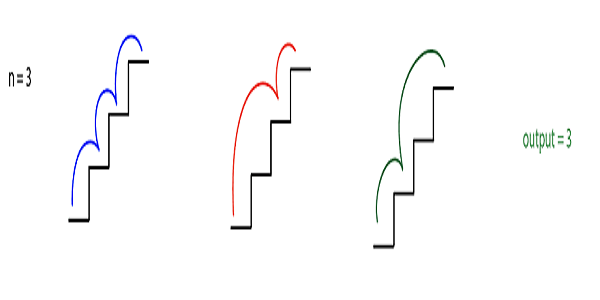
We can climb one step at a time i.e. {(0, 1) ,(1, 2),(2,3)} or we can climb the first two-step and then one step i.e. {(0,2),(1, 3)} or we can climb first one step and then two step i.e. {(0,1), (1,3)}.
Problem approach
Can be solve using recursion and DP.
2. Detect and Remove Loop
Easy
10m average time
90% success
0/40
Asked in companies


You have been given a Singly Linked List of integers, determine if it forms a cycle or not. If there is a cycle, remove the cycle and return the list.
A cycle occurs when a node's ‘next’ points back to a previous node in the list.
Problem approach
Given a singly linked list, you have to detect the loop and remove the loop from the linked list, if present. You have to make changes in the given linked list itself and return the updated linked list.
02
Round
Hard
Video Call
Duration60 minutes
Interview date28 Jan 2023
Coding problem2
1. MergeSort Linked List
Moderate
10m average time
90% success
0/80
Asked in companies



You are given a Singly Linked List of integers. Sort the Linked List using merge sort.
Merge Sort is a Divide and Conquer algorithm. It divides the input into two halves, calls itself for the two halves, and then merges the two sorted halves. The merge() function is used for merging two halves. The merge(arr, L, M, R) is a key process that assumes that arr[L..M] and arr[M + 1...R] are sorted and merges the two sorted subarrays into one.
Problem approach
For a given Singly Linked List of integers, sort the list using the 'Merge Sort' algorithm.
2. Merge Two Binary Trees
Easy
15m average time
85% success
0/40
Asked in companies


You are given roots of two binary trees, ‘ROOT1’ and ‘ROOT2’. You need to merge the two trees into a new binary tree. The merge rule is that if the two nodes overlap, then the sum of the two nodes values up as the new value of the merged node. Otherwise, the NOT null node will be used as the node of the new tree. Your task is to return the merged tree i.e. head of the new tree.
Note:
The merging process must start from the root nodes of both trees.
For example,
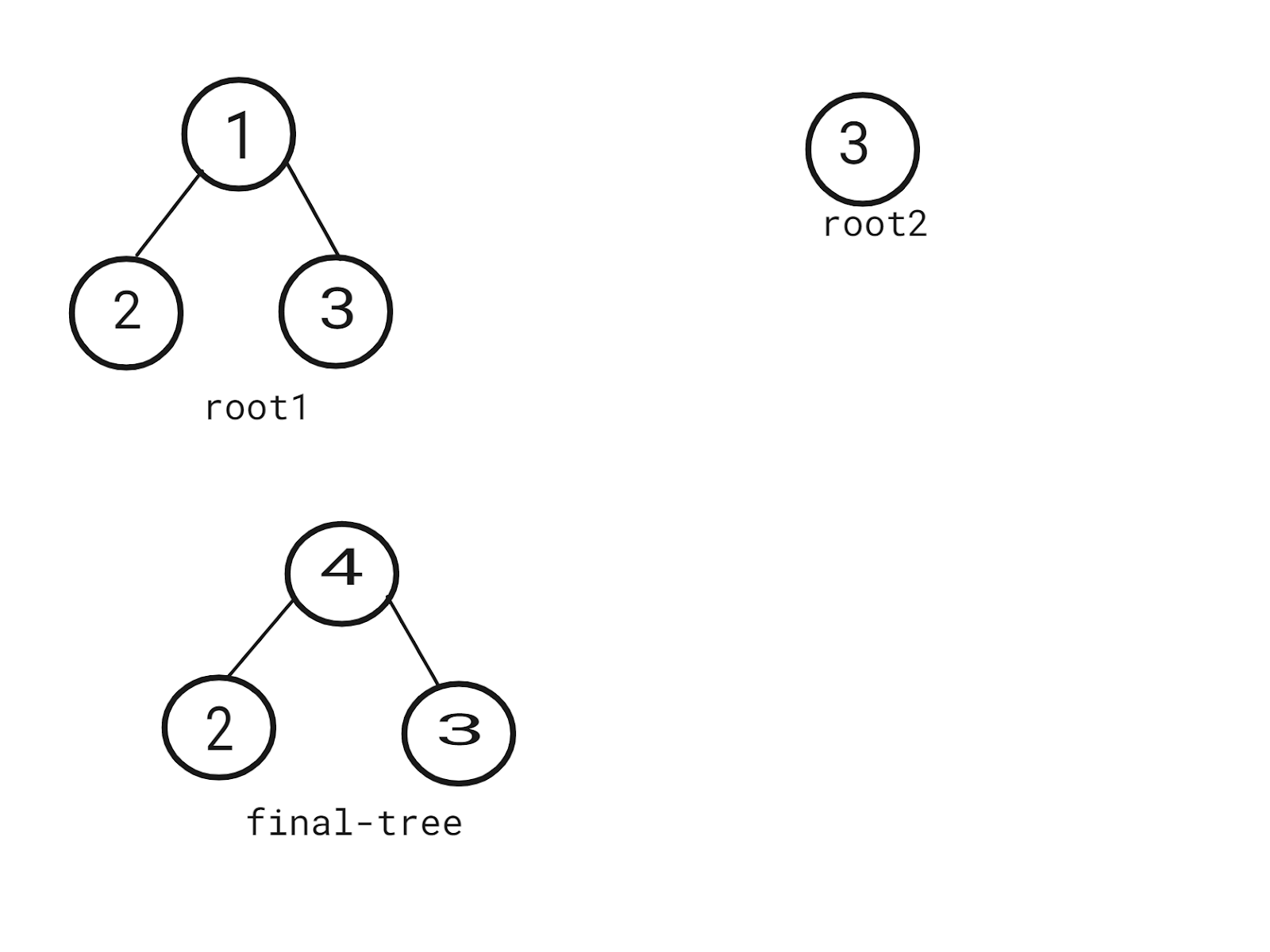
‘ROOT1’ = [1, 2, -1, -1, 3, -1, -1]  ‘ROOT2’ = [3, -1, -1].
The final tree would look like : [3, 2, -1, -1, 3, -1, -1], and the output will be printed in a pre-order way: 4 2 3.
Problem approach
You are given roots of two binary trees, ‘ROOT1’ and ‘ROOT2’. You need to merge the two trees into a new binary tree. The merge rule is that if the two nodes overlap, then the sum of the two nodes values up as the new value of the merged node. Otherwise, the NOT null node will be used as the node of the new tree. Your task is to return the merged tree i.e. head of the new tree.
03
Round
Medium
Video Call
Duration60 minutes
Interview date28 Jan 2023
Coding problem2
1. Cycle Detection in a Singly Linked List
Moderate
15m average time
80% success
0/80
Asked in companies


You are given a Singly Linked List of integers. Return true if it has a cycle, else return false.
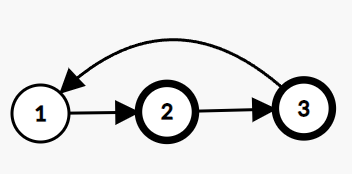
A cycle occurs when a node's next points back to a previous node in the list.
Example:
In the given linked list, there is a cycle, hence we return true.
Problem approach
Detect a loop in a linked list using slow and fast pointers, or we can also use a hashmap.
2. Min binary partition
Easy
15m average time
85% success
0/40
Asked in companies

You are given a string ‘S’ of size ‘N’ where ’S’ contains only characters ‘0’ and ‘1’. Your task is to divide ‘S’ into ‘K’ contiguous substrings such that the following conditions hold true :
1. Let ‘X’ be a binary number formed by reading a substring of ‘S’ from left to right.
2. ‘X’ must not contain leading zeroes.
3. The decimal equivalent of ‘X’ must be a power of 5.
4. K must be the minimum possible.
Note :
If no such ‘K’ possible, then you need to return -1.
Problem approach
You are given a string ‘S’ of size ‘N’ where ’S’ contains only characters ‘0’ and ‘1’. Your task is to divide ‘S’ into ‘K’ contiguous substrings such that the following conditions hold true :
1. Let ‘X’ be a binary number formed by reading a substring of ‘S’ from left to right.
2. ‘X’ must not contain leading zeroes.
3. The decimal equivalent of ‘X’ must be a power of 5.
4. K must be the minimum possible.


Here's your problem of the day 
Solving this problem will increase your chance to get selected in this company
Skill covered: Programming
How do you remove whitespace from the start of a string?
Choose another skill to practice
Similar interview experiences
SDE - 1
2 rounds | 4 problems
Interviewed by Grab
Rejected

976 views

0 comments

0 upvotes
SDE - 1
3 rounds | 5 problems
Interviewed by Grab
Rejected
1282 views
0 comments
0 upvotes
SDE - 1
3 rounds | 5 problems
Interviewed by Grab
Rejected
737 views
0 comments
0 upvotes
SDE - 1
2 rounds | 4 problems
Interviewed by Grab
Rejected
699 views
0 comments
0 upvotes
Companies with similar interview experiences
SDE - 1
5 rounds | 12 problems
Interviewed by Amazon

 Selected
 117552 views
24 comments
0 upvotes

SDE - 1
4 rounds | 5 problems
Interviewed by Microsoft
Selected 60143 views
5 comments
0 upvotes
SDE - 1
3 rounds | 7 problems
Interviewed by Amazon
 Selected
 36138 views
7 comments
0 upvotes