





HashedIn interview experience Real time questions & tips from candidates to crack your interview

Software Engineer
HashedIn


4 rounds | 6 Coding
problems

 Selected
 Interview preparation journey

Preparation
Duration: 7 months
Topics: OOPS, JAVA, DSA, OS, Database management system

Tip 1 : do focus on dsa
Tip 2 : do focus on the concepts of problems solving
Tip 3 : try to optimize your code
Application process
Where: Campus
Eligibility: 6.0 above
Tip 1 : Have some projects
Tip 2 : Do not put false things on that

Interview rounds
01
Round
Medium
Online Coding Interview
Duration30 minutes
Interview date2 Aug 2021
Coding problem3
It's basically consists of 3 questions and if medium level each and every person in my clg got different questions. What they were focusing on is how one should make their code optimize i.e we less time and soace complexity of the code
1. Frequency In A Sorted Array
Easy
15m average time
85% success

0/40
Asked in companies



You are given a sorted array 'ARR' and a number 'X'. Your task is to count the number of occurrences of 'X' in 'ARR'.
Note :
1. If 'X' is not found in the array, return 0.
2. The given array is sorted in non-decreasing order.
2. 0 1 Knapsack
Moderate
0/80
Asked in companies



A thief is robbing a store and can carry a maximum weight of ‘W’ into his knapsack. There are 'N' items available in the store and the weight and value of each item is known to the thief. Considering the constraints of the maximum weight that a knapsack can carry, you have to find the maximum profit that a thief can generate by stealing items.
Note: The thief is not allowed to break the items.
For example, N = 4, W = 10 and the weights and values of items are weights = [6, 1, 5, 3] and values = [3, 6, 1, 4]. Then the best way to fill the knapsack is to choose items with weight 6, 1 and 3. The total value of knapsack = 3 + 6 + 4 = 13.
Problem approach
In the Dynamic programming we will work considering the same cases as mentioned in the recursive approach. In a DP[][] table let’s consider all the possible weights from ‘1’ to ‘W’ as the columns and weights that can be kept as the rows.
The state DP[i][j] will denote maximum value of ‘j-weight’ considering all values from ‘1 to ith’. So if we consider ‘wi’ (weight in ‘ith’ row) we can fill it in all columns which have ‘weight values > wi’. Now two possibilities can take place:
Fill ‘wi’ in the given column.
Do not fill ‘wi’ in the given column.
Now we have to take a maximum of these two possibilities, formally if we do not fill ‘ith’ weight in ‘jth’ column then DP[i][j] state will be same as DP[i-1][j] but if we fill the weight, DP[i][j] will be equal to the value of ‘wi’+ value of the column weighing ‘j-wi’ in the previous row. So we take the maximum of these two possibilities to fill the current state. This visualisation will make the concept clear:
Let weight elements = {1, 2, 3}
Let weight values = {10, 15, 40}
Capacity=6
0 1 2 3 4 5 6
0 0 0 0 0 0 0 0
1 0 10 10 10 10 10 10
2 0 10 15 25 25 25 25
3 0
Explanation:
For filling 'weight = 2' we come
across 'j = 3' in which
we take maximum of
(10, 15 + DP[1][3-2]) = 25
| |
'2' '2 filled'
not filled
0 1 2 3 4 5 6
0 0 0 0 0 0 0 0
1 0 10 10 10 10 10 10
2 0 10 15 25 25 25 25
3 0 10 15 40 50 55 65
Explanation:
For filling 'weight=3',
we come across 'j=4' in which
we take maximum of (25, 40 + DP[2][4-3])
= 50
For filling 'weight=3'
we come across 'j=5' in which
we take maximum of (25, 40 + DP[2][5-3])
= 55
For filling 'weight=3'
we come across 'j=6' in which
we take maximum of (25, 40 + DP[2][6-3])
= 65
3. Delete a Node from Linked List
Moderate
40m average time
67% success
0/80
Asked in companies


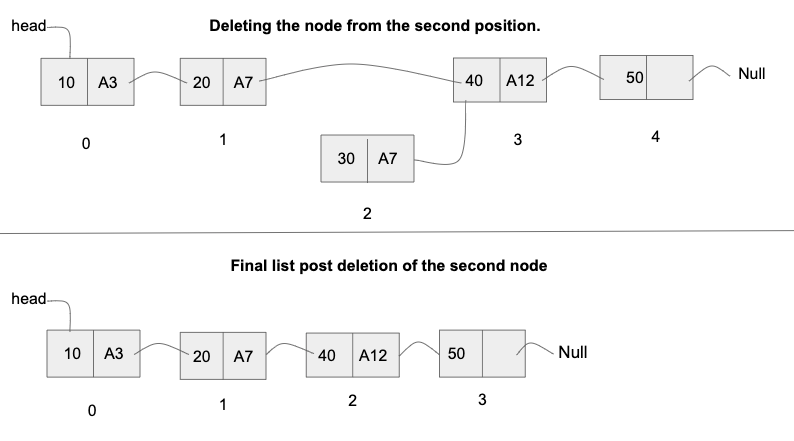
You have been given a linked list of integers. Your task is to write a function that deletes a node from a given position, 'POS'.
Note :
Assume that the Indexing for the linked list always starts from 0.

If the position is greater than or equal to the length of the linked list, you should return the same linked list without any change.
Illustration :
The following images depict how the deletion has been performed.
Image-I :
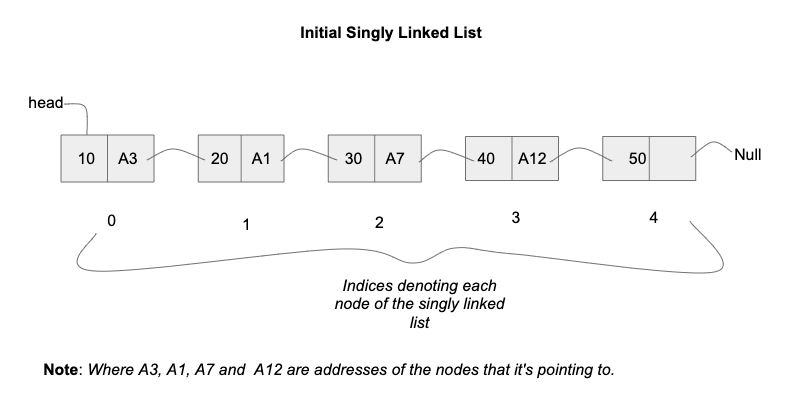
Image-II :
Problem approach
Deleting a node from the beginning of the list is the simplest operation of all. It just need a few adjustments in the node pointers. Since the first node of the list is to be deleted, therefore, we just need to make the head, point to the next of the head. This will be done by using the following statements.
ptr = head;
head = ptr->next;
Now, free the pointer ptr which was pointing to the head node of the list. This will be done by using the following statement.
free(ptr)
Algorithm
Step 1: IF HEAD = NULL
Write UNDERFLOW
Go to Step 5
[END OF IF]
Step 2: SET PTR = HEAD
Step 3: SET HEAD = HEAD -> NEXT
Step 4: FREE PTR
Step 5: EXIT
02
Round
Medium
Face to Face
Duration90 Minutes
Interview date10 Aug 2021
Coding problem1
They test our problem solving skills as well as knowledge of core subject like DBMS os they asked about oops some of the concepts from Java string string pool collection he asked to write SQL query as well
1. Design a stack that supports getMin() in O(1) time and O(1) extra space
Moderate
15m average time
85% success
0/80
Asked in companies


Create a stack data structure that allows operations such as push (adding an element), pop (removing the top element), top (retrieving the top element), and also provides a way to retrieve the minimum element in constant time.
Implement the following public functions :
1. push(data) :
This function should take one argument of type integer. It pushes the element into the stack and returns nothing.

2. pop() :
It pops the element from the top of the stack and returns nothing.

3. top() :
It returns the element being kept at the top of the stack.

4.  getMin() :
It returns the smallest element present in the stack.
Operations Performed on the Stack:
Query-1(Denoted by an integer 1): Pushes integer data to the stack. (push function)

Query-2(Denoted by an integer 2): Pops the data kept at the top of the stack. (pop function)

Query-3(Denoted by an integer 3): Fetches and returns the data being kept at the top of the stack. (top function)

Query-4(Denoted by an integer 4): Returns the smallest element present in the stack. (getMin() function)
03
Round
Hard
Face to Face
Duration120 Minutes
Interview date17 Aug 2021
Coding problem1
They asked me to design a schema , relationship,dfd for restaurent.
1. System Design Question
Ask to design restaurent app
Problem approach
Tip 1 : SQL should be strong
Tip 2 : having knowledge of relationship between 2 or more tables
Tip 3 : having knowledge of schema of tables
04
Round
Easy
HR Round
Duration20 Minutes
Interview date26 Aug 2021
Coding problem1
They basically asked for family background, future plans, internet.
1. Basic HR Questions
Family background, interest , future plans,career plans, why do we hure u
Problem approach
Tip 1 : be honest


Here's your problem of the day 
Solving this problem will increase your chance to get selected in this company
Skill covered: Programming
How do you remove whitespace from the start of a string?
Choose another skill to practice
Similar interview experiences
Software Engineer
3 rounds | 6 problems
Interviewed by HashedIn
 Selected
2644 views

0 comments

0 upvotes
Software Engineer
3 rounds | 5 problems
Interviewed by HashedIn
 Selected
 2593 views
0 comments
0 upvotes
Software Engineer
3 rounds | 3 problems
Interviewed by HashedIn
Selected 2146 views
0 comments
0 upvotes
Software Engineer
3 rounds | 5 problems
Interviewed by HashedIn
Selected 1208 views
0 comments
0 upvotes
Companies with similar interview experiences

Software Engineer
4 rounds | 1 problems
Interviewed by Newgen Software
 Selected
 3266 views
2 comments
0 upvotes

Software Engineer
2 rounds | 2 problems
Interviewed by Ernst & Young (EY)
Selected 0 views
0 comments
0 upvotes
Software Engineer
3 rounds | 3 problems
Interviewed by Newgen Software
Selected 1481 views
0 comments
0 upvotes