





HashedIn interview experience Real time questions & tips from candidates to crack your interview

SDE - Intern
HashedIn


4 rounds | 8 Coding
problems

 Selected
 Interview preparation journey

Preparation
Duration: 4 months
Topics: Data Structures and Algorithms(DSA), Database Management System(DBMS), Operating Systems(OS), OOPS(Object Oriented Programming in Java), SQL Queries, C++ STL

Tip 1 : Be excellent at DSA, since most of the rounds have 80% weightage on DSA and 20% on computer fundamentals and other factors.
Tip 2 : Try to gain some knowledge on database design while working on some projects. This will help you in Technical round 2 which is entirely dedicated for System design/Database Design and/or DSA.
Tip 3 : Try to interact more with the interviewer, communication is the key! Keep hustling!
Application process
Where: Linkedin
Eligibility: Computer Science Background
Tip 1 : Try to include coding profiles and your project links.
Tip 2 : Don't try to fake your skills and knowledge that you don't possess. But include and highlight the keywords.

Interview rounds
01
Round
Medium
Online Coding Interview
Duration90 minutes
Interview date4 Feb 2022
Coding problem2
The timing of the exam was at 6:00 pm. This round consisted of 1 DSA-based Questions. One easy and One medium level DSA questions.
1. Split Array Into Increasing Subsequences
Easy
15m average time
85% success

0/40
Asked in companies



You are given an integer array/list ‘ARR’ of size 'N' that is sorted in ascending order. Your task is to return '1' if and only if you can split it into one or more increasing subsequences such that each subsequence consists of consecutive integers and has a length of at least 3. Else, return '0'.
Note: An increasing sequence is a sequence where the difference between ith and i + 1th number is 1 exactly. For example : 1, 2, 3, 4 or 3, 4, 5 or -1, 0, 1 are all increasing subsequences.
For example:
Given ‘N’ = 4 and ‘ARR’[] = 1, 2, 3, 4.
The answer will be ‘1’ because an increasing subsequence of [1, 2, 3, 4]  having length greater than 3 can be made.
Problem approach
I could solve it using a map DS in an O(n) time.
2. Bridges In A Graph
Moderate
25m average time
65% success
0/80
Asked in companies



Given an undirected graph of V vertices and E edges. Your task is to find all the bridges in the given undirected graph. A bridge in any graph is defined as an edge which, when removed, makes the graph disconnected (or more precisely, increases the number of connected components in the graph).
For Example :
If the given graph is :
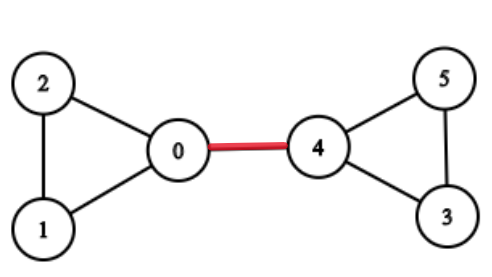
Then the edge between 0 and 4 is the bridge because if the edge between 0 and 4 is removed, then there will be no path left to reach from 0 to 4.and makes the graph disconnected, and increases the number of connected components.
Note :
There are no self-loops(an edge connecting the vertex to itself) in the given graph.

There are no parallel edges i.e no two vertices are directly connected by more than 1 edge.
Problem approach
A simple approach is to one by one remove all edges and see if removal of an edge causes disconnected graph. Following are steps of simple approach for connected graph.
For every edge (u, v), do following :
- Remove (u, v) from graph
- See if the graph remains connected (We can either use BFS or DFS)
- Add (u, v) back to the graph.
02
Round
Medium
Video Call
Duration60 minutes
Interview date10 Feb 2022
Coding problem3
Basic Questions on Introduction and Resume:
How are you doing? How’s the COVID situation in your place? Is your college open?
After basic questions revolving around my whereabouts, he asked me to introduce myself.
He picked some projects which intrigued him and started shooting questions about them.
I had prepared it on my own from scratch so I could answer all his queries with ease.
He asked me about my recent internships. Tech stacks that I am working on. Hardships I am facing. So on, so forth.
Theory Questions around CS Fundamentals: The interviewer covered all the core subjects:(CN/ DBMS/ OS/ OOP). So be well versed with them before the interview.
1. Shortest subarray with sum at least K
Moderate
15m average time
85% success
0/80
Asked in companies



Given an array/list 'ARR' of integers and an integer ‘K’. You are supposed to return the length of the shortest subarray that has a sum greater than or equal to ‘K’. If there is no subarray with a sum greater than or equal to K, then return -1.
Note :
An array ‘B’ is a subarray of an array ‘A’ if ‘B’ that can be obtained by deletion of, several elements(possibly none) from the start of ‘A’ and several elements(possibly none) from the end of ‘A’.
Problem approach
I explained the optimal solution at the first go. The interviewer asked me what would be the time complexity of the solution that I proposed. After that he said me to code it. My code successfully covered all the test cases that he gave.
2. 3Sum
Moderate
15m average time
85% success
0/80
Asked in companies


You are given an array/list ARR consisting of N integers. Your task is to find all the distinct triplets present in the array which adds up to a given number K.
An array is said to have a triplet {ARR[i], ARR[j], ARR[k]} with sum = 'K' if there exists three indices i, j and k such that i!=j, j!=k and i!=j and ARR[i] + ARR[j] + ARR[k] = 'K'.
Note:
1. You can return the list of values in any order. For example, if a valid triplet is {1, 2, -3}, then {2, -3, 1}, {-3, 2, 1} etc is also valid triplet. Also, the ordering of different triplets can be random i.e if there are more than one valid triplets, you can return them in any order.
2. The elements in the array need not be distinct.
3. If no such triplet is present in the array, then return an empty list, and the output printed for such a test case will be "-1".
Problem approach
I went for Brute Force and then optimal. Again, I could code and run it entirely.
3. Core CS Fundamentals
- What do you know about SQL Views?
- What are the different types of VPN?
- What is IPV6? Main Purpose of using it.
- What is Indexing in a Database?
- What is Data Abstraction?
- What do you mean by thrashing?
- What is the difference between Multitasking and Multiprogramming?
Problem approach
Be well versed with Core CS Subjects. At least go through their basic questions
03
Round
Medium
Video Call
Duration90 minutes
Interview date15 Feb 2022
Coding problem2
This round revolved around “Low-Level Design” or “DB schema Designing”. It’s generally a little challenging for freshers like us. But from my experience they judge you on a few parameters:
Your approach to a real-world problem.
Your thinking ability.
Basic knowledge of OOP implementation.
And, the correct usage of Data Structures.
This time the interview didn’t even ask me to introduce myself.
He started by saying, I can see a lot of Experience in your Resume.
Again, I was asked to explain both the projects and internships in my CV. The challenges that I faced. What new things did I learn? He asked me things related to Bootstrap, payment integration since it was on my CV. He asked me how proficient I was in JavaScript. He was a JS guy!
1. Multiply Strings
Moderate
35m average time
55% success
0/80
Asked in companies

You are given two big numbers ‘A’ and ‘B’ as strings. Your task is to find the product of both the numbers.
Note:
There are no leading zeros in both the strings, except the number 0 itself.
Do not use any built-in Big Integer Library.
For Example:
If, A = 123, and B = 456.
So the product of both numbers will be 56088.
Problem approach
You must not use any built-in Big Integer library or convert the inputs to integer directly. He gave strings of length around 60-80. He said that syntax doesn’t matter to him only the logic does. I explained my approach and he asked me to code it. After I finished coding he asked me to explain my code line by line. He was completely satisfied with my approach.
2. System Design
I was asked about the Low-Level System Design on an Elevator
Problem approach
I discussed the approach. He said that I was going in the correct direction. I made the prototype and coded 2 functions of the elevator. We discussed various approaches and many cases. The key is to communicate with the interviewer and think of all possible solutions. He said, we exceeded the time and we wrapped up the interview.
04
Round
Easy
HR Round
Duration30 minutes
Interview date16 Feb 2022
Coding problem1
1. Basic HR Questions
- How are you doing?
- Tell me about you and your family
- What are your interests / hobbies?
- Since you lead a club, tell me everything about it.
- The challenges you faced in your club during Pandemic.
- Why Hashed In?
- Do you hold any offers currently? If yes, What is CTC offered by them?
- Will you be available for an internship?
Problem approach
Communication is the key. Be frank with the interviewers. Reply their questions with full honesty and show interest in working with the organization


Here's your problem of the day 
Solving this problem will increase your chance to get selected in this company
Skill covered: Programming
How do you remove whitespace from the start of a string?
Choose another skill to practice
Similar interview experiences
SDE - Intern
4 rounds | 5 problems
Interviewed by HashedIn
 Selected
1208 views

0 comments

0 upvotes
SDE - Intern
4 rounds | 7 problems
Interviewed by HashedIn
Selected 1012 views
0 comments
0 upvotes
SDE - Intern
4 rounds | 6 problems
Interviewed by HashedIn
Selected 1269 views
0 comments
0 upvotes
SDE - Intern
4 rounds | 7 problems
Interviewed by HashedIn
Selected 1393 views
0 comments
0 upvotes
Companies with similar interview experiences
SDE - Intern
2 rounds | 4 problems
Interviewed by Arcesium
 Selected
 3738 views
0 comments
0 upvotes
SDE - Intern
3 rounds | 5 problems
Interviewed by Arcesium
Selected 2683 views
0 comments
0 upvotes

SDE - Intern
3 rounds | 5 problems
Interviewed by BNY Mellon
 Selected
 2347 views
0 comments
0 upvotes