





Hero MotoCorp interview experience Real time questions & tips from candidates to crack your interview
SDE - Intern
Hero MotoCorp


2 rounds | 4 Coding
problems

Rejected
Interview preparation journey

Journey
My B.Tech journey at IGDTUW was a thrilling experience that began with an orientation day buzzing with excitement. As I navigated through classes, I stumbled upon the fascinating world of coding.
Application story
The company visited my campus for placement. We need to apply for this opportunity through their career portal.
Why selected/rejected for the role?
I was rejected because I was not able to answer all the coding questions that were asked during the interview.
Preparation
Duration: 4 months
Topics: Data Structures, Pointers, OOPS, System Design, Algorithms, Dynamic Programming

Tip 1: Regularly practice on coding platforms and websites.
Tip 2: Consistent coding practice is crucial for improving your problem-solving skills and becoming familiar with various algorithms and data structures.
Tip 3: Allocate dedicated time each day to solve coding challenges on platforms like Code Studio.
Tip 4: This consistent practice will enhance your coding proficiency and boost your confidence..
Application process
Where: Campus
Eligibility: Above 7 CGPA
Tip 1: Include projects on your resume.
Tip 2: Avoid including false information on your resume.

Interview rounds
01
Round
Easy
Video Call
Duration60 minutes
Interview date12 Oct 2023
Coding problem2
1. Chocolate Problem
Moderate
15m average time
85% success

0/80
Asked in companies



Given an array/list of integer numbers 'CHOCOLATES' of size 'N', where each value of the array/list represents the number of chocolates in the packet. There are ‘M’ number of students and the task is to distribute the chocolate to their students. Distribute chocolate in such a way that:
1. Each student gets at least one packet of chocolate.
2. The difference between the maximum number of chocolate in a packet and the minimum number of chocolate in a packet given to the students is minimum.
Example :
Given 'N' : 5 (number of packets) and 'M' : 3 (number of students)
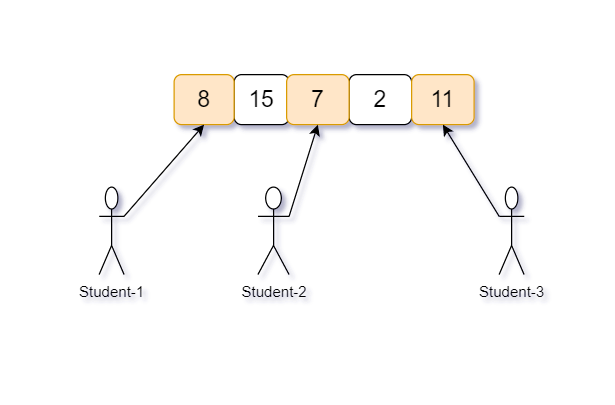
And chocolates in each packet is : {8, 11, 7, 15, 2}

All possible way to distribute 5 packets of chocolates among 3 students are -

( 8,15, 7 ) difference of maximum-minimum is ‘15 - 7’ = ‘8’
( 8, 15, 2 ) difference of maximum-minimum is ‘15 - 2’ = ‘13’
( 8, 15, 11 ) difference of maximum-minimum is ‘15 - 8’ = ‘7’
( 8, 7, 2 ) difference of maximum-minimum is ‘8 - 2’ = ‘6’
( 8, 7, 11 ) difference of maximum-minimum is ‘11 - 7’ = ‘4’
( 8, 2, 11 ) difference of maximum-minimum is ‘11 - 2’ = ‘9’
( 15, 7, 2 ) difference of maximum-minimum is ‘15 - 2’ = 13’
( 15, 7, 11 ) difference of maximum-minimum is ‘15 - 7’ = ‘8’
( 15, 2, 11 ) difference of maximum-minimum is ‘15 - 2’ = ‘13’
( 7, 2, 11 ) difference of maximum-minimum is ‘11 - 2’ = ‘9’

Hence there are 10 possible ways to distribute ‘5’ packets of chocolate among the ‘3’ students and difference of combination (8, 7, 11) is ‘maximum - minimum’ = ‘11 - 7’ = ‘4’ is minimum in all of the above.
Problem approach
Given an array/list of integer numbers 'CHOCOLATES' of size 'N', where each value of the array/list represents the number of chocolates in the packet. There are ‘M’ number of students and the task is to distribute the chocolate to their students.
2. Distinct Subsequences
Moderate
10m average time
80% success
0/80
Asked in companies


You have been given string 'S' of length 'N' that may contain duplicate alphabets. Your task is to return the count of distinct subsequences of it.
For example:
For the given string “deed” :
The possible subsequences are {“”}, {“d”}, {“e”}, {“de”}, {“e”}, {“de”}, {“ee”}, {“dee”}, {“d”}, {“dd”}, {“ed”}, {“ded”}, {“ed”}, {“ded”}, {“eed”} and {“deed”}.

As, {“d”}, {“e”}, {“de”}, {“ed”} and {“ded”} are repeated.

The distinct subsequences are {“”}, {“d”}, {“e”}, {“de”}, {“ee”}, {“dee”}, {“dd”}, {“ed”}, {“ded”}, {“eed”} and {“deed”}

Thus, the output will be 11.
Note:
As the answer can be large, return your answer modulo 10^9 + 7.
Problem approach
You have been given string 'S' of length 'N' that may contain duplicate alphabets. Your task is to return the count of distinct subsequences of it.
02
Round
Easy
Video Call
Duration60 minutes
Interview date12 Oct 2023
Coding problem2
1. Delete Kth node From End
Moderate
15m average time
95% success
0/80
Asked in companies



You have been given a singly Linked List of 'N' nodes with integer data and an integer 'K'.
Your task is to remove the 'K'th node from the end of the given Linked List and return the head of the modified linked list.
Example:
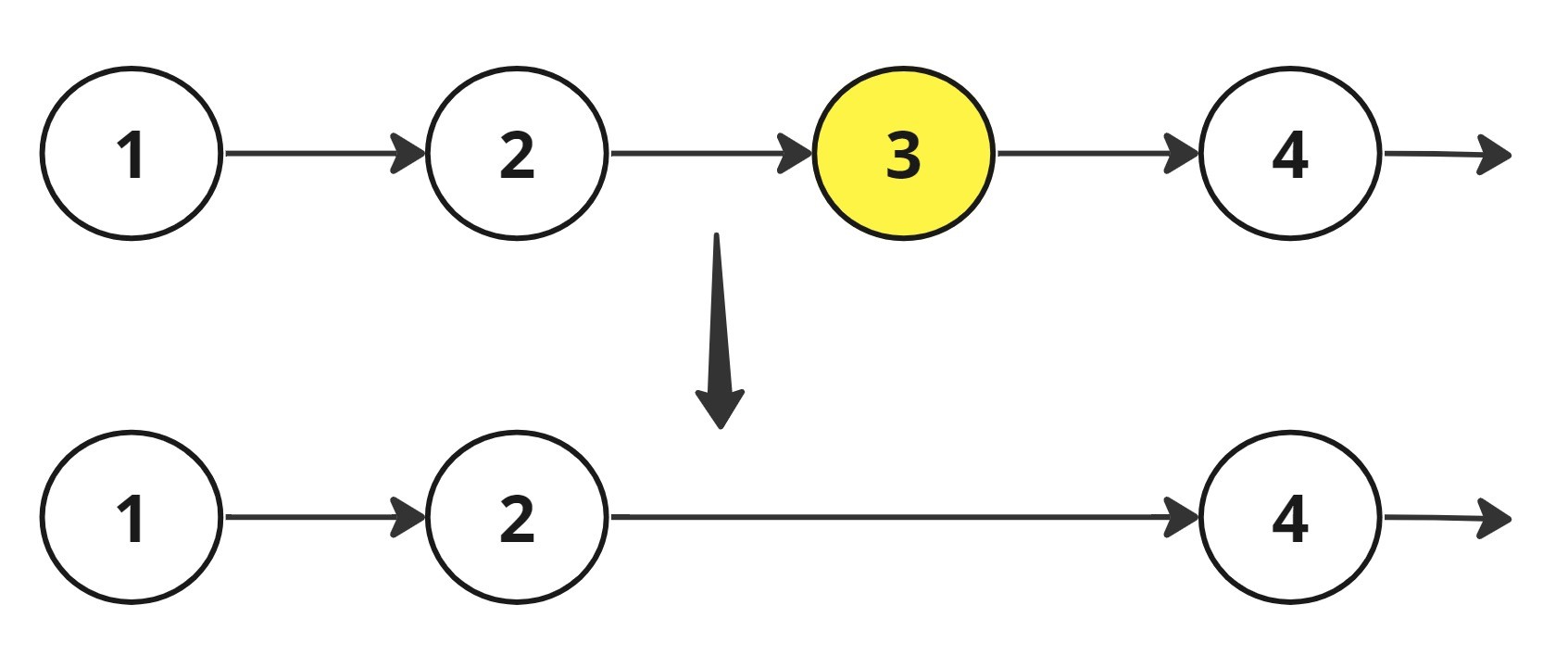
Input : 1 -> 2 -> 3 -> 4 -> 'NULL'  and  'K' = 2
Output: 1 -> 2 -> 4 -> 'NULL'
Explanation:
After removing the second node from the end, the linked list become 1 -> 2 -> 4 -> 'NULL'.
Problem approach
Our task is to remove the 'K'th node from the end of the given Linked List and return the head of the modified linked list.
2. Arithmetic Expression Evaluation
Moderate
30m average time
70% success
0/80
Asked in companies


You are given a string ‘expression’ consists of characters ‘+’, ‘-’, ‘*’, ‘/’, ‘(‘, ‘)’ and ‘0’ to ‘9’, that represents an Arithmetic Expression in Infix Notation. Your task is to evaluate this Arithmetic Expression.
In Infix Notation, operators are written in-between their operands.
Note :
1. We consider the ‘/’ operator as the floor division.

2. Operators ‘*’ and ‘/’ expression has higher precedence over operators‘+’ and ‘-’

3. String expression always starts with ‘(‘ and ends with ‘)’.

4. It is guaranteed that ‘expression’ represents’ a valid expression in Infix notation.

5. It is guaranteed that there will be no case that requires division by 0.

6. No characters other than those mentioned above are present in the string.

7. It is guaranteed that the operands and final result will fit in a 32-bit integer.
For example :
Consider string ‘expression’ = ‘((2+3)*(5/2))’.
Then it’s value after evaluation will be ((5)*(2)) = 10.
Problem approach
You are given a string ‘expression’ consists of characters ‘+’, ‘-’, ‘*’, ‘/’, ‘(‘, ‘)’ and ‘0’ to ‘9’, that represents an Arithmetic Expression in Infix Notation. Your task is to evaluate this Arithmetic Expression.


Here's your problem of the day 
Solving this problem will increase your chance to get selected in this company
Skill covered: Programming
How do you remove whitespace from the start of a string?
Choose another skill to practice
Similar interview experiences

SDE - 1
3 rounds | 7 problems
Interviewed by OYO
 Selected
6182 views

0 comments

0 upvotes
SDE - Intern
2 rounds | 3 problems
Interviewed by Amazon
Rejected
1566 views
0 comments
0 upvotes
SDE - 1
2 rounds | 5 problems
Interviewed by Meesho
Rejected
7245 views
0 comments
0 upvotes

SDE - 1
3 rounds | 9 problems
Interviewed by Salesforce
 Selected
 4552 views
0 comments
0 upvotes
Companies with similar interview experiences
SDE - Intern
3 rounds | 6 problems
Interviewed by Amazon

Rejected
16212 views
4 comments
0 upvotes
SDE - Intern
4 rounds | 7 problems
Interviewed by Microsoft
 Selected
 16223 views
1 comments
0 upvotes
SDE - Intern
2 rounds | 4 problems
Interviewed by Amazon
Selected 10541 views
2 comments
0 upvotes