





HSBC interview experience Real time questions & tips from candidates to crack your interview

SDE - 1
HSBC


1 rounds | 2 Coding
problems

Rejected
Interview preparation journey

Preparation
Duration: 2 months
Topics: Algorithms, Dynamic Programming, Data Structures, Pointers, OOPS, System Design

Tip 1 : Practice aptitude
Tip 2 : Practice coding
Tip 3 : Practice system design
Application process
Where: Other
Eligibility: No critera
Tip 1 : Have at least 2 good projects explained in short with all important points covered.
Tip 2 : Every skill must be mentioned.
Tip 3 : Focus on skills, projects and experiences more.

Interview rounds
01
Round
Easy
Online Coding Interview
Duration105 minutes
Interview date25 Feb 2022
Coding problem2
It was a Coding + MCQ round.
Aptitude(20 questions ) : Topics like Ratio and proportion, Speed and Distance, Percentage, Profit and Loss, etc.
Difficulty Level - Easy-medium.
Verbal(20 questions) : Topics like error correction, synonyms, antonyms, Comprehension passages, etc.
Difficulty Level - Easy-Medium.
Technical Subjects(30 questions) : Topics like DBMS, Operating System, Computer Network, Output based Questions, OOPs, etc.
Difficulty Level-Easy-Medium.
After the Aptitude test. Students who qualified(Qualifying marks were not disclosed), were redirected to the Coding assessment.
Coding Assessment: (30 min): This round consisted of two coding questions. Try to do both questions, as it would increase the chances of getting shortlisted.
1. Reverse the String
Easy
15m average time
85% success

0/40
Asked in companies



You are given a string 'STR'. The string contains [a-z] [A-Z] [0-9] [special characters]. You have to find the reverse of the string.
For example:
If the given string is: STR = "abcde". You have to print the string "edcba".
follow up:
Try to solve the problem in O(1) space complexity.
2. Snake and Ladder
Moderate
30m average time
60% success
0/80
Asked in companies



You have been given a Snake and Ladder Board with 'N' rows and 'N' columns with the numbers written from 1 to (N*N) starting from the bottom left of the board, and alternating direction each row.
For example
For a (6 x 6) board, the numbers are written as follows:
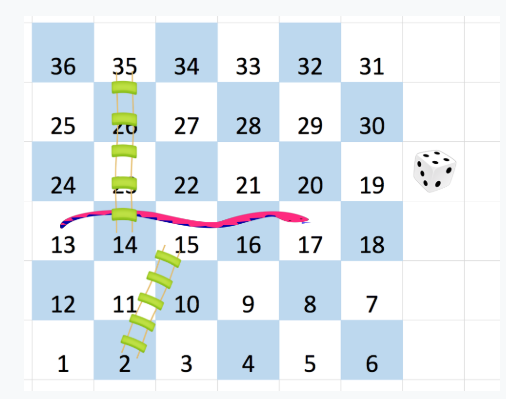
You start from square 1 of the board (which is always in the last row and first column). On each square say 'X', you can throw a dice which can have six outcomes and you have total control over the outcome of dice throw and you want to find out the minimum number of throws required to reach the last cell.
Some of the squares contain Snakes and Ladders, and these are possibilities of a throw at square 'X':
You choose a destination square 'S' with number 'X+1', 'X+2', 'X+3', 'X+4', 'X+5', or 'X+6', provided this number is <= N*N.
If 'S' has a snake or ladder, you move to the destination of that snake or ladder.  Otherwise, you move to S.
A board square on row 'i' and column 'j' has a "Snake or Ladder" if board[i][j] != -1. The destination of that snake or ladder is board[i][j].
Note :
You can only take a snake or ladder at most once per move: if the destination to a snake or ladder is the start of another snake or ladder, you do not continue moving - you have to ignore the snake or ladder present on that square.

For example, if the board is:
-1 1 -1
-1 -1 9
-1 4 -1
Let's say on the first move your destination square is 2  [at row 2, column 1], then you finish your first move at 4 [at row 1, column 2] because you do not continue moving to 9 [at row 0, column 0] by taking the ladder from 4.

A square can also have a Snake or Ladder which will end at the same cell.
For example, if the board is:
-1 3 -1
-1 5 -1
-1 -1 9
Here we can see Snake/Ladder on square 5 [at row 1, column 1] will end on the same square 5.


Here's your problem of the day 
Solving this problem will increase your chance to get selected in this company
Skill covered: Programming
How do you remove whitespace from the start of a string?
Choose another skill to practice
Similar interview experiences
SDE - 1
3 rounds | 3 problems
Interviewed by HSBC

 Selected
1990 views

0 comments

0 upvotes
SDE - 1
3 rounds | 3 problems
Interviewed by HSBC
 Selected
 2325 views
0 comments
0 upvotes
SDE - 1
2 rounds | 4 problems
Interviewed by HSBC
Rejected
1887 views
0 comments
0 upvotes
SDE - 1
2 rounds | 4 problems
Interviewed by HSBC
Rejected
942 views
0 comments
0 upvotes
Companies with similar interview experiences

SDE - 1
2 rounds | 3 problems
Interviewed by BNY Mellon
 Selected
 6786 views
3 comments
0 upvotes
SDE - 1
3 rounds | 6 problems
Interviewed by BNY Mellon
Selected 0 views
0 comments
0 upvotes
SDE - 1
3 rounds | 5 problems
Interviewed by CIS - Cyber Infrastructure
Selected 2418 views
0 comments
0 upvotes