





Incedo Inc. interview experience Real time questions & tips from candidates to crack your interview
SDE - 1
Incedo Inc.


2 rounds | 9 Coding
problems

Rejected
Interview preparation journey

Preparation
Duration: 5 months
Topics: Data Structures, Pointers, OOPS, System Design, Algorithms, Dynamic Programming

Tip 1 : Practice Atleast 250 Questions
Tip 2 : Do atleast 2 projects
Tip 3 : Practice good number of questions for Aptitude and Quantitative reasoning
Application process
Where: Campus
Eligibility: 6.5 CGPA
Tip 1 : Have some projects on resume.
Tip 2 : Do not put false things on resume.

Interview rounds
01
Round
Medium
Online Coding Interview
Duration90 minutes
Interview date19 Aug 2021
Coding problem4
There were four sections- Aptitude, Coding ,Automata Fix
1. Reverse String Word Wise
Moderate

0/80
Asked in companies



Reverse the given string word-wise. The last word in the given string should come at 1st place, the last-second word at 2nd place, and so on. Individual words should remain as it is.
Problem approach
Initially, reverse the individual words of the given string one by one, for the above example, after reversing individual words the string should be “i ekil siht margorp yrev hcum”.
Reverse the whole string from start to end to get the desired output “much very program this like i” in the above example.
2. Rotated Array
Moderate
10m average time
90% success
0/80
Asked in companies


You are given an array 'arr' of size 'n' having unique elements that has been sorted in ascending order and rotated between 1 and 'n' times which is unknown.
The rotation involves shifting every element to the right, with the last element moving to the first position. For example, if 'arr' = [1, 2, 3, 4] was rotated one time, it would become [4, 1, 2, 3].
Your task is to find the minimum number in this array.
Note :
All the elements in the array are distinct.
Example :
Input: arr = [3,4,5,1,2]

Output: 1

Explanation: The original array was [1,2,3,4,5] and it was rotated 3 times.
3. Technical Question
Check for syntax error/ logical error and correct the error to get the desired output.
Given n, print from n to 0
int main()
{
int n;
scanf("%d", &n);
unsigned int i = n;
while(i >= 0)
{
printf("%dn", i);
i--;
}
return 0;
}
Problem approach
Infinite loop
Answer: Error - Logical error
unsigned int i = n; unsigned integer ranges from 0 to 65535, which will be taken in the cyclic order.Soi-- will keep repeating in a cyclic way. The loop will never be terminated. So it should be written as int i = n;
4. Technical Question
Predict the output of the given pseudo code if the value of a number is 6:
Read number
k = 2
i = 2
while i<=number
k = k * i
i = i +1
end while
write k
Options
a : 1700.0
b : 1560.0
c : 1440.0
d : 1340.0
Problem approach
c) 1440.0
02
Round
Medium
Video Call
Duration60 minutes
Interview date25 Aug 2021
Coding problem5
The interviewer started with a coding question followed by skills mentioned in the resume
1. Maximum Difference
Easy
15m average time
85% success
0/40
Asked in companies


You are given an array 'ARR' of the 'N' element. Your task is to find the maximum difference between any of the two elements from 'ARR'.
If the maximum difference is even print “EVEN” without quotes. If the maximum difference is odd print “ODD” without quotes.
For example:
Given 'ARR' = [1, 10, 5, 2, 8, 1 ] , answer is "ODD".
Here the maximum difference is between 10 and 1, 10 - 1 = 9
Problem approach
Use two loops. In the outer loop, pick elements one by one and in the inner loop calculate the difference of the picked element with every other element in the array and compare the difference with the maximum difference calculated so far
2. Top View Of Binary Tree
Moderate
25m average time
70% success
0/80
Asked in companies



You are given a Binary Tree of 'n' nodes.
The Top view of the binary tree is the set of nodes visible when we see the tree from the top.
Find the top view of the given binary tree, from left to right.
Example :
Input: Let the binary tree be:
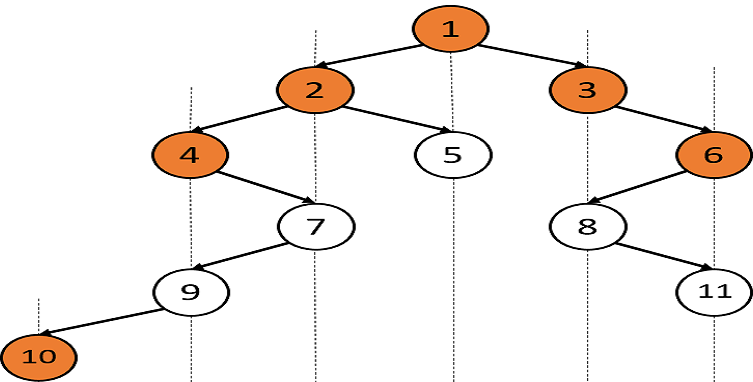
Output: [10, 4, 2, 1, 3, 6]

Explanation: Consider the vertical lines in the figure. The top view contains the topmost node from each vertical line.
Problem approach
Here we use the two variables, one for vertical distance of current node from the root and another for the depth of the current node from the root. We use the vertical distance for indexing. If one node with the same vertical distance comes again, we check if depth of new node is lower or higher with respect to the current node with same vertical distance in the map. If depth of new node is lower, then we replace it.
3. Kth Smallest and Largest Element of Array
Easy
15m average time
70% success
0/40
Asked in companies



You are given an array ‘Arr’ consisting of ‘N’ distinct integers and a positive integer ‘K’. Find out Kth smallest and Kth largest element of the array. It is guaranteed that K is not greater than the size of the array.
Example:
Let ‘N’ = 4,  ‘Arr’ be [1, 2, 5, 4] and ‘K’ = 3.
then the elements of this array in ascending order is [1, 2, 4, 5].  Clearly, the 3rd smallest and largest element of this array is 4 and 2 respectively.
4. OOPS Questions
Different types of overriding method.
What is object oriented programming give real life examples of different type of OOPS concept?
5. OS Question
What is Thrashing?
Problem approach
Thrashing is a situation when the performance of a computer degrades or collapses. Thrashing occurs when a system spends more time processing page faults than executing transactions.


Here's your problem of the day 
Solving this problem will increase your chance to get selected in this company
Skill covered: Programming
How do you remove whitespace from the start of a string?
Choose another skill to practice
Similar interview experiences
SDE - 1
3 rounds | 3 problems
Interviewed by Incedo Inc.
 Selected
0 views

0 comments

0 upvotes
SDE - 1
5 rounds | 11 problems
Interviewed by Incedo Inc.
 Selected
 561 views
0 comments
0 upvotes
SDE - 1
3 rounds | 9 problems
Interviewed by Incedo Inc.
Selected 842 views
0 comments
0 upvotes
SDE - 1
4 rounds | 4 problems
Interviewed by Incedo Inc.
 Selected
 449 views
0 comments
0 upvotes
Companies with similar interview experiences

SDE - 1
2 rounds | 3 problems
Interviewed by BNY Mellon
 Selected
 6365 views
3 comments
0 upvotes
SDE - 1
3 rounds | 6 problems
Interviewed by BNY Mellon
Selected 0 views
0 comments
0 upvotes

SDE - 1
3 rounds | 5 problems
Interviewed by CIS - Cyber Infrastructure
Selected 2198 views
0 comments
0 upvotes