





Info Edge India (Naukri.com) interview experience Real time questions & tips from candidates to crack your interview
Senior Software Engineer
Info Edge India (Naukri.com)


3 rounds | 5 Coding
problems

 Selected
 Interview preparation journey

Preparation
Duration: 6 months
Topics: Data Structures, Algorithms, System Design, Aptitude, OOPS

Tip 1 : Must do Previously asked Interview as well as Online Test Questions.
Tip 2 : Go through all the previous interview experiences from Codestudio.
Tip 3 : Do at-least 2 good projects and you must know every bit of them.
Application process
Where: Other
Eligibility: Above 7 CGPA
Tip 1 : Have at-least 2 good projects explained in short with all important points covered.
Tip 2 : Every skill must be mentioned.
Tip 3 : Focus on skills, projects and experiences more.

Interview rounds
01
Round
Easy
Video Call
Duration60 minutes
Interview date10 Sep 2021
Coding problem2
Technical interview round where the interviewer asked me 2 DSA based problems.
1. Buy and Sell Stock
Hard

0/120
Asked in companies



You are Harshad Mehta’s friend. He told you the price of a particular stock for the next ‘n’ days.
You are given an array ‘prices’ which such that ‘prices[i]’ denotes the price of the stock on the ith day.
You don't want to do more than 2 transactions. Find the maximum profit that you can earn from these transactions.
Note
1. Buying a stock and then selling it is called one transaction.

2. You are not allowed to do multiple transactions at the same time. This means you have to sell the stock before buying it again.
Example:
Input: ‘n’ = 7, ‘prices’ = [3, 3, 5, 0, 3, 1, 4].

Output: 6

Explanation:
The maximum profit can be earned by:
Transaction 1: Buying the stock on day 4 (price 0) and then selling it on day 5 (price 3).
Transaction 2: Buying the stock on day 6 (price 1) and then selling it on day 6 (price 4).
Total profit earned will be (3 - 0) + ( 4 - 1) = 6.
Problem approach
The idea is to traverse the given list of prices and find a local minimum of every increasing sequence. We can gain maximum profit if we buy the shares at the starting of every increasing sequence (local minimum) and sell them at the end of the increasing sequence (local maximum).
Steps :
1. Find the local minima and store it as starting index. If not exists, return.
2. Find the local maxima. and store it as an ending index. If we reach the end, set the end as the ending index.
3. Update the solution and Increment count of buy-sell pairs.
4. Repeat the above steps till the end is not reached.
2. Number of Flips
Easy
0/40
Asked in companies



Ninja is learning the binary representation of the numbers. He wanted to practice the topic, so he picked a question. The problem statement says, two numbers, ‘A’ and ‘B’ are given. Find the number of bits of ‘B’ that should be flipped to convert it into ‘A’.Can you help Ninja to solve this problem?
You are given two integers, ‘A’ and ‘B’.Find the number of bits of ‘B’ that should be flipped to convert it into ‘A’.
For Example
If ‘A’ is 13(1101) and ‘B’ is 7(0111), The number of bits that should be flipped is 2(0111).
Problem approach
For this question, it can be observed that there can be only two possible solutions for an alternate binary string. The resultant string will look like either of the two cases:
1. 010101…
2. 101010…
3.
Now, in order to find the minimum replacements, count the number of replacements to convert the string in type 1 and store it in variable count.
For type2, the number of replacements will be n-count (n is length of string).
So, the answer will be min(count, n-count).
To calculate the number of replacements for type 1, traverse the string and loop from i=0 to len-1. If 1 is present at even index positions or 0 is present at odd index positions, then we need to flip the bit, so update the count every time. The count after traversing the entire string will be the number of replacements required to convert the string to type 1.
Time Complexity : O(N)
Auxiliary Space : O(1)
02
Round
Medium
Video Call
Duration60 minutes
Interview date13 Sep 2021
Coding problem2
Technical interview round where the interviewer asked me 2 DSA based problems.
1. Boundary Traversal
Hard
20m average time
85% success
0/120
Asked in companies



You are given a binary tree having 'n' nodes.
The boundary nodes of a binary tree include the nodes from the left and right boundaries and the leaf nodes, each node considered once.
Figure out the boundary nodes of this binary tree in an Anti-Clockwise direction starting from the root node.
Example :
Input: Consider the binary tree A as shown in the figure:
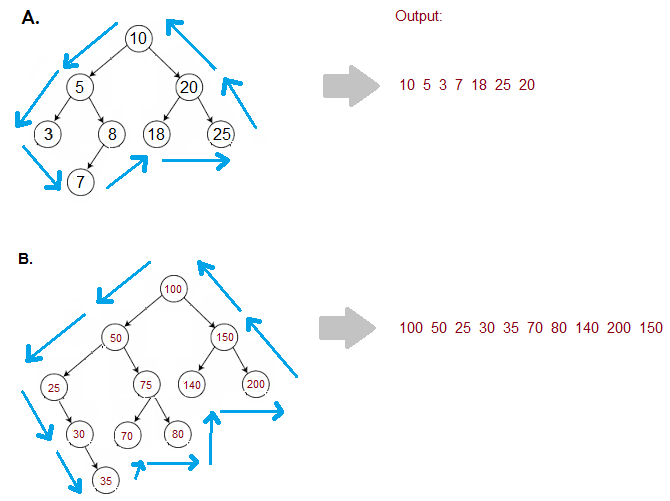
Output: [10, 5, 3, 7, 18, 25, 20]

Explanation: As shown in the figure

The nodes on the left boundary are [10, 5, 3]

The nodes on the right boundary are [10, 20, 25]

The leaf nodes are [3, 7, 18, 25].

Please note that nodes 3 and 25 appear in two places but are considered once.
Problem approach
The idea is to split the problem into 3 parts:
• Print the left boundary in a top-down manner.
• Print the leaf nodes in the same order as in the inorder traversal.
• Print the right boundary in a bottom-up manner.
Time Complexity : O(N)
2. Reverse List In K Groups
Hard
15m average time
85% success
0/120
Asked in companies



You are given a linked list of 'n' nodes and an integer 'k', where 'k' is less than or equal to 'n'.
Your task is to reverse the order of each group of 'k' consecutive nodes, if 'n' is not divisible by 'k', then the last group of nodes should remain unchanged.
For example, if the linked list is 1->2->3->4->5, and 'k' is 3, we have to reverse the first three elements, and leave the last two elements unchanged. Thus, the final linked list being 3->2->1->4->5.
Implement a function that performs this reversal, and returns the head of the modified linked list.
Example:
Input: 'list' = [1, 2, 3, 4], 'k' = 2

Output: 2 1 4 3

Explanation:
We have to reverse the given list 'k' at a time, which is 2 in this case. So we reverse the first 2 elements then the next 2 elements, giving us 2->1->4->3.
Note:
All the node values will be distinct.
Problem approach
Recursion can be used to solve this problem. We reverse every group of k linked list nodes and attach it to the previous group.
Steps :
1) The first step is to check whether the Head is NULL or Not, if its NULL then we can directly return NULL,
2) If the Head is not NULL, then we need to check the length of Linked List starting from current Head.
3) If the length is less than k , then there is no need to reverse it and hence we can directly return head,
4) Else if its a multiple of K, then we have to reverse the K elements starting from current Head. While reversing keep track of the next node and previous node.
5) We will follow the same steps for the rest of the elements Recursively and link the two sub-lists.
Time Complexity : O(n)
Auxiliary Space : O(n/k)
03
Round
Easy
HR Round
Duration30 minutes
Interview date14 Sep 2021
Coding problem1
Typical HR round where the interviewer asked behavioral problems.
1. Basic HR Questions
1. What are technical challenges that you solved?
2. Where do you want to work & what interests you?
3. Why Info Edge?
Problem approach
Tip 1 : The cross questioning can go intense some time, think before you speak.
Tip 2 : Be open minded and answer whatever you are thinking, in these rounds I feel it is important to have opinion.
Tip 3 : Context of questions can be switched, pay attention to the details. It is okay to ask questions in these round, like what are the projects currently the company is investing, which team you are mentoring. How all is the work environment etc.
Tip 4 : Since everybody in the interview panel is from tech background, here too you can expect some technical questions. No coding in most of the cases but some discussions over the design can surely happen.


Here's your problem of the day 
Solving this problem will increase your chance to get selected in this company
Skill covered: Programming
How do you remove whitespace from the start of a string?
Choose another skill to practice
Similar interview experiences
Senior Software Engineer
3 rounds | 3 problems
Interviewed by Info Edge India (Naukri.com)
 Selected
783 views

0 comments

0 upvotes
Senior Software Engineer
4 rounds | 6 problems
Interviewed by Info Edge India (Naukri.com)
Selected 744 views
0 comments
0 upvotes
Software Engineer
3 rounds | 7 problems
Interviewed by Info Edge India (Naukri.com)
Rejected
779 views
0 comments
0 upvotes
SDET
3 rounds | 10 problems
Interviewed by Info Edge India (Naukri.com)
Selected 1391 views
0 comments
0 upvotes
Companies with similar interview experiences

Senior Software Engineer
1 rounds | 3 problems
Interviewed by Intuit
Rejected
3024 views
1 comments
0 upvotes

Senior Software Engineer
5 rounds | 5 problems
Interviewed by PhonePe
Selected 2643 views
0 comments
0 upvotes
Senior Software Engineer
4 rounds | 4 problems
Interviewed by Walmart
 Selected
 7660 views
1 comments
0 upvotes