





Infosys private limited interview experience Real time questions & tips from candidates to crack your interview
System Engineer Specialist
Infosys private limited


3 rounds | 12 Coding
problems
 Selected
 Interview preparation journey

Preparation
Duration: 2 months
Topics: Data Structures, Algorithms, Digit DP, HashMap, Maths, Greedy, Dynamic Programming

Tip 1 : Prepare Data Structures and Algorithms properly
Tip 2 : Practice of competitive coding platforms
Tip 3 : Practice questions related to Maths, Digit DP, HashMap, Greedy Algorithms, DP, Graph
Application process
Where: Other
Eligibility: 3rd or 4th year student
Tip 1 : Mention those things only which are relevant
Tip 2 : Mention those skills only which you're aware of
Interview rounds
01
Round
Hard
Online Coding Test
Duration180 minutes
Interview date12 Apr 2020
Coding problem3
This round happened at HackerEarth which consists of 3 coding questions which were of 50, 75, and 100 marks according to the difficulty which you need to solve in 3 hours. Those who were able to solve 1 or more than 1 question were selected for the next round.
1. Rod cutting problem
Moderate
40m average time
75% success

0/80
Asked in companies



Given a rod of length ‘N’ units. The rod can be cut into different sizes and each size has a cost associated with it. Determine the maximum cost obtained by cutting the rod and selling its pieces.
Note:
1. The sizes will range from 1 to ‘N’ and will be integers.

2. The sum of the pieces cut should be equal to ‘N’.

3. Consider 1-based indexing.
Problem approach
First I tried to figure out the exact requirements and then tried brute force first but it shows TLE then I tried to optimize it and able to pass 48 out of 50 test cases.
2. Digit Count In Range
Moderate
25m average time
75% success
0/80
Asked in companies



You are given an integer ‘K’, and two numbers ‘A’ and ‘B’. You need to count the occurrences of the given digit ‘K’, in the range [A, B].
Note:
You need to count occurrences at every place of the number. You also need to include the lower and higher limits of the given range
For example :
Given K = 3, A = 1, B = 15, then 3 occurs 2 times(3, 13) in the range [1, 15], so you need to print 2.
3. Sort An Array of 0s, 1s and 2s
Easy
10m average time
90% success
0/40
Asked in companies


You have been given an array/list 'arr' consisting of 'n' elements.
Each element in the array is either 0, 1 or 2.
Sort this array/list in increasing order.
Do not make a new array/list. Make changes in the given array/list.
Example :
Input: 'arr' = [2, 2, 2, 2, 0, 0, 1, 0]

Output: Final 'arr' = [0, 0, 0, 1, 2, 2, 2, 2]

Explanation: The array is sorted in increasing order.
Problem approach
Tried to solve using Greedy Approach and 12 test cases passed out of 50
02
Round
Hard
Online Coding Test
Duration180 Minutes
Interview date15 Jun 2020
Coding problem3
This round was also happened at HackerEarth and having the same pattern for 3 hours and 3 questions. In this round questions were mostly based on DP, Mathematics, and Graph.
1. Ninja and Mathematics
Moderate
30m average time
70% success
0/80
Asked in companies



Ninja is a genius in mathematics. He got an interview call from MIT. During the interview, the professor asked Ninja a challenging question.
Given two integers 'N1' and 'N2', the professor asked Ninja to find the fraction when the first number i.e 'N1' is divided by the second number i.e 'N2'. If the fractional part is repeating, then the repeating part should be enclosed in parentheses.
For example, if 'N1' is 1 and 'N2' is 3 and when we divide 1 by 3 i.e 1/3, the answer is 0.333... Here 3 is repeated infinite times because the remainder never becomes zero in this problem. As we know the fractional part ( i.e 3 ) is repeating, so we have to enclose the repeating part in parentheses. Therefore, the answer is “0.(3)”.
Ninja is stuck in this problem. Can you help Ninja to crack this interview and get admission in MIT?
Problem approach
It was basically logical question where you've to analyze the problem and test cases very carefully. After, proper analysis I was able to come up with approach
2. Bridges In A Graph
Moderate
25m average time
65% success
0/80
Asked in companies

Given an undirected graph of V vertices and E edges. Your task is to find all the bridges in the given undirected graph. A bridge in any graph is defined as an edge which, when removed, makes the graph disconnected (or more precisely, increases the number of connected components in the graph).
For Example :
If the given graph is :
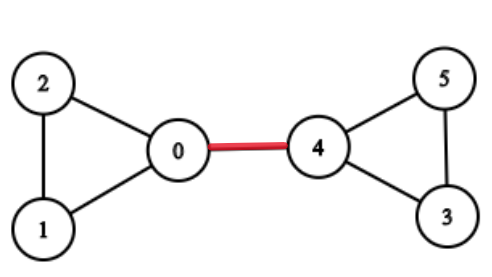
Then the edge between 0 and 4 is the bridge because if the edge between 0 and 4 is removed, then there will be no path left to reach from 0 to 4.and makes the graph disconnected, and increases the number of connected components.
Note :
There are no self-loops(an edge connecting the vertex to itself) in the given graph.

There are no parallel edges i.e no two vertices are directly connected by more than 1 edge.
3. Longest Sub-string with at most K Distinct Characters
Moderate
35m average time
65% success
0/80
Asked in companies



You are given string S of length N, and an integer K. Your task is to find the length of the longest substring that contains at most K distinct characters.
Problem approach
Passed 6 test cases out of 50
03
Round
Medium
Video Call
Duration90 minutes
Interview date5 Oct 2022
Coding problem6
This round takes place virtually on the Cisco Webex platform.
1. Project Based Question
Is your project based on 2-tier architecture or 3-tier?
Problem approach
Tip 1 : Explain the project first
Tip 2 : Then tell the answer
Tip 3 : Then tell why your answer is correct
2. OOPS Question
- Explain the difference between Encapsulation and Abstraction with a real-life example
- What do you mean by Polymorphism? What are its different types?
- What is method overriding and method overloading? Given an example of each by writing code
- What is data encapsulation and data abstraction.? Given an example of each by writing code
- What are data structures? Explain it's different kinds
Problem approach
Tip 1 : Go through the OOPS concepts very carefully
Tip 2 : Read some books of your academics over OOPS
Tip 3 : Take the help from the internet
3. Sort Linked List
Moderate
20m average time
80% success
0/80
Asked in companies


You are given a linked list of 'N' nodes where nodes can contain values 0, 1, and 2 only. Your task is to sort the linked list.
Problem approach
Implemented Linked List and sorted it by the conventional approach
4. Bubble Sort
Easy
10m average time
90% success
0/40
Asked in companies



Bubble Sort is one of the sorting algorithms that works by repeatedly swapping the adjacent elements of the array if they are not in sorted order.
You are given an unsorted array consisting of N non-negative integers. Your task is to sort the array in non-decreasing order using the Bubble Sort algorithm.
For Example:
Bubble Sort implementation for the given array: {6,2,8,4,10} is shown below :-
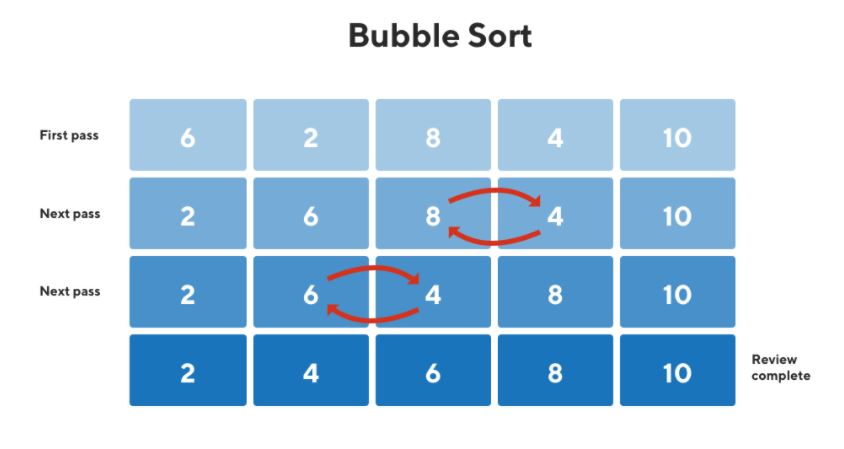
Problem approach
Written Code for Bubble Sort
5. Unique Binary Search Trees
Moderate
20m average time
80% success
0/80
Asked in companies

You are given an integer ‘N’, your task is to return the number of structurally unique BST's (binary search trees) which have exactly 'N' nodes of unique values from 1 to 'N'.
For example:
Given ‘N’ = 2, The total number of BST’s is 2.
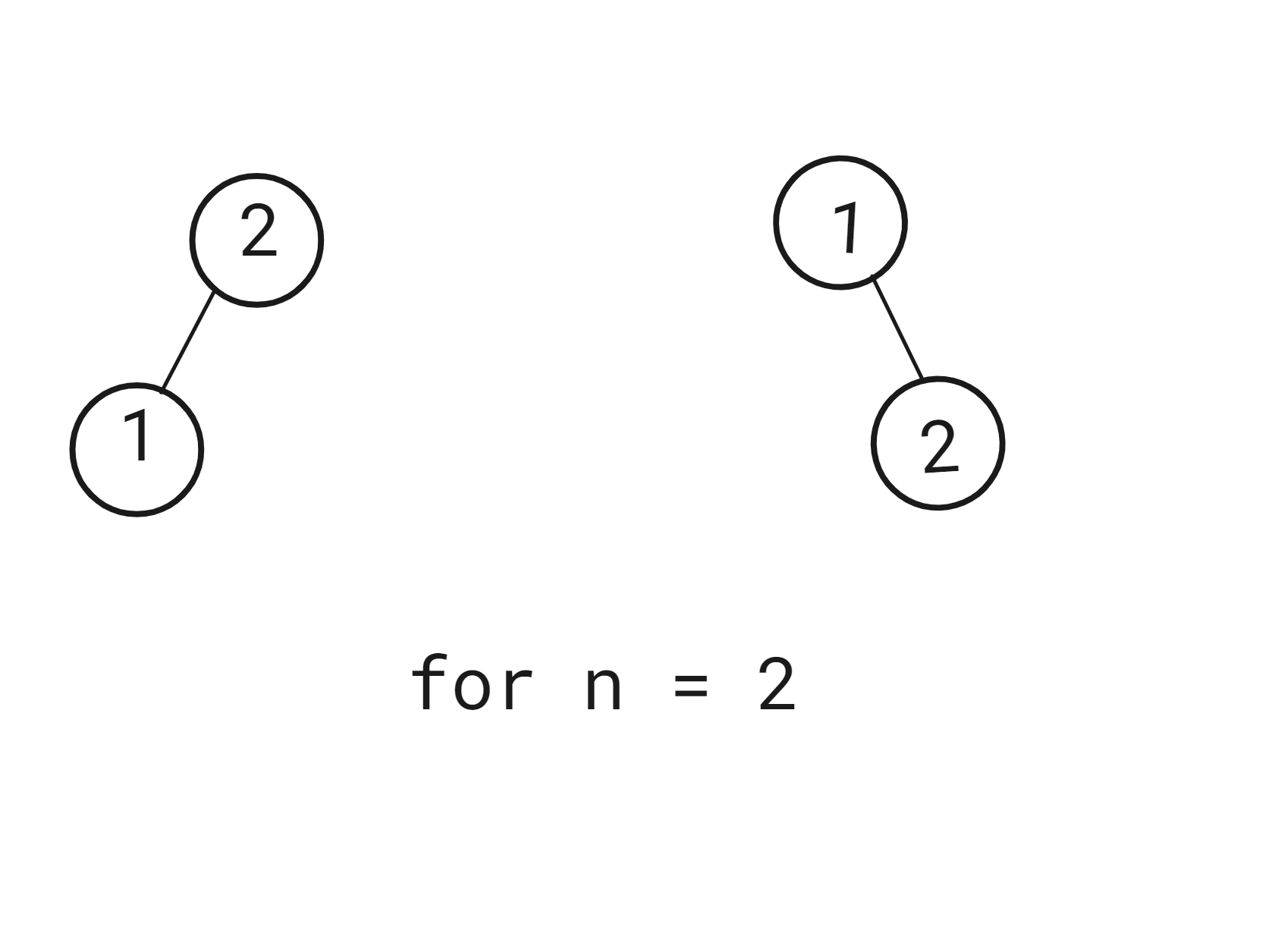
Note:
1. A binary search tree is a rooted binary tree whose internal nodes each store a key greater than all the keys in the node's left subtree and less than those in its right subtree.

2. A structurally unique binary search tree is a tree that has at least 1 node at a different position or with a different value compared to another binary search tree.
Problem approach
Tell him about binary search and applications
6. DBMS
- Explain normalization and its dis-advantages
- What is de-normalization?
- What do you understand by DDL and DML in SQL?
- Explain the difference between truncate, delete, and drop


Here's your problem of the day 
Solving this problem will increase your chance to get selected in this company
Skill covered: Programming
To make an AI less repetitive in a long paragraph, you should increase:
Choose another skill to practice
Similar interview experiences
System Engineer Specialist
2 rounds | 4 problems
Interviewed by Infosys private limited
 Selected
1453 views

0 comments

0 upvotes
System Engineer Specialist
3 rounds | 5 problems
Interviewed by Infosys private limited
Selected 1273 views
0 comments
0 upvotes
System Engineer Specialist
1 rounds | 3 problems
Interviewed by Infosys private limited

Rejected
1500 views
0 comments
0 upvotes
System Engineer Specialist
2 rounds | 2 problems
Interviewed by Infosys private limited
Selected 917 views
0 comments
0 upvotes
Companies with similar interview experiences

System Engineer Specialist
3 rounds | 9 problems
Interviewed by Tata Consultancy Services (TCS)
Selected 1280 views
0 comments
0 upvotes

System Engineer Specialist
4 rounds | 7 problems
Interviewed by Oracle
Rejected
0 views
0 comments
0 upvotes

System Engineer Specialist
3 rounds | 5 problems
Interviewed by HCL Technologies
Rejected
1234 views
0 comments
0 upvotes