





Infosys private limited interview experience Real time questions & tips from candidates to crack your interview
System Engineer
Infosys private limited


4 rounds | 13 Coding
problems

 Selected
 Interview preparation journey

Preparation
Duration: 4 Months
Topics: Data Structures, Algorithms, System Design, Aptitude, OOPS

Tip 1 : Must do Previously asked Interview as well as Online Test Questions.
Tip 2 : Go through all the previous interview experiences from Codestudio and Leetcode.
Tip 3 : Do at-least 2 good projects and you must know every bit of them.
Application process
Where: Campus
Eligibility: Above 7 CGPA
Tip 1 : Have at-least 2 good projects explained in short with all important points covered.
Tip 2 : Every skill must be mentioned.
Tip 3 : Focus on skills, projects and experiences more.
Interview rounds
01
Round
Medium
Online Coding Interview
Duration120 Minutes
Interview date18 Jul 2021
Coding problem2
This was an online MCQ + coding round where we had 1 hour to solve the MCQ's and another 1 hour to solve 2 coding
questions. The MCQ's were related to both General and Technical Aptitude and the coding questions were relatively
easy if one has a decent grip on Data Structures and Algorithms.
1. Count Ways To Reach The N-th Stairs
Moderate
30m average time
80% success

0/80
Asked in companies



You have been given a number of stairs. Initially, you are at the 0th stair, and you need to reach the Nth stair.
Each time, you can climb either one step or two steps.
You are supposed to return the number of distinct ways you can climb from the 0th step to the Nth step.
Note:
Note: Since the number of ways can be very large, return the answer modulo 1000000007.
Example :
N=3
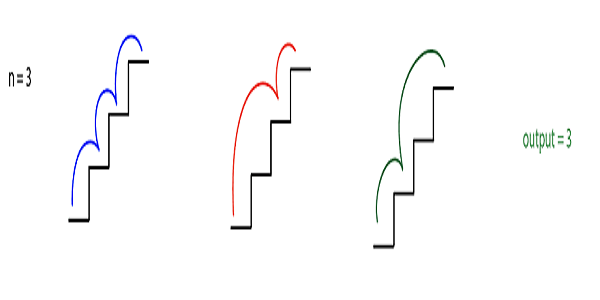
We can climb one step at a time i.e. {(0, 1) ,(1, 2),(2,3)} or we can climb the first two-step and then one step i.e. {(0,2),(1, 3)} or we can climb first one step and then two step i.e. {(0,1), (1,3)}.
Problem approach
Approach (Using DP) :
We reach “currStep” step in taking one step or two steps:
We can take the one-step from (currStep-1)th step or,
We can take the two steps from (currStep-2)th step.
So the total number of ways to reach “currStep” will be the sum of the total number of ways to reach at (currStep-1)th and the total number of ways to reach (currStep-2)th step.
Let dp[currStep] define the total number of ways to reach “currStep” from the 0th. So,
dp[ currStep ] = dp[ currStep-1 ] + dp[ currStep-2 ]
The base case will be, If we have 0 stairs to climb then the number of distinct ways to climb will be one (we are already at Nth stair that’s the way) and if we have only one stair to climb then the number of distinct ways to climb will be one, i.e. one step from the beginning.
TC : O(N), where N = number of stairs.
SC : O(N)
2. Distinct Strings With Odd and Even Swapping Allowed
Moderate
15m average time
85% success
0/80
Asked in companies

You are given an array of strings. Your task is to find the number of unique strings.
A string is considered unique if it cannot be formed from any other string, present in the array, even after applying the following operations any number of times and in any order:
1. Swapping two characters present at odd indices.
2. Swapping two characters present at even indices.
Note:
Strings contain only lowercase English alphabets.
Example:
Let the array of strings be [“abcd”, “cbad”, “bdac”, “adcb”]. From the given array, strings “abcd”, “cbad”, and “adcb” can be transformed into one another by applying the given operations. But “bdac” cannot be transformed into any other string. Hence, there are only 2 unique strings in the array.
Problem approach
Approach :
1) Create a hashtable, to store the distinct encoded strings.
2) For each string in the array:
2.1) Find the frequency of even and odd indexed characters and store them in hash table say, freqEven and freqOdd.
2.2) Initially, the encoded string is empty.
2.3) Iterate through the characters from ‘a’ to ‘z’:
2.3.1) Let the current character be ch.
2.3.2) Concatenate the encoded string with “freqEven[ch]-freqOdd[ch]-”.
2.4) If the encoded string is not present in the hashtable, then add it to the hashtable.
3) Return the number of strings present in the hashtable.
TC : O(N*M), where N is the number of strings in the array and M is the length of the longest string.
SC : O(N)
02
Round
Medium
Video Call
Duration60 Minutes
Interview date18 Jul 2021
Coding problem4
This round had 2 very standard questions of DSA followed by some questions from DBMS. The interviewer was quite friendly and gave me small hints wherever I was stuck.
1. Print All Subsets
Easy
20m average time
80% success
0/40
Asked in companies



You are given an array ‘arr’ of ‘N’ distinct integers. Your task is to print all the non-empty subsets of the array.
Note: elements inside each subset should be sorted in increasing order. But you can print the subsets in any order, you don’t have to specifically sort them.
Problem approach
Approach (Using Bit-Masking) :
1) Declare a 2-D container ans to store all the subsets
2) Run a for loop for num from 1 to 2^N -1
3) Run inner for loop for i from 0 to N-1
4) If the ith bit in num has value equal to 1 then include ith element of the array in the current subset.
5) Push each subset generated into ans
6) Finally, sort and print each container inside ans in a separate line
TC : O( N * 2^N ), where N = size of the input array.
SC : O( N * 2^N )
2. Maximum Subarray Sum
Moderate
35m average time
81% success
0/80
Asked in companies



You are given an array 'arr' of length 'n', consisting of integers.
A subarray is a contiguous segment of an array. In other words, a subarray can be formed by removing 0 or more integers from the beginning and 0 or more integers from the end of an array.
Find the sum of the subarray (including empty subarray) having maximum sum among all subarrays.
The sum of an empty subarray is 0.
Example :
Input: 'arr' = [1, 2, 7, -4, 3, 2, -10, 9, 1]

Output: 11

Explanation: The subarray yielding the maximum sum is [1, 2, 7, -4, 3, 2].
Problem approach
Approach (Using Kadane's Algo) :
1) Declare a variable ‘maxSum’ and initialize it with ‘minimum integer’
2) Declare a variable ‘localSum’ and initialize it with ‘0’
3) Declare 3 counter variables as ‘start’ , ‘end’ , ‘newStart’ as 0, 0, 0
4) Run a loop from i = 0 to N
4.1) Add a current element to ‘localSum’
4.2) If 'localSum' is greater than 'maxSum'
Update ‘maxSum’ with 'localSum', update start with ‘newStart’ and end with loop counter ‘i’
4.3) If 'localSum' is equal to ‘maxSum’ and the difference between ‘end’ and ‘start’ is less than the
difference between ‘newStart’ and ‘i’
Update start with ‘newStart’ and end with ‘i’
4.4) If 'localSum' is below ‘0’
Update ‘localSum’ as 0 and set ‘newStart' as ‘i’ + 1
5) Return the part of the array starting from ‘start’ and ending at ‘end’
TC : O(N), where N = size of the array
SC : O(N), we need a final array to store the result maximum subarray.
3. DBMS Question
Difference between INNER JOIN and OUTER JOIN
Problem approach
Inner Join :
1) It returns the combined tuple between two or more tables.
2) Used clause INNER JOIN and JOIN.
3) When any attributes are not common then it will return nothing.
4) If tuples are more. Then INNER JOIN works faster than OUTER JOIN.
5) It is used when we want detailed information about any specific attribute.
SQL Syntax :
select *
from table1 INNER JOIN / JOIN table2
ON table1.column_name = table2.column_name;
Outer Join :
1) It returns the combined tuple from a specified table even if the join condition fails.
2) Used clause LEFT OUTER JOIN, RIGHT OUTER JOIN, FULL OUTER JOIN, etc.
3) It does not depend upon the common attributes. If the attribute is blank then there is already placed NULL.
4) Generally, The OUTER JOIN is slower than INNER JOIN. But except for some special cases.
5) It is used when we want to complete information.
SQL Syntax :
select *
from table1 LEFT OUTER JOIN / RIGHT OUTER JOIN /
FULL OUTER JOIN / FULL JOIN table2 ON
table1.column_name = table2.column_name;
4. DBMS Question
What are the integrity rules in DBMS?
Problem approach
Data integrity is one significant aspect while maintaining the database. So, data integrity is enforced in the database system by imposing a series of rules. Those set of integrity is known as the integrity rules.
There are two integrity rules in DBMS:
Entity Integrity : It specifies that "Primary key cannot have a NULL value."
Referential Integrity: It specifies that "Foreign Key can be either a NULL value or should be the Primary Key value of other relation
03
Round
Medium
Video Call
Duration60 Minutes
Interview date18 Jul 2021
Coding problem5
This round had 1 question of DS/Algo where I had to implement the Trie Data Structure and write its pseudo code. This was followed by some questions from Operating System and OOPS.
1. Trie Implementation
Moderate
25m average time
65% success
0/80
Asked in companies


Implement a Trie Data Structure which supports the following three operations:
Operation 1 - insert(word) - To insert a string WORD in the Trie.

Operation 2-  search(word) - To check if a string WORD is present in Trie or not.

Operation 3-  startsWith(word) - To check if there is a string that has the prefix WORD.
Trie is a data structure that is like a tree data structure in its organisation. It consists of nodes that store letters or alphabets of words, which can be added, retrieved, and deleted from the trie in a very efficient way.
In other words, Trie is an information retrieval data structure, which can beat naive data structures like Hashmap, Tree, etc in the time complexities of its operations.
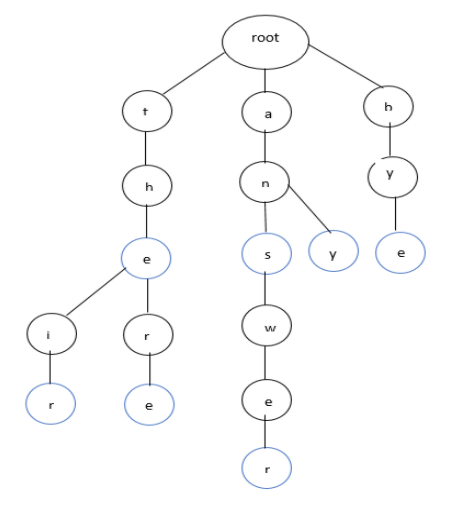
The above figure is the representation of a Trie. New words that are added are inserted as the children of the root node.

Alphabets are added in the top to bottom fashion in parent to children hierarchy. Alphabets that are highlighted with blue circles are the end nodes that mark the ending of a word in the Trie.
For Example:-
Type = ["insert", "search"], Query = ["coding", "coding].
We return ["null", "true"] as coding is present in the trie after 1st operation.
Problem approach
Approach (Using Array) :
Definition of Trie Node :
1) child - storing the address of child nodes (Array of the address of Trie Nodes with size 26 initialized with NULL)
2) isEnd - a bool variable for marking this node as an end of some word.
Then we have defined our Trie Class having members:
1) root - The root node for whole Trie, every word starts from this node.
2) insert(word) - To insert a string "word" in Trie
3) search(word) - To check if string "word" is present in Trie or not.
4) startsWith(word) - To check if there is any string in the Trie that starts with the given prefix string "word".
insert(word) :
1) Initialize the current node with the root node of Trie.
2) Iterate over the word from left to right and if there is NULL in the address of the node for the next character of the word then create a new node and store the address in child member of the previous character’s node.
3) Keep updating the current node to the corresponding node for the next character of the word.
4) Finally, when we reached the end of the word, mark the isEnd member of the current node to true as it will denote the word is present or not.
search(word) :
1) Initialize the current node with the root node of Trie.
2) Iterate over the word from left to right and if there is NULL in the address of the node for the next character of the word then return false as the word is not present in the Trie.
3) Keep updating the current node to the corresponding node for the next character of the word.
4) Finally, when we reached the end of the word, return the isEnd bool variable of the current node as it will denote the word is present or not.
startsWith(word) :
1) Initialize the current node with the root node of Trie.
2) Iterate over the word from left to right and if there is NULL in the address of the node for the next character of the word then return false as the no word is present in the Trie with this word as a Prefix.
3) Keep updating the current node to the corresponding node for the next character of the word.
4) Finally, when we reached the end of the word, return true as some word must be present in the Trie as we are able to cover the whole prefix word.
TC : O(N*W) (insert - O(W), search - O(W), startsWith - O(W))
where N is the number of queries and W is the average length of words.
SC : O(N*W)
2. OS Question
What is meant by Multitasking and Multithreading in OS?
Problem approach
Multitasking : It refers to the process in which a CPU happens to execute multiple tasks at any given time. CPU
switching occurs very often when multitasking between various tasks. This way, the users get to collaborate with
every program together at the same time. Since it involves rapid CPU switching, it requires some time. It is because
switching from one user to another might need some resources. The processes in multi-tasking, unlike multi-
threading, share separate resources and memories.
Multithreading : It is a system that creates many threads out of a single process to increase the overall power and
working capacity of a computer. In the process of multi-threading, we use a CPU for executing many threads out of a
single process at any given time. Also, the process of creation depends entirely on the cost. The process of
multithreading, unlike multitasking, makes use of the very same resources and memory for processing the execution.
3. OS Question
What is thrashing in OS?
Problem approach
Answer :
1) It is generally a situation where the CPU performs less productive work and more swapping or paging work.
2) It spends more time swapping or paging activities rather than its execution.
3) By evaluating the level of CPU utilization, a system can detect thrashing.
4) It occurs when the process does not have enough pages due to which the page-fault rate is increased. 5) It inhibits
much application-level processing that causes computer performance to degrade or collapse.
4. OOPS Question
Difference between Constructor and Method?
Problem approach
Constructors :
1) A Constructor is a block of code that initializes a newly created object.
2) A Constructor can be used to initialize an object.
3) A Constructor is invoked implicitly by the system
4) A Constructor is invoked when a object is created using the keyword new.
5) A Constructor doesn’t have a return type.
6) A Constructor’s name must be same as the name of the class.
7) A Constructor cannot be inherited by subclasses.
Method :
1) A Method is a collection of statements which returns a value upon its execution.
2) A Method consists of Java/C++ code to be executed.
3) A Method is invoked by the programmer.
4) A Method is invoked through method calls.
5) A Method must have a return type.
6) A Method’s name can be anything.
7) A Method can be inherited by subclasses.
5. OOPS Question
What is Garbage collector in JAVA?
Problem approach
1) Garbage Collection in Java is a process by which the programs perform memory management automatically.
2) The Garbage Collector(GC) finds the unused objects and deletes them to reclaim the memory.
3) In Java, dynamic memory allocation of objects is achieved using the new operator that uses some memory and the
memory remains allocated until there are references for the use of the object.
4) When there are no references to an object, it is assumed to be no longer needed, and the memory, occupied by
the object can be reclaimed.
5) There is no explicit need to destroy an object as Java handles the de-allocation automatically.
The technique that accomplishes this is known as Garbage Collection. Programs that do not de-allocate memory can
eventually crash when there is no memory left in the system to allocate. These programs are said to have memory
leaks.
Garbage collection in Java happens automatically during the lifetime of the program, eliminating the need to de-
allocate memory and thereby avoiding memory leaks.
In C language, it is the programmer’s responsibility to de-allocate memory allocated dynamically using free() function.
This is where Java memory management leads.
04
Round
Easy
HR Round
Duration30 Minutes
Interview date18 Jul 2021
Coding problem2
This is a cultural fitment testing round .HR was very frank and asked standard questions. Then we discussed about my role.
1. Basic HR Question
Why should we hire you ?
Problem approach
Tip 1 : The cross questioning can go intense some time, think before you speak.
Tip 2 : Be open minded and answer whatever you are thinking, in these rounds I feel it is important to have opinion.
Tip 3 : Context of questions can be switched, pay attention to the details. It is okay to ask questions in these round,
like what are the projects currently the company is investing, which team you are mentoring. How all is the work
environment etc.
Tip 4 : Since everybody in the interview panel is from tech background, here too you can expect some technical
questions. No coding in most of the cases but some discussions over the design can surely happen.
2. Basic HR Question
Why do you want to work at Infosys?
Problem approach
Answer :
1) Work-Life Balance : As per the employees of Infosys, they have a well-maintained work-life balance. The
employees believe that the company offers them certain opportunities allowing them to maintain their home life while
focusing on the career at the same time.
2) Brand Name : Infosys has become a brand name over time and with the high popularity, it has become one of the
major companies that are making employees jump at the offer from Infosys. The brand has a good reputation in the
market that is one of the top reasons to work at Infosys.
3) Work Environment : The work environment of Infosys is well-known as the colleagues are not only supportive but
ensure that the new employees can work in a learning environment.


Here's your problem of the day 
Solving this problem will increase your chance to get selected in this company
Skill covered: Programming
To make an AI less repetitive in a long paragraph, you should increase:
Choose another skill to practice
Similar interview experiences
System Engineer
3 rounds | 3 problems
Interviewed by Infosys private limited
Selected 
2677 views

0 comments

0 upvotes
System Engineer
2 rounds | 3 problems
Interviewed by Infosys private limited
Selected 0 views
0 comments
0 upvotes
System Engineer
2 rounds | 5 problems
Interviewed by Infosys private limited
Selected 1084 views
0 comments
0 upvotes
System Engineer
3 rounds | 3 problems
Interviewed by Infosys private limited
Selected 1026 views
0 comments
0 upvotes
Companies with similar interview experiences

System Engineer
2 rounds | 2 problems
Interviewed by Cognizant
Selected 4965 views
5 comments
0 upvotes
System Engineer
3 rounds | 3 problems
Interviewed by Tata Consultancy Services (TCS)
 Selected
 2463 views
0 comments
0 upvotes
System Engineer
2 rounds | 1 problems
Interviewed by Tata Consultancy Services (TCS)
Selected 2038 views
0 comments
0 upvotes