





Infosys Technologies Limited interview experience Real time questions & tips from candidates to crack your interview
Specialist Programmer
Infosys Technologies Limited


2 rounds | 8 Coding
problems

 Selected
 Interview preparation journey

Journey
I started my coding journey in 2021 during my first year of college with Java, where I learned the basic syntax and gradually moved on to mastering Data Structures in the same language. Personally, I recommend Java or C++ over Python for DSA, as these languages involve more coding effort, which helps in strengthening problem-solving skills and logical thinking. Alongside DSA, I also explored web development, initially working on the MERN stack but later transitioning to Spring and Spring Boot after gaining deeper knowledge of Java. To improve my speed and accuracy, I regularly participated in coding contests on online platforms, which provided valuable time-bound practice.
Application story
I applied through my college, where we received a mail containing a Google form to fill in our details. Later, we got the test link. The test consisted of three problems: one easy, one medium, and one hard. Candidates who were able to solve two or more problems were most likely shortlisted for the interview round.
Why selected/rejected for the role?
I got selected because I had a thorough understanding of data structures and algorithms. I also knew everything about what i had in my resume. I also had projects which were different from the generic projects that ended up in me getting selected for the role. I also gave special time to the core subjects.
Preparation
Duration: 3 months
Topics: DSA, Arrays, Strings, Linked Lists, Sorting, Searching. Recursion, Trees, Graphs. OOPS, DBMS, SQL, Operating System

Tip 1: Solve a lot of DSA problems — at least 300. This will help you build a strong grasp of most data structure concepts. In interviews, the first set of questions is often from DSA, so solving them confidently will leave a strong impression early on. Performing well here sets a positive tone for the rest of the interview and significantly increases your chances of selection.
Tip 2: Keep working on projects alongside your preparation—don’t wait until the end. Interviewers usually go deep into the details of your projects, so ensure you understand them thoroughly. Focus on building unique, impactful projects with real-world use cases instead of generic ones. This will make your resume stand out and give you an edge.
Tip 3: Be confident during interviews. Don’t hesitate to share your thought process and approaches to problems. Even if you don’t know the optimal solution, start with the brute-force approach and then work on optimizing it. Also, be well-prepared with DBMS queries and theoretical concepts, as these are frequently asked.
Application process
Where: Campus
Eligibility: No active backlogs, (Salary Package: 9.5 LPA)
Tip 1: You should have a thorough understanding of the resume. They can ask anything from the resume. So it is advised don't put false things in the resume.
Tip 2: Keep the resume structured and try to increase the ATS score of the resume. this will help in getting your resume shortlisted in many companies.

Interview rounds
01
Round
Hard
Online Coding Interview
Duration180 minutes
Interview date29 Jul 2025
Coding problem3
It had 3 coding problems. They were marked as easy, medium and hard. Actually all the problems were kind hard and not that easy. If you solve 2 problems it will increase your chances of selection.
1. Distinct Queries on Tree
Hard

0/120
You are given a tree T with N nodes (numbered 0 to N-1) and a string S where S[i] is the lowercase letter written on node i.
You must answer Q queries of two types:
Type 1 (Update): 1 U X - Change the letter on node U to the X-th letter of the alphabet (0-indexed, 'a'=0, 'b'=1, ...).
Type 2 (Query): 2 U V - Count the number of distinct letters on the unique simple path from node U to node V.
After processing all queries, you need to calculate a final weighted sum. Let the answers to the Type 2 queries be C1, C2, ..., Ck. The final result is (C1 * 3^1 + C2 * 3^2 + ... + Ck * 3^k).
Return this final sum modulo 1,000,000,007.
Problem approach
1) Build the tree using an adjacency list from the given edges for efficient traversal.
2) Pre-process for LCA using Binary Lifting to quickly find paths between any two nodes.
3) Handle updates by changing the letter at the specified node when a Type 1 query is given.
4) Answer path queries by collecting and counting distinct letters from U to V using LCA and bit masking.
5) Calculate the final sum by multiplying each result with powers of 30 and taking modulo.
2. Circular Jump Game
Hard
0/120
A group of N people are seated in chairs numbered 1 to N arranged in a circle. You are given an array A, where A[i-1] represents the jump distance for the person on chair i.
From any chair i, a person can jump A[i-1] chairs in either a clockwise (right) or counter-clockwise (left) direction.
Bob starts at chair X and needs to reach chair Y. Your task is to find the minimum number of jumps required to get from chair X to chair Y. If it's impossible to reach chair Y, return -1.
Problem approach
1) Model the chairs as nodes in a graph.
2) Use BFS (Breadth-First Search).
3) Handle circular jumps using modulo arithmetic.
4) Track visited chairs.
5) Return the minimum jumps or -1 if unreachable.
3. Great Bitwise Arrays
Hard
0/120
You are given three integers: N, M, and K. Your task is to find the number of "great" arrays of length N.
An array A of length X is considered great if for all i from 2 to X, the condition bitcount(A[i-1] & A[i]) = K holds true. The elements A[i] of the array must satisfy 0 <= A[i] < 2^M.
Since the total number of great arrays can be very large, you must return the count modulo 1,000,000,007.
Problem approach
1) Model all states as numbers from 0 to 2^m-1 representing possible elements of the array.
2) Build a graph or transition matrix where an edge exists between states u and v if bitcount(u & v) == K.
3) Use dynamic programming or matrix exponentiation to count the number of valid sequences of length N based on transitions.
4 )Sum over all possible starting states since the array can start with any valid element.
5) Return the result modulo.
02
Round
Medium
Face to Face
Duration90 minutes
Interview date2 Jul 2025
Coding problem5
It was a face to face interview time was 12pm in afternoon. I reached an hour ago. It turned out to be a 1.5 hrs. interview that had everything covered starting from data structures, operating system oops, dbms, projects etc. The environment was good the office was nice as well. All my college students who got shortlisted were there. Some students from other states were there as well. We all were waiting in lobby. There were multiple interviewers and you can get allotted to anyone based on your luck. Your interview also depends a lot on the interviewer as well.
1. Digit Zero Tally
Moderate
0/80
You are given a positive integer N. Your task is to calculate the total number of times the digit '0' appears in the decimal representations of all integers from 1 to N, inclusive.
Problem approach
1) Iterate through all numbers from 1 to n – each number will be checked for zeros.
2) Convert each number to a string to examine its digits individually.
3) Count the number of '0' characters in the string representation of each number.
4) Accumulate the counts in a total counter as you process each number.
5) Return the final total as the number of zeros from 1 to n.
2. Flatten Binary Tree to Linked List
Moderate
25m average time
70% success
0/80
Asked in companies



You are given a binary tree consisting of 'n' nodes.
Convert the given binary tree into a linked list where the linked list nodes follow the same order as the pre-order traversal of the given binary tree.
Use the right pointer of the binary tree as the “next” pointer for the linked list and set the left pointer to NULL.
Use these nodes only. Do not create extra nodes.
Example :
Input: Let the binary be as shown in the figure:
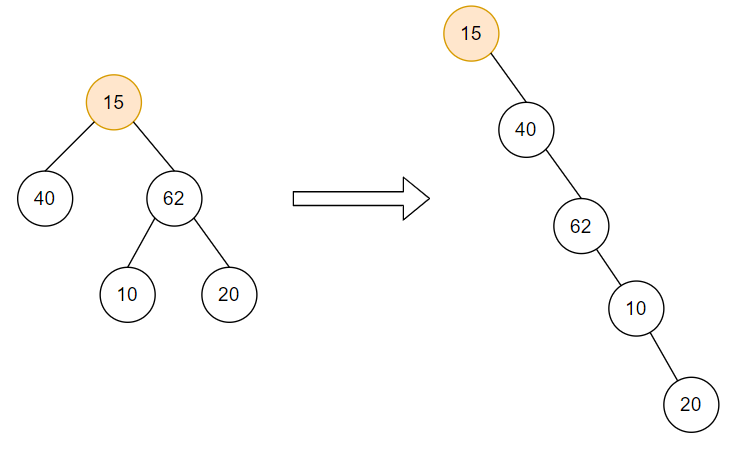
Output: Linked List: 15 -> 40 -> 62 -> 10 -> 20 -> NULL

Explanation: As shown in the figure, the right child of every node points to the next node, while the left node points to null.

Also, the nodes are in the same order as the pre-order traversal of the binary tree.
Problem approach
1) Identify the Pre-order Traversal:
Understand that the desired flattened structure should follow the pre-order traversal of the binary tree, where the root node comes first, followed by the left subtree, and then the right subtree.
2) Iterate Through the Tree:
Use a while loop to traverse the tree starting from the root node.
3) Process Each Node:
If the current node has a left child:
Find the rightmost node in the left subtree.
Connect the rightmost node's right pointer to the current node's right child.
Move the current node's left child to its right pointer.
Set the current node's left pointer to null.
If the current node does not have a left child, simply move to the right child.
4)Repeat Until the End:
Continue the process until all nodes have been processed and the tree is flattened.
3. Puzzle
There are 25 horses among which you need to find out the fastest 3 horses. You can conduct a race among at most 5 to find out their relative speed. At no point can you find out the actual speed of the horse in a race.
Find out the minimum no. of races which are required to get the top 3 horses. (Learn)
4. Second Highest Salary
Find the second highest salary from employees table. (Practice)
Problem approach
Tip: Use subqueries(corelated).
5. Operating System
Difference between multi programming and multi tasking. (Learn)
Problem approach
Tip: Make short notes and keep revising.


Here's your problem of the day 
Solving this problem will increase your chance to get selected in this company
Skill covered: Programming
What does dict.keys() return?
Choose another skill to practice
Similar interview experiences
Specialist Programmer
2 rounds | 3 problems
Interviewed by Infosys Technologies Limited
 Selected
1167 views

0 comments

0 upvotes
Specialist Programmer
2 rounds | 4 problems
Interviewed by Infosys Technologies Limited
Selected 1674 views
0 comments
0 upvotes
Specialist Programmer
2 rounds | 4 problems
Interviewed by Infosys Technologies Limited
Selected 1320 views
0 comments
0 upvotes
Specialist Programmer
2 rounds | 2 problems
Interviewed by Infosys Technologies Limited
Selected 1191 views
0 comments
0 upvotes