





Intuit interview experience Real time questions & tips from candidates to crack your interview

Software Developer
Intuit


3 rounds | 7 Coding
problems

Rejected
Interview preparation journey

Preparation
Duration: 6 months
Topics: Data Structures, Algorithms, System Design, Algorithmic Approach To Problem Solving, OOPS

Tip 1 : Must do Previously asked Interview as well as Online Test Questions.
Tip 2 : Go through all the previous interview experiences from Codestudio and Leetcode.
Tip 3 : Do at-least 2 good projects and you must know every bit of them.
Application process
Where: Campus
Eligibility: Above 7 CGPA
Tip 1 : Have at-least 2 good projects explained in short with all important points covered.
Tip 2 : Every skill must be mentioned.
Tip 3 : Focus on skills, projects and experiences more.

Interview rounds
01
Round
Hard
Online Coding Interview
Duration60 minutes
Interview date10 May 2017
Coding problem2
10 MCQs and 3 programming questions are given.
MCQs included questions asking the outputs of code snippets, algorithmic complexities.
Programming problems are tough.
I was able to solve only 1 problem completely and 1 partially.
Partial score is given for passing some test cases.
Tips: For programming problems code any solution(even brute force) if you are not able to come up with exact solution
1. LCA Of Binary Tree
Moderate
10m average time
90% success

0/80
Asked in companies



You have been given a Binary Tree of distinct integers and two nodes ‘X’ and ‘Y’. You are supposed to return the LCA (Lowest Common Ancestor) of ‘X’ and ‘Y’.
The LCA of ‘X’ and ‘Y’ in the binary tree is the shared ancestor of ‘X’ and ‘Y’ that is located farthest from the root.
Note :
You may assume that given ‘X’ and ‘Y’ definitely exist in the given binary tree.
For example :
For the given binary tree
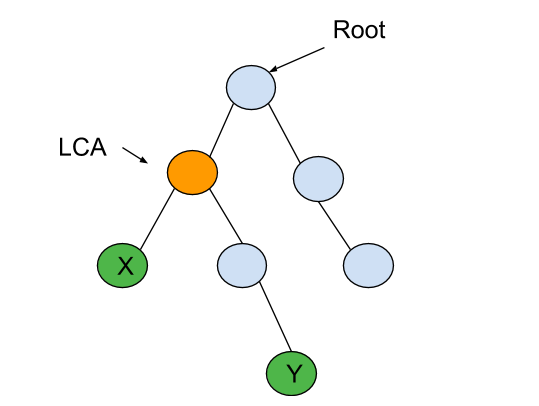
LCA of ‘X’ and ‘Y’ is highlighted in yellow colour.
Problem approach
The recursive approach is to traverse the tree in a depth-first manner. The moment you encounter either of the nodes node1 or node2, return the node. The least common ancestor would then be the node for which both the subtree recursions return a non-NULL node. It can also be the node which itself is one of node1 or node2 and for which one of the subtree recursions returns that particular node.
Pseudo code :
LowestCommonAncestor(root, node1, node2) {
if(not root)
return NULL
if (root == node1 or root == node2)
return root
left = LowestCommonAncestor(root.left, node1, node2)
right = LowestCommonAncestor(root.right, node1, node2)
if(not left)
return right
else if(not right)
return left
else
return root
}
2. Design a stack that supports getMin() in O(1) time and O(1) extra space
Moderate
15m average time
85% success
0/80
Asked in companies


Create a stack data structure that allows operations such as push (adding an element), pop (removing the top element), top (retrieving the top element), and also provides a way to retrieve the minimum element in constant time.
Implement the following public functions :
1. push(data) :
This function should take one argument of type integer. It pushes the element into the stack and returns nothing.

2. pop() :
It pops the element from the top of the stack and returns nothing.

3. top() :
It returns the element being kept at the top of the stack.

4.  getMin() :
It returns the smallest element present in the stack.
Operations Performed on the Stack:
Query-1(Denoted by an integer 1): Pushes integer data to the stack. (push function)

Query-2(Denoted by an integer 2): Pops the data kept at the top of the stack. (pop function)

Query-3(Denoted by an integer 3): Fetches and returns the data being kept at the top of the stack. (top function)

Query-4(Denoted by an integer 4): Returns the smallest element present in the stack. (getMin() function)
Problem approach
Two stacks can be used to implement a min Stack. One stack can be used to store the actual stack elements and the other auxiliary stack is used to store minimum values. The top element of the auxiliary stack will always store the minimum at that point of time. Let us see how push() and pop() operations work.
Push(int x)
1) push x to the original stack (the stack with actual elements)
2) compare x with the top element of the auxiliary stack. Let the top element be y.
…..a) If x < y then push x to the auxiliary stack.
…..b) If x > y then push y to the auxiliary stack.
int Pop()
1) pop the top element from the auxiliary stack. This is necessary to update the auxiliary stack.
2) pop the top element from the original stack and return it.
int getMin()
1) Return the top element of the auxiliary stack.
The time Complexity for push, pop and getMin operation is O(1) and auxiliary space is O(n).
02
Round
Easy
Face to Face
Duration60 minutes
Interview date15 May 2017
Coding problem2
This was a technical interview round. I was able to solve all questions.
1. Number Of Pairs With Given Sum
Moderate
39m average time
60% success
0/80
Asked in companies



You have been given an integer array/list(arr) and a number 'Sum'. Find and return the total number of pairs in the array/list which when added, results equal to the 'Sum'.
Note:
Given array/list can contain duplicate elements.

(arr[i],arr[j]) and (arr[j],arr[i]) are considered same.
Problem approach
The problem can be solved in O(n) time using hashing. Use a hash map to check for the current array value. Check if target sum – current value exists in the map or not. If it exists, that means a pair with sum equal to target sum exists in the array.
2. OOPS Question
Explain all oops concepts.
Problem approach
The building blocks of OOPs are :
1.Classes & Objects : An Object can be defined as an entity that has a state and behavior. Class is basically a collection of objects which act as building blocks.
2.Abstraction : It helps in displaying the essential features without showing the details or the functionality to the user. It avoids unnecessary information or irrelevant details and shows only that specific part which the user wants to see.
3.Encapsulation: The wrapping up of data and functions together in a single unit is known as encapsulation. It can be achieved by making the data members' scope private and the member function’s scope public to access these data members.
4.Inheritance: Inheritance is the process in which two classes have an is-a relationship among each other and objects of one class acquire properties and features of the other class. The class which inherits the features is known as the child class, and the class whose features it inherited is called the parent class.
5.Polymorphism: Polymorphism is defined as the ability to take more than one form. It is a feature that provides a function or an operator with more than one definition. It can be implemented using function overloading, operator overload, function overriding, virtual function
03
Round
Hard
Face to Face
Duration60 minutes
Interview date15 May 2017
Coding problem3
I couldn't answer 3rd and 4th questions properly but gave some suboptimal solutions.
Tips: Answer multiple solutions trading off time and space complexities
1. Math Question
Calculate definite integral of a function in limits a to b
Problem approach
Boole’s rule can be used to calculate the approximate integral value of a given function f(x). Boole’s formula is given by:
[x1 to x5 ] f(x)dx = (2/45 * h * (7*f1 + 32*f2 + 12*f3 + 32*f4 + 7*f5) ) + Error term
The following steps can be followed to compute the integral of some function f(x) in the interval (a, b):
1.Find the value of n , which is the number of parts the interval is divided into.
2.Calculate the width, h = (b – a)/4.
3.Calculate the values of x1 to x5 as : X1 = a , x2 = a + h, x3 = a + 2*h , x4 = a + 3*h , x5 = a + 4*h
4.Consider y = f(x). Now find the values y1, y2, y3, y4 and y5 for the corresponding x1, x2, x3, x4 and x5 values.
5.Substitute all the values in Boole’s rule to calculate the integral value.
2. Closest Distance Pair
Easy
20m average time
0/40
Asked in companies
You are given an array containing 'N' points in the plane. The task is to find out the distance of the closest points.
Note :
Where distance between two points (x1, y1) and (x2, y2) is calculated as [(x1 - x2) ^ 2] + [(y1 - y2) ^ 2].
Problem approach
One direct solution could be to calculate the distance of all points from the given point, sort the distances and then choose the point with minimum distance.
3. System Design Question
Design a website which displays say top 1000 products with product rating updating every second?


Here's your problem of the day 
Solving this problem will increase your chance to get selected in this company
Skill covered: Programming
How do you remove whitespace from the start of a string?
Choose another skill to practice
Similar interview experiences
SDE - Intern
3 rounds | 6 problems
Interviewed by Intuit

 Selected
4330 views

0 comments

0 upvotes
Software Developer
4 rounds | 5 problems
Interviewed by Intuit
Selected 905 views
0 comments
0 upvotes
Software Engineer
3 rounds | 7 problems
Interviewed by Intuit
Rejected
1903 views
0 comments
0 upvotes
SDE - 1
2 rounds | 4 problems
Interviewed by Intuit

Rejected
1230 views
0 comments
0 upvotes
Companies with similar interview experiences

Software Developer
5 rounds | 14 problems
Interviewed by Microsoft
 Selected
 4029 views
1 comments
0 upvotes

Software Developer
6 rounds | 12 problems
Interviewed by SAP Labs
Selected 2912 views
0 comments
0 upvotes
Software Developer
3 rounds | 3 problems
Interviewed by Amazon
 Selected
 1270 views
0 comments
0 upvotes