





Ion Trading interview experience Real time questions & tips from candidates to crack your interview
SDE - Intern
Ion Trading


2 rounds | 4 Coding
problems

Rejected
Interview preparation journey

Journey
I initially wanted to join the defence forces, but I was unable to join the NDA due to my physical condition. After that, I took the JEE Mains exam and enrolled in a BTech college.
Application story
This company visited our campus for the placement, and every student from the Computer Science and IT departments with more than 8 CGPA could apply.
Why selected/rejected for the role?
I was rejected because I was not able to answer all the questions confidently. Therefore, I think I was not qualified.
Preparation
Duration: 3 months
Topics: Data Structures, Pointers, OOPS, System Design, Algorithms, Dynamic Programming, Data Science and Data Analytics

Tip 1: Participate in live contests on coding platforms as much as possible.
Tip 2: Practice previous interview questions from CodeStudio.
Tip 3: Revise computer science subjects like DBMS and OOPS thoroughly.
Application process
Where: Campus
Eligibility: 8 CGPA
Tip 1: Thoroughly review your resume for grammatical errors, typos, and inconsistencies. Pay attention to formatting, punctuation, and overall clarity. Consider seeking feedback from trusted friends, mentors, or professional resume reviewers to ensure your resume is polished and error-free.
Tip 2: Start each bullet point describing your experiences with strong action verbs to convey a sense of accomplishment and impact. Examples include "developed," "implemented," "led," "optimized," "collaborated," etc. This makes your resume more dynamic and engaging.

Interview rounds
01
Round
Easy
Video Call
Duration45 minutes
Interview date19 Nov 2021
Coding problem2
The technical interview delved into complex DSA problems, challenging candidates to devise algorithms for tasks like graph traversal, sorting, and searching. We were evaluated not only on the correctness of our solutions but also on our ability to explain the underlying logic and optimize the algorithms.
1. Coin change
Hard

0/120
Asked in companies



You are given an array of integers ‘coins’ denoting the denomination of coins and another array of integers ‘freq’ denoting the number of coins of each denomination.
You have to find the number of ways to make the sum ‘V’ by selecting some(or all) coins from the array.
The answer can be very large. So, return the answer modulo 1000000007.
For Example :
‘N’ = 3, ‘coins’ = {1, 2, 3}, ‘freq’ = {1, 1, 3}, ‘V’ = 6

For the given example, we can make six by using the following coins:
{1, 2, 3}
{3. 3}
Hence, the answer is 2.
Problem approach
At first, I considered the recursion approach, but its complexity was exponential, and it failed all test cases. Then, I opted for a DP approach, using the concepts of including and excluding the current coin to determine the total number of ways, and this solution passed all test cases. I managed to submit it just one minute before the test deadline.
2. Distinct Island
Moderate
25m average time
80% success
0/80
Asked in companies


You are given a two-dimensional array/list of integers consisting of 0s and 1s. In the list, 1 represents land and 0 represents water.
The task is to find the number of distinct islands where a group of connected 1s(horizontally or vertically) forms an island.
Note:
Two islands are considered to be the same if and only if one island is equal to another(not rotated or reflected) i.e if we can translate one island on another without rotating or reflecting then it would be considered as the same islands.
For example:
1 1 0
0 0 1
0 0 1

In this example, we have two islands and they would be considered as distinct islands as we can not translate them on one another even if they have the same no of 1's.
For example :
1 1 0 0 0
1 1 0 0 0
0 0 0 1 1
0 0 0 1 1

In this example, we have two islands and they are the same as we can translate one island onto another island, so our answer should be 1.
Problem approach
Firstly, I explained to the interviewer the Depth-first search approach. I applied a Depth-first search to each unvisited element of the matrix. For each island found, I assigned a unique code and stored it on a map. Since all components with the same code are not distinct, I removed duplicate elements from the map and returned the size of the map. After explaining the approach, I wrote a properly commented code. The interviewer then provided test cases which I dry ran through and explained thoroughly. He was very satisfied with my approach, which I had thought of during the interview itself.
02
Round
Easy
Video Call
Duration45 minutes
Interview date19 Nov 2021
Coding problem2
1. Cycle Detection in a Singly Linked List
Moderate
15m average time
80% success
0/80
Asked in companies



You are given a Singly Linked List of integers. Return true if it has a cycle, else return false.
A cycle occurs when a node's next points back to a previous node in the list.
Example:
In the given linked list, there is a cycle, hence we return true.
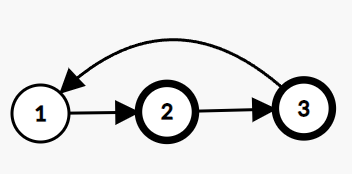
Problem approach
Firstly I gave the interviewer a hashing solution but that was taking extra space so the interviewer asked me to reduce its time complexity thereafter I gave him the Floyd algorithm approach using two pointers that are fast and slow.
2. Merge Sort Linked List
Moderate
10m average time
90% success
0/80
Asked in companies



You are given a Singly Linked List of integers. Sort the Linked List using merge sort.
Merge Sort is a Divide and Conquer algorithm. It divides the input into two halves, calls itself for the two halves, and then merges the two sorted halves. The merge() function is used for merging two halves. The merge(arr, L, M, R) is a key process that assumes that arr[L..M] and arr[M + 1...R] are sorted and merges the two sorted subarrays into one.
Problem approach
It was a simple one, I first explained to him the approach of merge sort using recursion and then wrote him a proper neat and clean code on paper.


Here's your problem of the day 
Solving this problem will increase your chance to get selected in this company
Skill covered: Programming
How do you remove whitespace from the start of a string?
Choose another skill to practice
Similar interview experiences
SDE - 1
3 rounds | 8 problems
Interviewed by Ion Trading
 Selected
1577 views

0 comments

0 upvotes
SDE - 1
4 rounds | 6 problems
Interviewed by Ion Trading
 Selected
 1630 views
0 comments
0 upvotes
SDE - 1
3 rounds | 6 problems
Interviewed by Ion Trading
Rejected
1069 views
0 comments
0 upvotes
SDE - 1
6 rounds | 7 problems
Interviewed by Ion Trading
Selected 2268 views
0 comments
0 upvotes
Companies with similar interview experiences

SDE - Intern
2 rounds | 4 problems
Interviewed by Arcesium
 Selected
 3915 views
0 comments
0 upvotes
SDE - Intern
3 rounds | 5 problems
Interviewed by Arcesium
Selected 2888 views
0 comments
0 upvotes

SDE - Intern
3 rounds | 5 problems
Interviewed by BNY Mellon
 Selected
 2483 views
0 comments
0 upvotes