





ION interview experience Real time questions & tips from candidates to crack your interview

SDE - 1
ION


2 rounds | 4 Coding
problems

Rejected
Interview preparation journey

Preparation
Duration: 3 months
Topics: Data Structures, Algorithms, OOPs, DBMS, SQL, Web Development

Tip 1 : Do not rush into things. Learning takes time. Focus should be on the concepts and not just on leaving topics half-prepared. Devote 70% of both time and effort to DSA. I solved a total of around 500 questions on sites like GFG and Leetcode. Do not repeat similar questions just to increase the count of the number of questions
Tip 2 : Competitive Programming is a bonus and not a necessity, rather focus on core DSA based problems before trying CP. Do not pursue CP if you do not like it. Devote that extra time to core CS subjects and aptitude preparation.
Tip 3 : Projects play an important role too, do no ignore them. Try to get your hands dirty with a little bit of every field i.e., frontend, backend, and database.
Application process
Where: Campus
Eligibility: Above 7 CGPA
Tip 1 : Try to make a single-page resume. Highlight skills, projects, and work experience more than CGPA. Ensure proper spacing and font to maintain professionalism.
Tip 2 : Does not lie on a resume. Everything written on your resume must be known by you in and out

Interview rounds
01
Round
Easy
Face to Face
Duration45 minutes
Interview date13 Jan 2021
Coding problem2
1. Reverse Linked List
Moderate
15m average time
85% success

0/80
Asked in companies



Given a singly linked list of integers. Your task is to return the head of the reversed linked list.
For example:
The given linked list is 1 -> 2 -> 3 -> 4-> NULL. Then the reverse linked list is 4 -> 3 -> 2 -> 1 -> NULL and the head of the reversed linked list will be 4.
Follow Up :
Can you solve this problem in O(N) time and O(1) space complexity?
Problem approach
You are given a Singly Linked List of integers. You need to reverse the Linked List by changing the links between nodes.
2. Puzzle Question
There are 100 light bulbs lined up in a row in a long room. Each bulb has its own switch and is currently switched off. The room has an entry door and an exit door. There are 100 people lined up outside the entry door. Each bulb is numbered consecutively from 1 to 100. So is each person.
Problem approach
We notice that for a perfect square (like 9), the number of factors are always odd, for example:
Number of factors of (16) = # [1,2,4,8,16] = 5
Note that for non-square numbers, factors are even.
As a factor toggles the state of a bulb, bulb number 9 will be toggled by 1,3 & 9. Thus bulb number 9 will switch ON, OFF, ON respectively. Note that odd number of factors cause bulb 9 to be ON at the end.
We note that for odd number of factors is the cause of bulb staying on at the end. Similarly every squared digit bulb will be switched on, and rest will remain off after all factors toggle. Thus the bulbs 1,4,9....81,100 are ON, at the end. Hence 10 bulbs are on.
02
Round
Easy
Face to Face
Duration45 minutes
Interview date13 Jan 2021
Coding problem2
1. Level order traversal of Binary Tree
Easy
15m average time
85% success
0/40
Asked in companies



You have been given a Binary Tree of integers. You are supposed to return the level order traversal of the given tree.
For example:
For the given binary tree
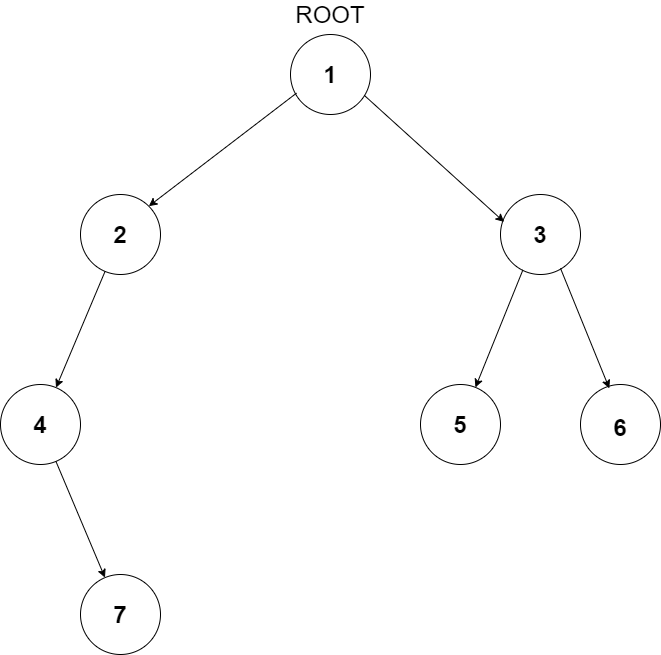
The level order traversal will be {1,2,3,4,5,6,7}.
Problem approach
You have been given a Binary Tree of integers. You are supposed to return the level order traversal of the given tree.
2. Operating System Question
Difference between Mutex and Semaphore
Problem approach
Mutex uses a locking mechanism i.e. if a process wants to use a resource then it locks the resource, uses it and then release it. But on the other hand, semaphore uses a signaling mechanism where wait() and signal() methods are used to show if a process is releasing a resource or taking a resource.
A mutex is an object but semaphore is an integer variable.
In semaphore, we have wait() and signal() functions. But in mutex, there is no such function.
A mutex object allows multiple process threads to access a single shared resource but only one at a time. On the other hand, semaphore allows multiple process threads to access the finite instance of the resource until available.
In mutex, the lock can be acquired and released by the same process at a time. But the value of the semaphore variable can be modified by any process that needs some resource but only one process can change the value at a time.


Here's your problem of the day 
Solving this problem will increase your chance to get selected in this company
Skill covered: Programming
How do you remove whitespace from the start of a string?
Choose another skill to practice
Similar interview experiences
SDE - 1
6 rounds | 3 problems
Interviewed by ION
 Selected
1682 views

0 comments

0 upvotes
SDE - 1
1 rounds | 3 problems
Interviewed by ION
Rejected
1357 views
0 comments
0 upvotes
SDE - 1
2 rounds | 4 problems
Interviewed by ION
Rejected
884 views
0 comments
0 upvotes
SDE - 1
2 rounds | 4 problems
Interviewed by ION
Rejected
1626 views
0 comments
0 upvotes
Companies with similar interview experiences

SDE - 1
5 rounds | 12 problems
Interviewed by Amazon
 Selected
 117552 views
24 comments
0 upvotes

SDE - 1
4 rounds | 5 problems
Interviewed by Microsoft
Selected 60143 views
5 comments
0 upvotes
SDE - 1
3 rounds | 7 problems
Interviewed by Amazon
 Selected
 36138 views
7 comments
0 upvotes