





Ittiam interview experience Real time questions & tips from candidates to crack your interview
SDE - 1
Ittiam


3 rounds | 5 Coding
problems

 Selected
 Interview preparation journey

Preparation
Duration: 13 months
Topics: Data Structures, OOPs, Operating systems, Computer network, DBMS

Tip 1 : Invest more time on DSA, follow love babbar sheet it would help a lot
Tip 2 : Have a rock solid resume, gives you control over the interview
Tip 3 : Work on your communication skills so you are able to convey your thoughts to interviewer conveniently
Application process
Where: Campus
Eligibility: >8 SGPA
Tip 1 : Have an internship, gives you the edge
Tip 2 : Try to have a project using some latest technology or something related to development or open source

Interview rounds
01
Round
Medium
Online Coding Interview
Duration30 minutes
Interview date10 Aug 2022
Coding problem1
1. Next Greater Element
Moderate
20m average time
90% success

0/80
Asked in companies



You are given an array arr of length N. You have to return a list of integers containing the NGE(next greater element) of each element of the given array. The NGE for an element X is the first greater element on the right side of X in the array. Elements for which no greater element exists, consider the NGE as -1.
For Example :
If the given array is [1, 3, 2], then you need to return [3, -1, -1]. Because for 1, 3 is the next greater element, for 3 it does not have any greater number to its right, and similarly for 2.
02
Round
Medium
Face to Face
Duration25 minutes
Interview date11 Aug 2022
Coding problem3
1. Dijkstra's shortest path
Easy
20m average time
70% success
0/40
Asked in companies



You have been given an undirected, connected graph of ‘V’ vertices (labelled from 0 to V-1) and ‘E’ edges. Each edge connecting two nodes 'u' and 'v' has a weight denoting the distance between them.
Your task is to find the shortest path distance from the source node 'S' to all the vertices. You have to return a list of integers denoting the shortest distance between each vertex and source vertex 'S'.
Note:
1. There are no self-loops(an edge connecting the vertex to itself) in the given graph.

2. There are no parallel edges i.e no two vertices are directly connected by more than 1 edge.
For Example:
Input:
4 5
0 1 5
0 2 8
1 2 9
1 3 2
2 3 6
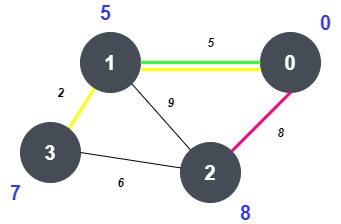
The source node is node 0.

The shortest distance from node 0 to node 0 is 0.

The shortest distance from node 0 to node 1 is 5. In the above figure, the green path represents this distance. The path goes from node 0->1, giving distance = 5.

The shortest distance from node 0 to node 2 is 8. In the above figure, the pink path represents this distance. The path goes from node 0->2, giving distance = 8.

The shortest distance from node 0 to node 3 is 7. In the above figure, the yellow path represents this distance. The path goes from node 0->1->3, giving distance = 7.
Problem approach
step 1: I explained the algorithm taking a sample graph
step 2: Explained what data structure is required and what would be the complexity
step3: Wrote the code for the same.
2. Operating System based Questions
What are semaphores?
Implement binary mutex?
what is race condition?
3. Implement a priority queue
Moderate
0/80
Asked in companies



You have to implement the pop function of Max Priority Queue and implement using a heap.
Functions :
a) push(int x) : 'x' has to be inserted in the priority queue. This has been implemented already

b) pop() : return the maximum element in the priority queue, if priority queue is empty then return '-1'.
Example:
We perform the following operations on an empty priority queue:

When operation push(5) is performed, we insert 1 in the priority queue.

When operation push(2) is performed, we insert 2 in the priority queue.

When operation pop() is performed, we remove the maximum element from the priority queue and print which is 5.

When operation push(3) is performed, we insert 1 in the priority queue.

When operation pop() is performed, we remove the maximum element from the priority queue and print which is 3.
Problem approach
step 1: I explained the algorithm taking a sample array
step 2: Explained min & max heap
step 3: Explained what data structure is required and what would be the complexity
step 4: Wrote the code for the same.
03
Round
Medium
HR Round
Duration50 minutes
Interview date11 Aug 2022
Coding problem1
1. Basic HR Questions
How do you describe yourself?
Name some qualities that defines you?
Why do you want join our company?


Here's your problem of the day 
Solving this problem will increase your chance to get selected in this company
Skill covered: Programming
How do you remove whitespace from the start of a string?
Choose another skill to practice
Similar interview experiences
SDE - 1
3 rounds | 7 problems
Interviewed by OYO
 Selected
6182 views

0 comments

0 upvotes
SDE - Intern
2 rounds | 3 problems
Interviewed by Amazon
Rejected
1566 views
0 comments
0 upvotes

SDE - 1
2 rounds | 5 problems
Interviewed by Meesho
Rejected
7246 views
0 comments
0 upvotes

SDE - 1
3 rounds | 9 problems
Interviewed by Salesforce
 Selected
 4552 views
0 comments
0 upvotes
Companies with similar interview experiences
SDE - 1
5 rounds | 12 problems
Interviewed by Amazon
 Selected
 117552 views
24 comments
0 upvotes

SDE - 1
4 rounds | 5 problems
Interviewed by Microsoft
Selected 60143 views
5 comments
0 upvotes
SDE - 1
3 rounds | 7 problems
Interviewed by Amazon
 Selected
 36138 views
7 comments
0 upvotes