





Josh Technology Group interview experience Real time questions & tips from candidates to crack your interview

SDE - 1
Josh Technology Group


6 rounds | 12 Coding
problems

Rejected
Interview preparation journey

Preparation
Duration: 6 months
Topics: Data Structures, algorithms, OS, DBMS, OOPS.

Tip 1 : Before interview, practice questions with company tag on websites and see previous experiences.
Tip 2 : Even if you're able to solve the question, see approaches used by other people and try to solve the question in multiple ways.
Application process
Where: Campus
Eligibility: No criteria
Tip 1 : Put links of your work like competitive coding profiles, hosted projects, etc.
Tip 2 : Revise everything on your resume before interview.

Interview rounds
01
Round
Easy
Online Coding Test
Duration50 minutes
Interview date6 Sep 2021
Coding problem2
1. Add Two Numbers As Linked Lists
Moderate
20m average time
80% success

0/80
Asked in companies



You are given two non-negative numbers 'num1' and 'num2' represented in the form of linked lists.
The digits in the linked lists are stored in reverse order, i.e. starting from least significant digit (LSD) to the most significant digit (MSD), and each of their nodes contains a single digit.
Calculate the sum of the two numbers and return the head of the sum list.
Example :
Input:
'num1' : 1 -> 2 -> 3 -> NULL
'num2' : 4 -> 5 -> 6 -> NULL

Output: 5 -> 7 -> 9 -> NULL

Explanation: 'num1' represents the number 321 and 'num2' represents 654. Their sum is 975.
Problem approach
using 2 pointers.
1. loop both lists till both dont reach null
2. loop first list till it doesnt reach null
3. loop second list till it doesnt reach null
2. Kth Smallest Element
Moderate
0/80
Asked in companies



You are given a square matrix ‘NxN’ rows and columns. The matrix is sorted, meaning all rows and columns of the matrix are sorted in ascending order. You are also given an integer ‘K’, and your task is to find the ‘K’th smallest element in the sorted order.
For example:
You are given ‘mat’ = [[1, 2, 2,], [3, 3, 4], [5, 6 ,7]]] and ‘K’ = 5, the elements of the matrix are [1, 2, 2, 3, 3, 4, 5, 6, 7], the 5th smallest element in the matrix is 3. Hence the answer is 3.
Problem approach
using heap of size k
02
Round
Easy
Online Coding Test
Duration75 minutes
Interview date6 Sep 2021
Coding problem2
1. Detect And Remove Cycle
Easy
10m average time
90% success
0/40
Asked in companies


You have been given a Singly Linked List of integers, determine if it forms a cycle or not. If there is a cycle, remove the cycle and return the list.
A cycle occurs when a node's ‘next’ points back to a previous node in the list.
Problem approach
uusing the 2 pointer approach
2. Sum Root to Leaf
Easy
10m average time
90% success
0/40
Asked in companies



You are given an arbitrary binary tree consisting of N nodes where each node is associated with a certain integer value from 1 to 9. Consider each root to leaf path as a number.
For example:
       1
      /  \
     2    3

The root to leaf path 1->2 represents the number 12.
The root to leaf path 1->3 represents the number 13.
Your task is to find the total sum of all the possible root to leaf paths.
In the above example,
The total sum of all the possible root to leaf paths is 12+13 = 25
Note:
The output may be very large, return the answer after taking modulus with (10^9+7).
03
Round
Easy
Online Coding Test
Duration75 minutes
Interview date6 Sep 2021
Coding problem2
1. Remove Duplicates From Sorted List
Easy
0/40
Asked in companies



A doubly-linked list is a data structure that consists of sequentially linked nodes, and the nodes have reference to both the previous and the next nodes in the sequence of nodes.
You are given a sorted doubly linked list of size 'n'.
Remove all the duplicate nodes present in the linked list.
Example :
Input: Linked List: 1 <-> 2 <-> 2 <-> 2 <-> 3

Output: Modified Linked List: 1 <-> 2 <-> 3

Explanation: We will delete the duplicate values ‘2’ present in the linked list.
Problem approach
Using pointers and while loop
2. Check If Linked List Is Palindrome
Easy
15m average time
85% success
0/40
Asked in companies


You are given a Singly Linked List of integers. You have to return true if the linked list is palindrome, else return false.
A Linked List is a palindrome if it reads the same from left to right and from right to left.
Example:
The lists (1 -> 2 -> 1), (3 -> 4 -> 4-> 3), and (1) are palindromes, while the lists (1 -> 2 -> 3) and (3 -> 4) are not.
Problem approach
reversed the list and compared to original
04
Round
Hard
Video Call
Duration70 minutes
Interview date11 Sep 2021
Coding problem3
1. Point to Greatest Value Node
Easy
10m average time
90% success
0/40
Asked in companies
You are given a singly linked list with every node having an additional “arbitrary” pointer that currently points to NULL. We need to make the “arbitrary” pointer to the greatest value node in a linked list on its right side.
More formally, each Linked List node has three attributes ‘data’, which is the value of the node, the ‘next’ pointer, which points to the next node, and an ‘arbit’ pointer which is initially NULL.
Note:
You need to return the head after populating the ‘arbit’ pointer.
For example:
Given ‘head’ as 3 -> 5 -> 2 -> 1.
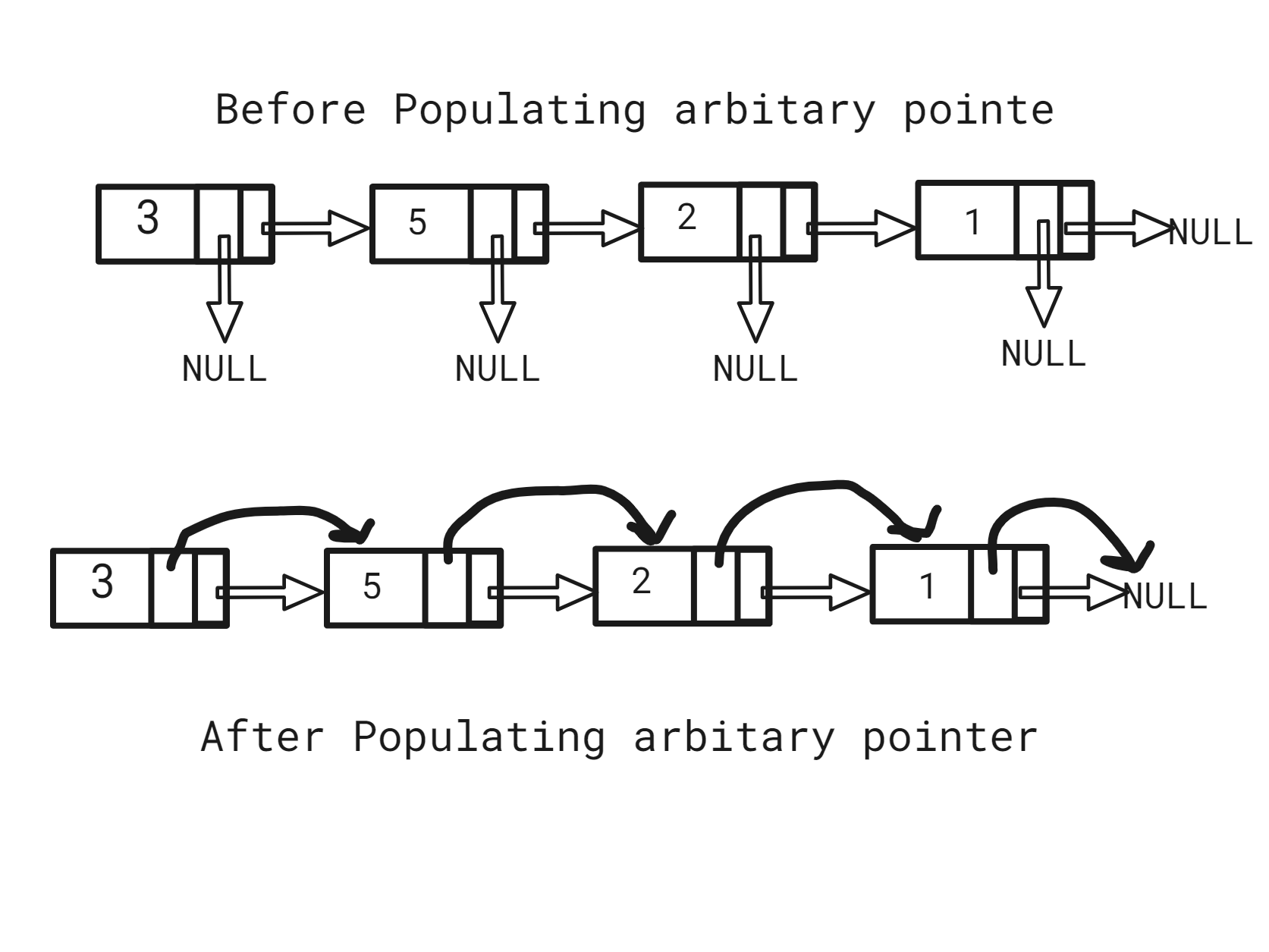
After populating the arbitrary pointer, each node's ‘arbit’ pointer would point to 5 2 1 -1 respectively.
2. Maximum Sum Of Nodes
Moderate
30m average time
70% success
0/80
Asked in companies

You have been given a binary tree with an integer value associated to each node. You are supposed to choose a subset of these nodes such that the sum of these chosen nodes is maximum. Keep in mind that no two of the chosen nodes must be adjacent to each other.
Note :
Two nodes are said to be adjacent to each other if they are directly connected to each other. This means that if a node is taken as part of the sum, then none of its children can be considered for the same and vice versa.
For example :
For the given binary tree
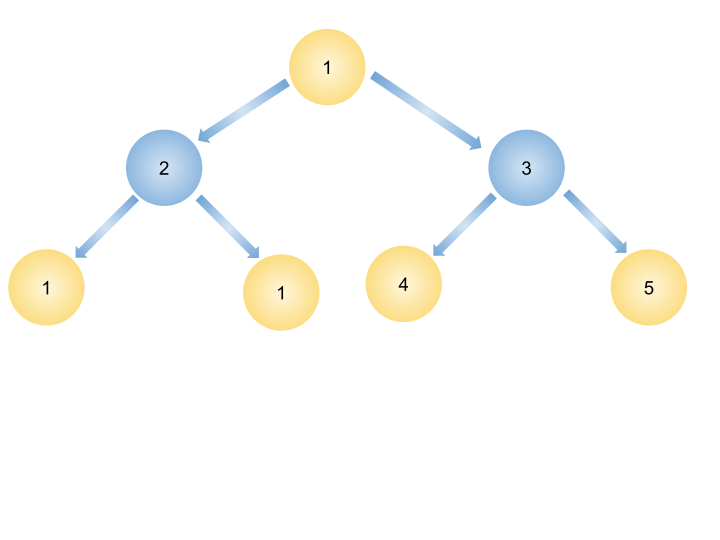
Nodes used in consideration for maximum sum such that no two of them are adjacent are highlighted. Maximum sum of nodes = 1 + 1 + 1 + 4 + 5 = 12.
3. Children Sum Property
Moderate
36m average time
70% success
0/80
Asked in companies


Given a binary tree of nodes 'N', you need to modify the value of its nodes, such that the tree holds the Children sum property.
A binary tree is said to follow the children sum property if, for every node of that tree, the value of that node is equal to the sum of the value(s) of all of its children nodes( left child and the right child).
Note :
 1. You can only increment the value of the nodes, in other words, the modified value must be at least equal to the original value of that node.
 2. You can not change the structure of the original binary tree.
 3. A binary tree is a tree in which each node has at most two children.
 4. You can assume the value can be 0 for a NULL node and there can also be an empty tree.
Problem approach
recursion
05
Round
Hard
Video Call
Duration50 minutes
Interview date11 Sep 2021
Coding problem2
1. Binary Tree Pruning
Moderate
20m average time
80% success
0/80
Asked in companies


You have been given a Binary Tree where the value of each node is either 0 or 1. Your task is to return the same Binary Tree but all of its subtrees that don't contain a 1 have been removed.
Note :
A subtree of a node X is X, plus every node that is a descendant of X.
For Example :
Look at the below example to see a Binary Tree pruning.
Input: [1, 1, 1, 0, 1, 0, 1, 0, 0, -1, -1, -1, -1, -1, -1, -1, -1, -1, -1]
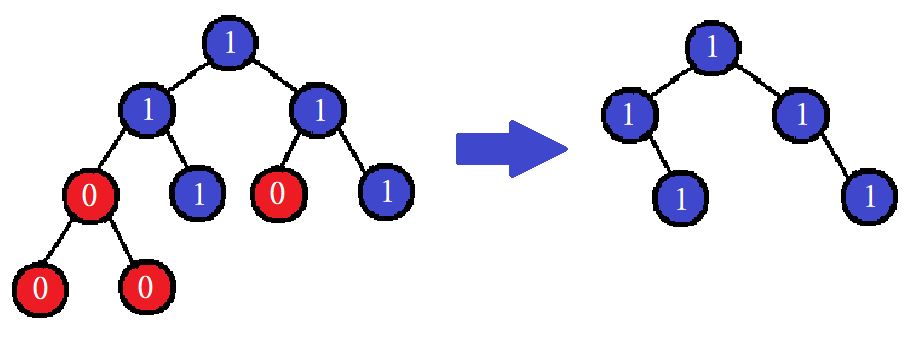
Output: [1, 1, 1, -1, 1, -1, 1, -1, -1, -1, -1]

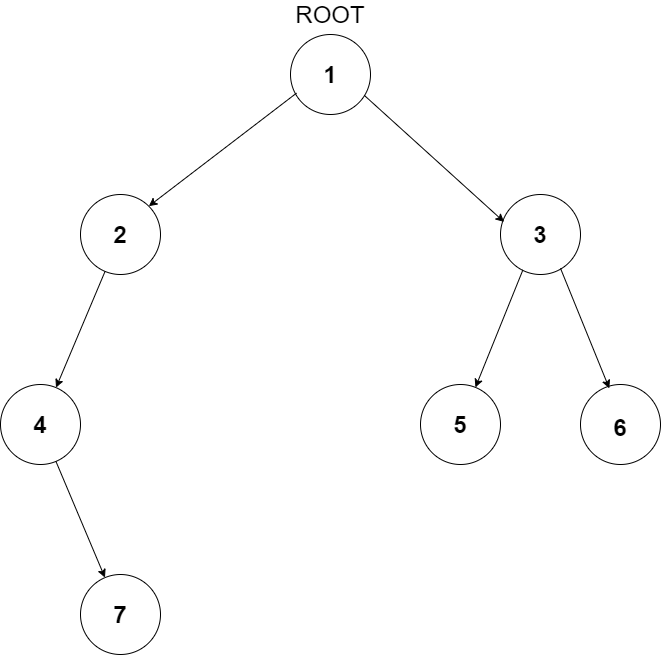
For example, the input for the tree depicted in the below image would be :
1
2 3
4 -1 5 6
-1 7 -1 -1 -1 -1
-1 -1
Explanation :
Level 1 :
The root node of the tree is 1

Level 2 :
Left child of 1 = 2
Right child of 1 = 3

Level 3 :
Left child of 2 = 4
Right child of 2 = null (-1)
Left child of 3 = 5
Right child of 3 = 6

Level 4 :
Left child of 4 = null (-1)
Right child of 4 = 7
Left child of 5 = null (-1)
Right child of 5 = null (-1)
Left child of 6 = null (-1)
Right child of 6 = null (-1)

Level 5 :
Left child of 7 = null (-1)
Right child of 7 = null (-1)

The first not-null node (of the previous level) is treated as the parent of the first two nodes of the current level. The second not-null node (of the previous level) is treated as the parent node for the next two nodes of the current level and so on.
The input ends when all nodes at the last level are null (-1).
Note :
The above format was just to provide clarity on how the input is formed for a given tree.

The sequence will be put together in a single line separated by a single space. Hence, for the above-depicted tree, the input will be given as:
1 2 3 4 -1 5 6 -1 7 -1 -1 -1 -1 -1 -1
2. Water
Easy
15m average time
85% success
0/40
Asked in companies
You are given an array 'ARR' of positive integers, each of which represents the number of liters of water in that particular bucket, we have to make the liters of water in every bucket equal.
We are allowed to do two types of operations any number of times:
1. We can altogether remove a bucket from the sequence
2. We can draw some water from a bucket
We have to tell the minimum number of liters removed to make all buckets have the same amount of water.
For example:
Given ‘N’ = 4 and ‘ARR’ = [1, 1, 2, 2].
The answer will be 2, i.e., if we chose that all buckets should have 1 unit of water, we will have to throw 1 unit of water from buckets 3 and 4. Hence 2.
Problem approach
applied binary search on x
06
Round
Hard
Video Call
Duration150 minutes
Interview date11 Sep 2021
Coding problem1
1. Subset Sum
Easy
0/40
Asked in companies

You are given an array 'nums' of ‘n’ integers.
Return all subset sums of 'nums' in a non-decreasing order.
Note:
Here subset sum means sum of all elements of a subset of 'nums'. A subset of 'nums' is an array formed by removing some (possibly zero or all) elements of 'nums'.
For example
Input: 'nums' = [1,2]

Output: 0 1 2 3

Explanation:
Following are the subset sums:
0 (by considering empty subset)
1
2
1+2 = 3
So, subset sum are [0,1,2,3].


Here's your problem of the day 
Solving this problem will increase your chance to get selected in this company
Skill covered: Programming
How do you remove whitespace from the start of a string?
Choose another skill to practice
Similar interview experiences
SDE - 1
3 rounds | 6 problems
Interviewed by Josh Technology Group
Rejected

1521 views

0 comments

0 upvotes
SDE - 1
3 rounds | 6 problems
Interviewed by Josh Technology Group
Rejected
1027 views
0 comments
0 upvotes
SDE - 1
3 rounds | 3 problems
Interviewed by Josh Technology Group
 Selected
 1486 views
0 comments
0 upvotes
SDE - 1
4 rounds | 7 problems
Interviewed by Josh Technology Group
Rejected
1160 views
0 comments
0 upvotes
Companies with similar interview experiences

SDE - 1
2 rounds | 3 problems
Interviewed by BNY Mellon
 Selected
 6365 views
3 comments
0 upvotes
SDE - 1
3 rounds | 6 problems
Interviewed by BNY Mellon
 Selected
 0 views
0 comments
0 upvotes

SDE - 1
3 rounds | 5 problems
Interviewed by CIS - Cyber Infrastructure
Selected 2197 views
0 comments
0 upvotes