





Josh Technology Group interview experience Real time questions & tips from candidates to crack your interview

SDE - 1
Josh Technology Group


2 rounds | 4 Coding
problems

Rejected
Interview preparation journey

Preparation
Duration: 8 months
Topics: DSA , OOPS , OS, CN, Algorithms, DBMS , Dynamic Programming , Graphs

Tip 1 : Do DSA
Tip 2 : Do Extra Subjects
Tip 3 : Prepare some Projects
Application process
Where: Campus
Eligibility: 7 CGPA
Tip 1 : Do Mention coding profiles in resume
Tip 2 : Do add summary of Projects

Interview rounds
01
Round
Hard
Online Coding Test
Duration60 minutes
Interview date6 Sep 2021
Coding problem2
2 Coding questions
1. Subtract two numbers given in form of linkedlist
2. LCA application
1. Add Two Numbers As Linked Lists ll
Moderate
10m average time
80% success

0/80
Asked in companies



You have been given two singly Linked Lists, where each of them represents a positive number without any leading zeros.
Your task is to add these two numbers and print the summation in the form of a linked list.
Example:
If the first linked list is 1 -> 2 -> 3 -> 4 -> 5 -> NULL and the second linked list is 4 -> 5 -> NULL.

The two numbers represented by these two lists are 12345 and 45, respectively. So, adding these two numbers gives 12390.

So, the linked list representation of this number is 1 -> 2 -> 3 -> 9 -> 0 -> NULL.
Problem approach
Calculate sizes of given two linked lists.
If sizes are not the same, then append zeros in the smaller linked list.
If the size is the same, then follow the below steps:
Find the smaller valued linked list.
One by one subtract nodes of the smaller-sized linked list from the larger size. Keep track of borrow while subtracting.
2. Lowest Common Ancestor of a Binary Tree III
Moderate
25m average time
75% success
0/80
Asked in companies



The node structure of a binary tree is modified such that each node has the reference to its parent node.
You are given two nodes: ‘N1’ and ‘N2’, of the above binary tree. Your task is to return the lowest common ancestor (LCA) of the given nodes.
Note:
Let ‘TREE’ be a binary tree. The lowest common ancestor of two nodes, ‘N1’ and ‘N2’, is defined as the lowest node in ‘TREE’ with ‘N1’ and ‘N2’ as descendants (where we allow a node to be a descendant of itself).
Problem approach
Find a path from the root to n1 and store it in a vector or array.
Find a path from the root to n2 and store it in another vector or array.
Traverse both paths till the values in arrays are the same. Return the common element just before the mismatch.
02
Round
Hard
Online Coding Test
Duration60 minutes
Interview date6 Sep 2021
Coding problem2
2 coding questions
1. Backtracking(Similar to rat in a maze)
2. graph(Application of Dijkstra
1. Rat In A Maze
Easy
15m average time
85% success
0/40
Asked in companies



You are given a starting position for a rat which is stuck in a maze at an initial point (0, 0) (the maze can be thought of as a 2-dimensional plane). The maze would be given in the form of a square matrix of order 'N' * 'N' where the cells with value 0 represent the maze’s blocked locations while value 1 is the open/available path that the rat can take to reach its destination. The rat's destination is at ('N' - 1, 'N' - 1). Your task is to find all the possible paths that the rat can take to reach from source to destination in the maze. The possible directions that it can take to move in the maze are 'U'(up) i.e. (x, y - 1) , 'D'(down) i.e. (x, y + 1) , 'L' (left) i.e. (x - 1, y), 'R' (right) i.e. (x + 1, y).
Note:
Here, sorted paths mean that the expected output should be in alphabetical order.
For Example:
Given a square matrix of size 4*4 (i.e. here 'N' = 4):
1 0 0 0
1 1 0 0
1 1 0 0
0 1 1 1
Expected Output:
DDRDRR DRDDRR
i.e. Path-1: DDRDRR and Path-2: DRDDRR

The rat can reach the destination at (3, 3) from (0, 0) by two paths, i.e. DRDDRR and DDRDRR when printed in sorted order, we get DDRDRR DRDDRR.
Problem approach
1. Create a solution matrix, initially filled with 0’s.
2. Create a recursive function, which takes initial matrix, output matrix and position of rat (i, j).
if the position is out of the matrix or the position is not valid then return.
3. Mark the position output[i][j] as 1 and check if the current position is destination or not. If destination is reached print the output matrix and return.
4. Recursively call for position (i-1,j), (I,j-1), (i+1, j) and (i, j+1).
Unmark position (i, j), i.e output[i][j] = 0.
2. Dijkstra's shortest path
Moderate
25m average time
65% success
0/80
Asked in companies


You have been given an undirected graph of ‘V’ vertices (labeled 0,1,..., V-1) and ‘E’ edges. Each edge connecting two nodes (‘X’,’Y’) will have a weight denoting the distance between node ‘X’ and node ‘Y’.
Your task is to find the shortest path distance from the source node, which is the node labeled as 0, to all vertices given in the graph.
Example:
Input:
4 5
0 1 5
0 2 8
1 2 9
1 3 2
2 3 6
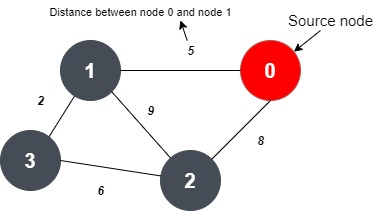
In the given input, the number of vertices is 4, and the number of edges is 5.

In the input, following the number of vertices and edges, three numbers are given. The first number denotes node ‘X’, the second number denotes node ‘Y’ and the third number denotes the distance between node ‘X’ and ‘Y’.

As per the input, there is an edge between node 0 and node 1 and the distance between them is 5.

The vertices 0 and 2 have an edge between them and the distance between them is 8.
The vertices 1 and 2 have an edge between them and the distance between them is 9.
The vertices 1 and 3 have an edge between them and the distance between them is 2.
The vertices 2 and 3 have an edge between them and the distance between them is 6.
Note:
1. There are no self-loops(an edge connecting the vertex to itself) in the given graph.

2. There can be parallel edges i.e. two vertices can be directly connected by more than 1 edge.
Problem approach
1) Create a set sptSet (shortest path tree set) that keeps track of vertices included in the shortest-path tree, i.e., whose minimum distance from the source is calculated and finalized. Initially, this set is empty.
2) Assign a distance value to all vertices in the input graph. Initialize all distance values as INFINITE. Assign distance value as 0 for the source vertex so that it is picked first.
3) While sptSet doesn’t include all vertices
….a) Pick a vertex u which is not there in sptSet and has a minimum distance value.
….b) Include u to sptSet.
….c) Update distance value of all adjacent vertices of u. To update the distance values, iterate through all adjacent vertices. For every adjacent vertex v, if the sum of distance value of u (from source) and weight of edge u-v, is less than the distance value of v, then update the distance value of v.


Here's your problem of the day 
Solving this problem will increase your chance to get selected in this company
Skill covered: Programming
How do you remove whitespace from the start of a string?
Choose another skill to practice
Similar interview experiences
SDE - 1
3 rounds | 6 problems
Interviewed by Josh Technology Group
Rejected

1522 views

0 comments

0 upvotes
SDE - 1
3 rounds | 6 problems
Interviewed by Josh Technology Group
Rejected
1027 views
0 comments
0 upvotes
SDE - 1
3 rounds | 3 problems
Interviewed by Josh Technology Group
 Selected
 1486 views
0 comments
0 upvotes
SDE - 1
4 rounds | 7 problems
Interviewed by Josh Technology Group
Rejected
1160 views
0 comments
0 upvotes
Companies with similar interview experiences

SDE - 1
2 rounds | 3 problems
Interviewed by BNY Mellon
 Selected
 6365 views
3 comments
0 upvotes
SDE - 1
3 rounds | 6 problems
Interviewed by BNY Mellon
 Selected
 0 views
0 comments
0 upvotes

SDE - 1
3 rounds | 5 problems
Interviewed by CIS - Cyber Infrastructure
Selected 2198 views
0 comments
0 upvotes