





Josh Technology Group interview experience Real time questions & tips from candidates to crack your interview

Software Engineer
Josh Technology Group


4 rounds | 4 Coding
problems

 Selected
 Interview preparation journey

Preparation
Duration: 3 Months
Topics: DSA, CS FUNDAMENTALS, WEB CONCEPTS, OOPS

Tip 1 : Take your time before directly jumping onto the solution even if you have done the code already, it might be possible that interviewer would add any constraints of his own choice.
Tip 2 : Speak out loud, that's very important. If you are stuck onto something in between the interview, don't just sit idle or give up. Talk to your interviewer, let him/her know what's going in your mind, what approach are you trying to implement. The interviewer is your only friend in that room.
Tip 3 : Don't worry if you haven't been into Competitive Programming before, you can still crack a lot of companies with decent DSA skills, projects are add on.
Tip 4 : For preparation, go through coding ninja's course thoroughly. It's very likely to encounter same questions that are already in the course itself. Common problems like, stock span, balanced parentheses, edit distance-DP, etc.
Application process
Where: Campus
Eligibility: above 7 cgpa
Tip 1 : Take a nice template for resume, you can even refer sites like novoresume.com. It has got good templates, just pick any with no fancy fonts and colors. Keep it simple.
Tip 2 : Be very specific. Write out important stuff only if you applying for a tech job. No one's going to see your dance/acting skills while interviewing you.

Interview rounds
01
Round
Medium
Online Coding Interview
Duration45 minutes
Interview date1 Jul 2021
Coding problem0
There were around 50 mcq's on C/C++ concepts.
There was no negative marking though.
02
Round
Easy
Video Call
Duration50 Minutes
Interview date3 Jul 2021
Coding problem1
It was Online Videocall technical round where i was asked 2 coding questions.
It lasted for 40-50 minutes.
1. Kth ancestor of a node in binary tree
Hard
50m average time
35% success

0/120
Asked in companies


You are given an arbitrary binary tree consisting of N nodes numbered from 1 to N, an integer 'K', and a node 'TARGET_NODE_VAL' from the tree. You need to find the Kth ancestor of the node 'TARGET_NODE_VAL'. If there is no such ancestor, then print -1.
The Kth ancestor of a node in a binary tree is the Kth node in the path going up from the given node to the root of the tree. Refer to sample test cases for further explanation.
Note:
1. The given node 'TARGET_NODE_VAL' is always present in the tree.
2. The value of each node in the tree is unique.
3. Notice that the Kth ancestor node if present will always be unique.
Problem approach
Step 1: Find the given node in the tree.
Step 2: If node not found then simply return null, else check if K is greater than 0, if yes that means we haven't found the Kth ancestor, so we decrement the value of K.
03
Round
Medium
Video Call
Duration40 Minutes
Interview date5 Jul 2021
Coding problem2
Only 7 students were shortlisted after the first face to face round out of 40 students.
The interviewer seemed cool and was trying to calm down me as i was getting nervous.
Again there were 2 coding questions.
1. Reverse Linked List
Moderate
15m average time
85% success
0/80
Asked in companies

Given a singly linked list of integers. Your task is to return the head of the reversed linked list.
For example:
The given linked list is 1 -> 2 -> 3 -> 4-> NULL. Then the reverse linked list is 4 -> 3 -> 2 -> 1 -> NULL and the head of the reversed linked list will be 4.
Follow Up :
Can you solve this problem in O(N) time and O(1) space complexity?
2. Convert Bst To The Greater Sum Tree
Moderate
30m average time
70% success
0/80
Asked in companies



You have been given a Binary Search Tree of integers. You are supposed to convert it to a greater sum tree such that the value of every node in the given BST is replaced with the sum of the values of all the nodes which are greater than the value of the current node in the tree.
A Binary Search Tree is a tree, whose internal nodes each store a value greater than all the values in the node's left subtree and less than those in its right subtree.
Note :
You need to modify the given tree only. You are not allowed to create a new tree.
For example:
For the given binary search tree
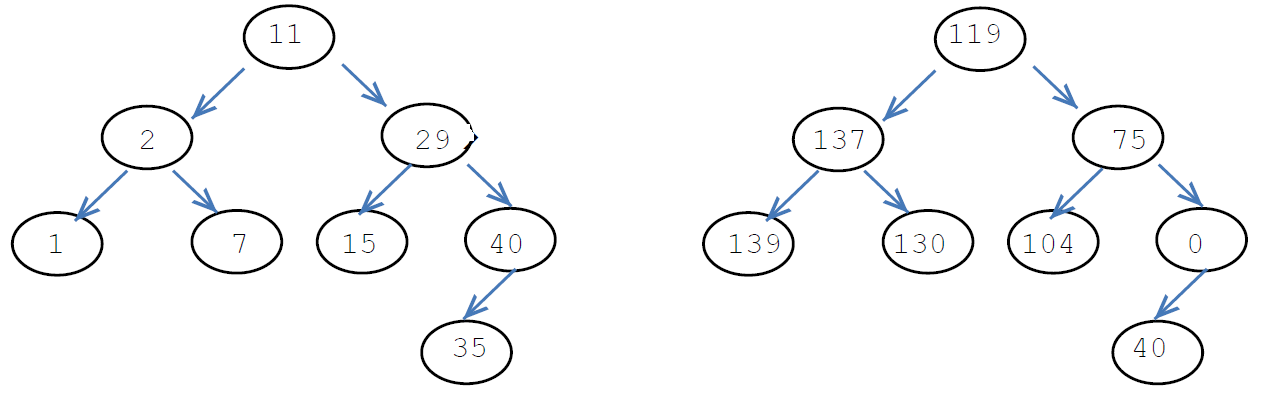
11 will be replaced by {15 + 29 + 35 + 40}, i.e. 119.
2 will be replaced by {7 + 11 + 15 + 29 + 35 + 40}, i.e. 137.
29 will be replaced by {35 + 40}, i.e. 75.
1 will be replaced by {2 + 7 + 11 + 15 + 29 + 35 + 40}, i.e. 139.
7 will be replaced by {11 + 15 + 29 + 35 + 40}, i.e. 130.
15 will be replaced by {15 + 29 + 35 + 40}, i.e. 104.
40 will be replaced by 0 {as there is no node with a value greater than 40}.
35 will be replaced by {40}, i.e. 40.
Problem approach
Step 1: I made a helper function where i passed the root node and 0 which worked as the sum in it.
Step 2: Made a base case, if root is null, return.
Step 3: Went to the rightmost node of the tree as the rightmost node is the only node which will have highest value in whole BST.
Step 4: Added the root's data to the sum variable which was passed in the helper function.
Step 5: After adding the root's sum with the sum variable, update the current root data with that sum.
04
Round
Easy
HR Round
Duration10 Minutes
Interview date8 Jul 2021
Coding problem1
It was Quite easy round and i cleared this round and got offered
1. Basic HR Questions
1. Your strengths and weaknesses
2. Where do you see yourself after 5 years?


Here's your problem of the day 
Solving this problem will increase your chance to get selected in this company
Skill covered: Programming
How do you remove whitespace from the start of a string?
Choose another skill to practice
Similar interview experiences
Software Engineer
3 rounds | 3 problems
Interviewed by Josh Technology Group
Rejected

2071 views

0 comments

0 upvotes
Software Engineer
3 rounds | 2 problems
Interviewed by Josh Technology Group
 Selected
 0 views
0 comments
0 upvotes
Associate Enginner
3 rounds | 5 problems
Interviewed by Josh Technology Group
Rejected
1004 views
0 comments
0 upvotes
SDE - 1
3 rounds | 3 problems
Interviewed by Josh Technology Group
Selected 1486 views
0 comments
0 upvotes
Companies with similar interview experiences

Software Engineer
4 rounds | 1 problems
Interviewed by Newgen Software
 Selected
 3266 views
2 comments
0 upvotes

Software Engineer
3 rounds | 6 problems
Interviewed by HashedIn
 Selected
 2643 views
0 comments
0 upvotes

Software Engineer
2 rounds | 2 problems
Interviewed by Ernst & Young (EY)
Selected 0 views
0 comments
0 upvotes