





Josh Technology Group interview experience Real time questions & tips from candidates to crack your interview

SDE - Intern
Josh Technology Group


6 rounds | 16 Coding
problems

 Selected
 Interview preparation journey

Preparation
Duration: 4 months
Topics: Data Structures, Trees, Linked List, arrays, computer Fundaments

Tip 1 : Practice at least 200 Questions(Mostly from trees and linked list)
Tip 2 : Try to dry run every problem you practice
Application process
Where: Campus
Eligibility: candidate should not have more than 5 active backlogs
Tip 1 : Do not puts false things on resume
Tip 2 : Its good to have some projects

Interview rounds
01
Round
Easy
Online Coding Interview
Duration50 minutes
Interview date16 Aug 2022
Coding problem1
1. MCQ Questions
This Round consists of 50 MCQs questions Out of Which 40 were related to basic programming questions and 10 were related to aptitude. some questions were output bases. Also, there was negative marking too.
Number Of MCQs - 50
02
Round
Medium
Online Coding Test
Duration75 minutes
Interview date16 Aug 2021
Coding problem2
This Round consists of 2 coding Questions.
1. Longest Substring Without Repeating Characters
Moderate
30m average time
65% success

0/80
Asked in companies



Given a string input of length n, find the length of the longest substring without repeating characters i.e return a substring that does not have any repeating characters.
Substring is the continuous sub-part of the string formed by removing zero or more characters from both ends.
Problem approach
I solved This problem using sliding Window Technique
2. Convert a binary tree to its sum tree
Easy
15m average time
85% success
0/40
Asked in companies



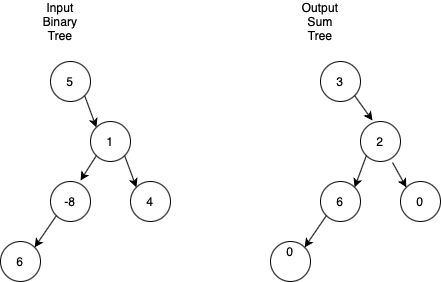
Given a binary tree of integers, you are supposed to modify the given binary tree to a sum tree where each node value is replaced by the sum of the values of both left and right subtrees in the given tree. The value of leaf nodes is changed to zero.
Example:
Below is the example showing the input tree and its sum tree.
Problem approach
I solved it using preorder traversal.
03
Round
Medium
Online Coding Test
Duration75 minutes
Interview date16 Aug 2022
Coding problem3
This Round consists of 3 Coding Problems of Medium Difficulty
1. Symmetric Tree
Easy
20m average time
82% success
0/40
Asked in companies



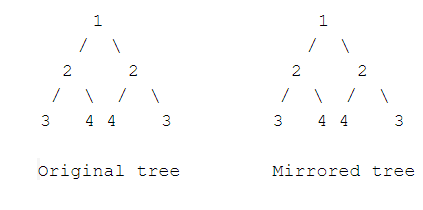
You are given a binary tree, where the data present in each node is an integer. You have to find whether the given tree is symmetric or not.
Symmetric tree is a binary tree, whose mirror image is exactly the same as the original tree.
For Example:
Problem approach
i solves it using recusion
2. Odd and even positioned linked list nodes
Easy
10m average time
90% success
0/40
Asked in companies



You are given a singly linked list ‘HEAD’ consisting of ‘N’ nodes. The task is to group all the odd nodes together, followed by the even nodes, maintaining the relative order of nodes given in the input. Note that we are talking about the node’s positions and not the value stored in the node. Try to write an in-place algorithm (i.e., without using any extra space) to solve this problem.
Example:
Given linked list: ‘2 => 1 => 3 => 4 => 6 => 5’

While maintaining the relative order of nodes as it is in the input, Nodes at odd positions are (2, 3, 6), and nodes at evens position are (1, 4, 5).

Modified linked list: ‘2 => 3 => 6 => 1 => 4 => 5’
Note:
1. Consider that the first node is odd, the second is even, and so on.
Problem approach
I solved it by finding integral square root of every Node.
3. Gas Stations
Moderate
10m average time
90% success
0/80
Asked in companies



You have been given a circular path. There are 'N' petrol pumps on this path that are numbered from 0 to N - 1 (Both inclusive). Each petrol pump has two values associated with it:
1)The amount of petrol that is available at this particular petrol pump.
2)The distance to reach the next petrol pump.
You are on a truck having an empty tank of infinite capacity. You can start the tour from any of the petrol pumps. Your task is to calculate the first petrol pump from where the truck will be able to complete the full circle or determine if it is impossible to do so.
You may assume that the truck will stop at every petrol pump and it will add the petrol from that pump to its tank. The truck will move one kilometre for each litre of petrol consumed.
Problem approach
I solved it using greedy algorithm
04
Round
Medium
Video Call
Duration90 minutes
Interview date27 Aug 2022
Coding problem3
This round started at 9 AM. The interviewer asked me about my introduction and about my projects. the interviewer was really polite.
1. Sort an array in wave form
Easy
10m average time
85% success
0/40
Asked in companies

You have been given an unsorted array ‘ARR’.
Your task is to sort the array in such a way that the array looks like a wave array.
Example:
If the given sequence ‘ARR’ has ‘N’ elements then the sorted wave array looks like -
‘ARR[0] >= ARR[1]’ and ‘ARR[1] <= ARR[2]’
‘ARR[2] >= ARR[3]’ and ‘ARR[3] <= ARR[4]’
‘ARR[4] >= ARR[5]’ and ‘ARR[5] <= ARR[6]’  And so on.
Note:
1. ‘ARR[0]’ must be greater than or equal to ‘ARR[1]’.

2. There can be multiple arrays that look like a wave array but you have to return only one.

3. We have an internal function that will check your solution and return 'True' in case your array is one of the solutions otherwise return 'False'.
Explanation
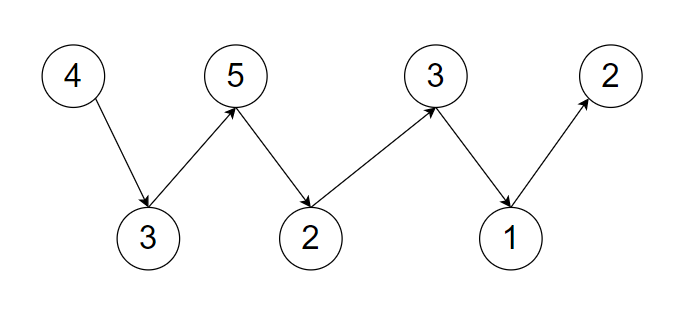
The given array ‘ ARR = { 4, 3, 5, 2, 3, 1, 2 } ’
The below figure is a visual representation of the given ‘ARR’ and you can see we can express ‘ARR’ in a waveform array because
4>3 and 3<5
5>2 and 2<3
3>1 and 1<2
And it follows the condition of wave array.
Follow up:
Try to solve this problem in linear time complexity.
Problem approach
if an even index node is less than previous node then it with previous node and if an odd index node is greater than previous node then swap it with previous node.
2. Maximum Sum BST
Hard
50m average time
55% success
0/120
Asked in companies

You are given a Binary Tree ‘root’. The given Binary Tree may or may not be a Binary Search Tree(BST) itself. Your task is to find the maximum sum of node values of any subtree that is a Binary Search Tree(BST).
Binary Search Tree is defined as follows:
1) If the left subtree exists it should contain only nodes with values less than the current node's value.

2) If the right subtree exists it should contain only nodes with values greater than the current node's value.

3) Both the left and right subtrees should also be Binary Search Tree.
Example :
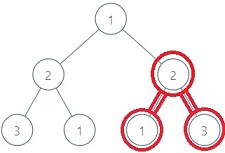
For the above binary tree, the BST with the maximum possible sum is marked with RED colour, the sum of this BST is equal to 6.
Problem approach
I solved it using post order traversal and making a class to return various answers such as curr_sum, maxSum, isBst etc
3. Remove BST keys outside the given range
Easy
15m average time
85% success
0/40
Asked in companies



Given a Binary Search Tree (BST) and a range [min, max], remove all keys which are outside the given range. The modified tree should also be BST.
Problem approach
if root node is less than low then return right subtree and if root node is greater than max then return left subtree
05
Round
Medium
Video Call
Duration120 minutes
Interview date29 Aug 2022
Coding problem2
This round started at 12 PM. The interviewer asked me about my introduction and about my projects. the interviewer was really polite.
1. Pair with Given Sum in a Balanced BST
Moderate
25m average time
65% success
0/80
Asked in companies



You are given the ‘root’ of a Balanced Binary Search Tree and an integer ‘target,’ you have to tell if there exists any pair of nodes such that the sum of their value is equal to the target.
More formally check if there exist any two distinct nodes, whose sum is equal to ‘target.’
Note:
A binary search tree, also called an ordered or sorted binary tree, is a rooted binary tree whose internal nodes each store a key greater than all the keys in the node's left subtree and less than those in its right subtree.

A balanced binary search tree is a tree in which each node has either 0 or 2 children.
Example:
For Example, the root node is given as follows :
‘ROOT’ = 5 2 6 -1 -1 -1 -1 and ‘target’ = 8, The answer will be true since the sum of both leaf nodes is equal to 8.
Problem approach
I first tried to convert the tree to Doubly Linked List but the interviewer asked me to do it without conversion. then create a function to traverse the tree in inorder and reverse inorder traversal and then the interviewer was satisfied with this approach.
2. Minimum Time To Solve The Problems
Hard
50m average time
50% success
0/120
Asked in companies



There are 'N' number of subjects and the ith subject contains subject[i] number of problems. Each problem takes 1 unit of time to be solved. Also, you have 'K' friends, and you want to assign the subjects to each friend such that each subject is assigned to exactly one friend. Also, the assignment of subjects should be contiguous. Your task is to calculate the maximum number of problems allocated to a friend is minimum. See example for more understanding.
For Example:
If N = 4, K = 2 and subjects = {50,100,300,400}
Assignment of problems can be done in the following ways among the two friends.
{} and {50,100,300,400}. Time required = max(0, 50+100+300+400) = max(0, 850) = 850
{50} and {100,300,400}. Time required = max(50, 100+300+400) = max(50, 800) = 800
{50, 100} and {300,400}. Time required = max(50+100, 300+400) = max(150, 700) = 700
{50,100,300} and {400}. Time required = max(50+100+300, 400) = max(450, 400) = 400
{50,100,300, 400} and {}. Time required = max(50+100+300+400, 0) = max(850, 0) = 850

So, out of all the above following ways, 400 is the lowest possible time.
Problem approach
I solved it using Binary Search.
06
Round
Easy
HR Round
Duration20 minutes
Interview date29 Aug 2022
Coding problem5
This round was a Discussion Round.
1. Basic HR Question
How was your Day?
2. Basic HR Question
Tell me about Yourself.
3. Basic HR Question
2 strengths and weaknesses.
4. Basic HR Question
How many members in your family?
5. Basic HR Question
Can you work form office?


Here's your problem of the day 
Solving this problem will increase your chance to get selected in this company
Skill covered: Programming
What does the SQL function NOW() return?
Choose another skill to practice
Similar interview experiences
SDE - Intern
6 rounds | 14 problems
Interviewed by Josh Technology Group
 Selected
5694 views

0 comments

0 upvotes
SDE - Intern
5 rounds | 6 problems
Interviewed by Josh Technology Group
Selected 3317 views
0 comments
0 upvotes
SDE - Intern
2 rounds | 4 problems
Interviewed by Josh Technology Group
Selected 1175 views
1 comments
0 upvotes
SDE - Intern
7 rounds | 7 problems
Interviewed by Josh Technology Group
Selected 1173 views
0 comments
0 upvotes
Companies with similar interview experiences

SDE - Intern
2 rounds | 4 problems
Interviewed by Arcesium
 Selected
 3786 views
0 comments
0 upvotes
SDE - Intern
3 rounds | 5 problems
Interviewed by Arcesium
Selected 2726 views
0 comments
0 upvotes

SDE - Intern
3 rounds | 5 problems
Interviewed by BNY Mellon
 Selected
 2375 views
0 comments
0 upvotes