





Josh Technology Group interview experience Real time questions & tips from candidates to crack your interview

Software Developer
Josh Technology Group


3 rounds | 5 Coding
problems

 Selected
 Interview preparation journey

Journey
In our college, there were few opportunities available, so my only choice was to either work hard for placements or prepare for M.tech. I was inclined towards getting a placement because I was strong in DSA. I practised extensively on various online platforms and performed well in both off-campus and on-campus interviews.
Application story
JTG visited our campus for hiring. I applied, received the test link, cleared the test, interviewed, and got the offer.
Why selected/rejected for the role?
I was selected. The interview was easy for me. Good knowledge of DSA, especially in trees and arrays, is required.
Preparation
Duration: 12 months
Topics: Data Structures, Algorithms, Database, System Design, Operating Systems

Tip 1: Practice data structure questions as much as possible. Be confident in explaining your solutions during interviews. For practice, consider using Coding Ninjas.
Tip 2: Research previously asked questions by the company.
Application process
Where: Campus
Eligibility: Above 7 CGPA
Tip 1: Keep it concise. Mention your academic and professional projects. Provide accurate educational details, including your percentage or CGPA obtained.
Tip 2: Include only the information you are confident about in your resume, and continue practising.

Interview rounds
01
Round
Easy
Video Call
Duration60 minutes
Interview date17 Jan 2022
Coding problem2
3 DSA questions were asked in this round.
1. Flatten Binary Tree to Linked List
Moderate
25m average time
70% success

0/80
Asked in companies



You are given a binary tree consisting of 'n' nodes.
Convert the given binary tree into a linked list where the linked list nodes follow the same order as the pre-order traversal of the given binary tree.
Use the right pointer of the binary tree as the “next” pointer for the linked list and set the left pointer to NULL.
Use these nodes only. Do not create extra nodes.
Example :
Input: Let the binary be as shown in the figure:
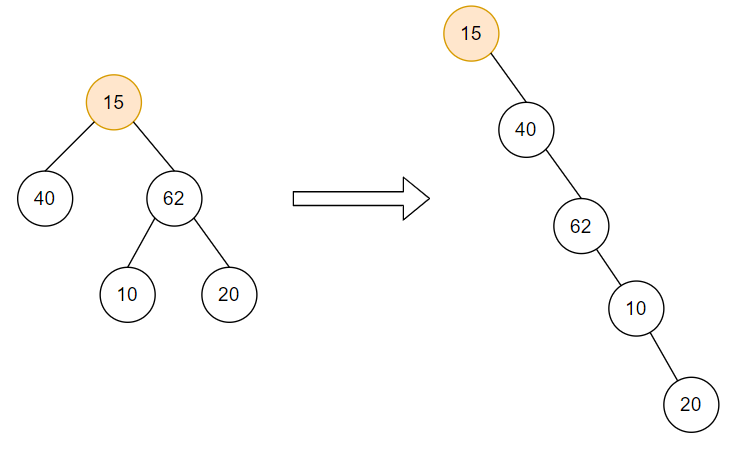
Output: Linked List: 15 -> 40 -> 62 -> 10 -> 20 -> NULL

Explanation: As shown in the figure, the right child of every node points to the next node, while the left node points to null.

Also, the nodes are in the same order as the pre-order traversal of the binary tree.
Problem approach
At a node(say cur) if there exists a left child, we will find the rightmost node in the left subtree(say prev).
We will set prev’s right child to cur’s right child,
We will then set Cur’s right child to its left child.
We will then move cur to the next node by assigning cur it to its right child
We will stop the execution when cur points to NULL.
2. Minimum Rotations
Easy
10m average time
90% success
0/40
Asked in companies


You’re given a string 'S' of length 'N'. Your task is to find the minimum number of rotations to get the same string 'S'.
NOTE :
The string only consists of lowercase English alphabets.
02
Round
Medium
Video Call
Duration60 minutes
Interview date17 Jan 2022
Coding problem2
2 DSA Questions were asked in this round along with my projects.
1. Kth smallest node in BST
Moderate
15m average time
80% success
0/80
Asked in companies



You have been given a Binary Search Tree of integers. You are supposed to return the k-th (1-indexed) smallest element in the tree.
For example:
For the given binary search tree and k = 3
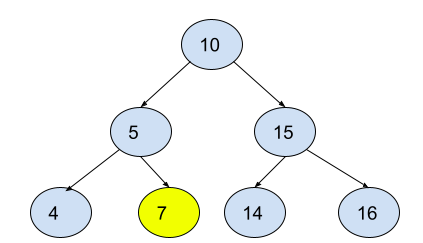
The 3rd smallest node is highlighted in yellow colour.
Problem approach
Create an empty stack and set the current node to the root of the BST.
Push all the left subtree nodes of the current node onto the stack until the current node is NULL.
Pop the top node from the stack and check if it is the k-th element. If it is, return its value.
Decrement the value of k by 1.
Set the current node to the right child of the popped node.
Go to step 2 if the stack is not empty or k is not equal to 0.
2. Maximum Product Subarray
Moderate
25m average time
75% success
0/80
Asked in companies

You are given an array “arr'' of integers. Your task is to find the contiguous subarray within the array which has the largest product of its elements. You have to report this maximum product.
An array c is a subarray of array d if c can be obtained from d by deletion of several elements from the beginning and several elements from the end.

For e.g.- The non-empty subarrays of an array [1,2,3] will be- [1],[2],[3],[1,2],[2,3],[1,2,3].
For Example:
If arr = {-3,4,5}.
All the possible non-empty contiguous subarrays of “arr” are {-3}, {4}, {5}, {-3,4}, {4,5} and {-3,4,5}.
The product of these subarrays are -3, 4, 5, -12, 20 and -60 respectively.
The maximum product is 20. Hence, the answer is 20.
Follow Up:
Can you solve this in linear time and constant space complexity?
Problem approach
Here we use 3 variables called max_so_far, max_ending_here & min_ending_here
For every index, the maximum number ending at that index will be the maximum(arr[i], max_ending_here * arr[i], min_ending_here[i]*arr[i])
Similarly, the minimum number ending here will be the minimum of these 3
Thus we get the final value for the maximum product subarray
0
Round
Easy
HR Round
Duration20 minutes
Interview date18 Jan 2022
Coding problem1
1. Basic HR Questions
- What are your hobbies?
- Are you willing to relocate?


Here's your problem of the day 
Solving this problem will increase your chance to get selected in this company
Skill covered: Programming
Which traversal uses a queue as its primary data structure?
Choose another skill to practice
Similar interview experiences
Software Developer
6 rounds | 7 problems
Interviewed by Josh Technology Group
 Selected
3645 views

2 comments

0 upvotes
Associate Enginner
3 rounds | 5 problems
Interviewed by Josh Technology Group

Rejected
1038 views
0 comments
0 upvotes
SDE - 1
3 rounds | 3 problems
Interviewed by Josh Technology Group
Selected 1558 views
0 comments
0 upvotes
SDE - 1
4 rounds | 7 problems
Interviewed by Josh Technology Group
Rejected
1254 views
0 comments
0 upvotes
Companies with similar interview experiences

Software Developer
3 rounds | 3 problems
Interviewed by HCL Technologies
 Selected
 3781 views
1 comments
0 upvotes

Software Developer
3 rounds | 6 problems
Interviewed by Arcesium
Selected 1825 views
0 comments
0 upvotes
Software Developer
3 rounds | 5 problems
Interviewed by HCL Technologies
 Selected
 4559 views
0 comments
0 upvotes