





Josh Technology Group interview experience Real time questions & tips from candidates to crack your interview

Intern
Josh Technology Group


6 rounds | 7 Coding
problems

 Selected
 Interview preparation journey

Preparation
Duration: 5 Months
Topics: DBMS, OS, OOPS, Data Structure, Array, String, Bit manipulation, BInary Search, Sorting, Number Theory Linked List, Trees, Graph, DP

Tip 1 : Focus the most on Data Structure topics and practice atleast 300 medium level ques (min 2 approaches for each qs)
Tip 2 : Have a strong grip on Core Subjects i.e OS, DBMS, OOPS, CN, System Design(for big mnc's)
Tip 3 : Learn any good development framework and make min 2 good projects with that and try to do any 1 or 2 min intern to put it in your resume.
Application process
Where: Campus
Eligibility: 7+ CGPA
Tip 1 : Keep it short and to the point
Tip 2 : Have good knowledge of every single thing you mentioned there.

Interview rounds
01
Round
Medium
Online Coding Interview
Duration60 minutes
Interview date16 Jul 2021
Coding problem0
It was an mcq round based on DSA and problem solving.
02
Round
Easy
Online Coding Test
Duration90 minutes
Interview date16 May 2022
Coding problem1
It was just after the first round in the morning
1. Huffman Coding
Moderate
25m average time
75% success

0/80
Asked in companies



You are given an array 'ARR' of Integers having 'N' elements. The array contains an encoded message. For each index 'i', 'ARR[i]' denotes the frequency of the 'i'th' character in the message. The characters are of an alien language having 'N' alphabets. Given the frequency of each of the 'N' alphabets in the message, your task is to find out the Huffman codes for each of the 'N' alphabets in the message.
The Huffman Code for a message is the set of codes such that :
1) All codes are binary strings.
2) Each code should be able to determine its corresponding character uniquely.
3) The total numbers of bits used to represent the message are minimized.
Note:
If there are multiple sets of valid Huffman codes for a message. You can print any of them.
For example:
Consider the array ARR = [ 1, 4, 2 ] having 3 elements.
The array containing Huffman Codes for the above array will be [ '10', '0', '11' ]. Other Valid Huffman Codes are [ '01', '1', '00' ], [ '00', '1', '01' ] etc. Codes like [ '1', '0', '01' ], [ '1', '10' , '0' ] are some of the invalid Huffman Codes.
03
Round
Medium
Online Coding Test
Duration90 Minutes
Interview date16 May 2022
Coding problem1
1 hr after the second round got over and results were announced in the morning.
1. Ways To Make Coin Change
Moderate
20m average time
80% success
0/80
Asked in companies



You are given an infinite supply of coins of each of denominations D = {D0, D1, D2, D3, ...... Dn-1}. You need to figure out the total number of ways W, in which you can make a change for value V using coins of denominations from D. Print 0, if a change isn't possible.
04
Round
Medium
Face to Face
Duration90 Minutes
Interview date26 May 2022
Coding problem2
10 A.M in the morning.
The interviewers were very knowledgeable and humble
1. Unique Element In Sorted Array
Easy
15m average time
85% success
0/40
Asked in companies



You are given a sorted array ‘arr’ of ‘n’ numbers such that every number occurred twice in the array except one, which appears only once.
Return the number that appears once.
Example:
Input: 'arr' = [1,1,2,2,4,5,5]

Output: 4

Explanation:
Number 4 only appears once the array.
Note :
Exactly one number in the array 'arr' appears once.
Problem approach
Step 1 : I told them brute force approach.
Step 2 : Told about bitmasking approach.
Step 3 : I them them Binary Search approach(the most optiimsed one)
Step 4 : They told me to code it and run test cases.
2. Print Nodes at Distance K From a Given Node
Hard
20m average time
80% success
0/120
Asked in companies



You are given an arbitrary binary tree, a node of the tree, and an integer 'K'. You need to find all such nodes which have a distance K from the given node and return the list of these nodes.
Distance between two nodes in a binary tree is defined as the number of connections/edges in the path between the two nodes.
Note:
1. A binary tree is a tree in which each node has at most two children.
2. The given tree will be non-empty.
3. The given tree can have multiple nodes with the same value.
4. If there are no nodes in the tree which are at distance = K from the given node, return an empty list.
5. You can return the list of values of valid nodes in any order. For example if the valid nodes have values 1,2,3, then you can return {1,2,3} or {3,1,2} etc.
Example :
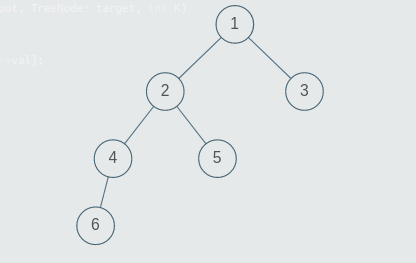
Consider this tree above. The target node is 5 and K = 3. The nodes at distance 1 from node 5 are {2}, nodes at distance 2 from node 5 are {1, 4} and nodes at distance 3 from node 5 are {6, 3}.
Problem approach
Step 1 : I told them brute force approach.
Step 2 : Told them about Binary tree approach
Step 3 : They told me to code it and dry run and run test cases.
05
Round
Medium
Face to Face
Duration90 Minutes
Interview date26 May 2022
Coding problem2
It was after the first technical interview round.
Got a mail for the second interview round .
Timings approx 12 AM
1. Remove BST keys outside the given range
Easy
15m average time
85% success
0/40
Asked in companies



Given a Binary Search Tree (BST) and a range [min, max], remove all keys which are outside the given range. The modified tree should also be BST.
Problem approach
Step 1 : Brute force array conversion approach.
Step 2 : Delete a node in a tree approach.
Step 3 : Optimised the above approach to delete only specified nodes to achieve the answer
Step 4 : Coded the approach and ran the test cases provided
2. Inorder Sucessor
Moderate
30m average time
65% success
0/80
Asked in companies


You have been given an arbitrary binary tree and a node of this tree. You need to find the inorder successor of this node in the tree.
The inorder successor of a node in a binary tree is that node that will be visited immediately after the given node in the inorder traversal of the tree. If the given node is visited last in the inorder traversal, then its inorder successor is NULL.
The inorder traversal of a binary tree is the traversal method in which for any node its left subtree is visited first, then the node itself, and then the right subtree.
Note
1. Each node is associated with a unique integer value.

2. The node for which the successor is to be found is guaranteed to be part of the tree.
06
Round
Easy
HR Round
Duration30 Minutes
Interview date26 May 2022
Coding problem1
Got a call from Hr after clearance of the first 2 rounds.
Timing were 5:30 P.M
1. Basic HR Questions
She asked me about my hobbies, strength, weaknesses, why i want to join.
Problem approach
Tip 1 : Donot lie in front of HR's
Tip 2 : Keep your answer short and simple
Tip 3 : Have a good insight about the organisation


Here's your problem of the day 
Solving this problem will increase your chance to get selected in this company
Skill covered: Programming
How do you remove whitespace from the start of a string?
Choose another skill to practice
Similar interview experiences
Software Developer
3 rounds | 5 problems
Interviewed by Josh Technology Group
 Selected
936 views

0 comments

0 upvotes
Associate Enginner
3 rounds | 5 problems
Interviewed by Josh Technology Group

Rejected
1003 views
0 comments
0 upvotes
SDE - 1
3 rounds | 3 problems
Interviewed by Josh Technology Group
Selected 1485 views
0 comments
0 upvotes
SDE - 1
4 rounds | 7 problems
Interviewed by Josh Technology Group
Rejected
1159 views
0 comments
0 upvotes
Companies with similar interview experiences

Intern
3 rounds | 4 problems
Interviewed by CIS - Cyber Infrastructure
 Selected
 650 views
0 comments
0 upvotes