





Josh Technology Group interview experience Real time questions & tips from candidates to crack your interview

SDE - 1
Josh Technology Group


3 rounds | 5 Coding
problems

 Selected
 Interview preparation journey

Preparation
Duration: 6 Months
Topics: I covered major data structure topics like Arrays, Stacks, Queues, Linked List, Trees, Graphs, backtracking, Dynamic Programming. After reading each topic, I tried to practice maximum questions on the concerned topic from Coding Ninjas, geeksforgeeks, Hackerrank and when stuck on a question, I preferred watching solution videos provided by Coding Ninjas.

Tip 1 : It is important to practice coding consistently because it is what enables you to solve interview-questions in the stipulated time. But before this, it is even important to have a clear understanding of all the data-structures, so that they can be easily implemented as and when required to solve a problem. It is also mandatory to have a clear understanding of the time and space complexities of algorithms because this is what you are judged upon in real interviews. Good intuition and a good approach to solve a problem is what really helps to crack the interview of such companies.
Tip 2 : They do not judge you upon the number of internships you have done or the number of projects you have made. A single ,good-quality project is sufficient, provided you have in-depth knowledge about it. What matters to them is how efficient learner you are, how good is your problem-solving skill and also how confident you are with your answers.
Tip 3 : Practise topic -wise questions, participate in lots of coding contests, watch lots of Youtube solutions even after you could solve a question, because you may find a different approach that is efficient than yours and watching video solutions is always a better option than just reading the solution , as it gives a clear and deeper understanding of the logics . Also pray hard along with your preparation.
Application process
Where: Campus
Eligibility: Above 7 CGPA,
Tip 1 : Keep your resume short and clear. Mention your projects and internships with a brief description and year of completion. Mention coding languages are known to you, or other technical skills that you are good at. Do not mention anything that you are not good at. Highlight the topics that you are really good at.
Tip 2 : Be very honest and figure out only those things in your resume that you really know. Anything extra or unknown may have a negative impact upon your interview if asked by the interviewer.

Interview rounds
01
Round
Easy
Video Call
Duration45 Minutes
Interview date27 Jun 2022
Coding problem2
1. Add Two Numbers As Linked Lists ll
Moderate
10m average time
80% success

0/80
Asked in companies



You have been given two singly Linked Lists, where each of them represents a positive number without any leading zeros.
Your task is to add these two numbers and print the summation in the form of a linked list.
Example:
If the first linked list is 1 -> 2 -> 3 -> 4 -> 5 -> NULL and the second linked list is 4 -> 5 -> NULL.

The two numbers represented by these two lists are 12345 and 45, respectively. So, adding these two numbers gives 12390.

So, the linked list representation of this number is 1 -> 2 -> 3 -> 9 -> 0 -> NULL.
Problem approach
Given two numbers represented by linked lists. Your task is find the sum list and return the head of the sum list.
The sum list is a linked list representation of addition of two numbers.
2. Is Height Balanced Binary Tree
Moderate
15m average time
85% success
0/80
Asked in companies


You are given the root node of a binary tree.
Return 'true' if it is a height balanced binary tree.
Note:
Height of a tree is the maximum number of nodes in a path from the node to the leaf node.

An empty tree is a height-balanced tree. A non-empty binary tree is a height-balanced binary tree if
1. The left subtree of a binary tree is already the height-balanced tree.
2. The right subtree of a binary tree is also the height-balanced tree.
3. The difference between heights of left subtree and right subtree must not more than ‘1’.
Example:
Input: Consider the binary tree given below:
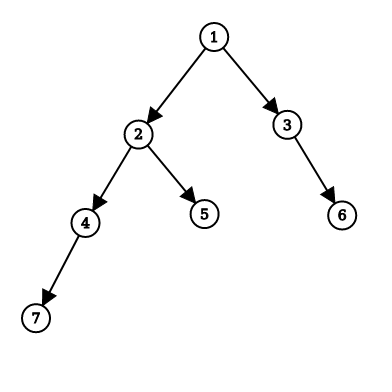
Output: 'true'

Explanation:
Consider subtree at Node ( 7 )
Left subtree height is ‘0’ and right subtree height is ‘0’, the absolute height difference is ‘0-0 = 0’ and ‘0’ is not more than ‘1’ so subtree at Node ( 7 ) is a height-balanced binary tree.
Same for subtrees at Nodes ( 5, 6 ).

Consider subtree at Node ( 4 )
Left subtree height is ‘1’ and right subtree height is ‘0’, the absolute height difference is ‘1-0 = 1’ and ‘1’ is not more than ‘1’ so subtree at Node ( 4 ) is a height-balanced binary tree.
Same for subtree at Node ( 3)

Consider subtree at Node ( 2 )
Left subtree height is ‘2’ and right subtree height is ‘1’, the absolute height difference is ‘2-1 = 1’ and ‘1’ is not more than ‘1’ so subtree at Node ( 2 ) is a height-balanced binary tree.

Consider subtree at Node ( 1 )
Left subtree height is ‘3’ and right subtree height is ‘2’, the absolute height difference is ‘3-2 = 1’ and ‘1’ is not more than ‘1’ so subtree at Node ( 1 ) is a height-balanced binary tree.

Because the root node ( 1 ) is a height-balanced binary tree, so the complete tree is height-balanced.
Problem approach
Given a binary tree. You need to check if it is a height-balanced binary tree.
Height of a tree is the maximum number of nodes in a path from the node to the leaf node.
An empty tree is a height-balanced tree. A non-empty binary tree is a height-balanced binary tree if
1. The left subtree of a binary tree is already the height-balanced tree.
2. The right subtree of a binary tree is also the height-balanced tree.
3. The difference between heights of left subtree and right subtree must not more than ‘1’.
02
Round
Easy
Video Call
Duration45 Minutes
Interview date28 Jun 2022
Coding problem2
1. Best Time To Buy and Sell Stock
Moderate
20m average time
80% success
0/80
Asked in companies



You are given an array/list 'prices' where the elements of the array represent the prices of the stock as they were yesterday and indices of the array represent minutes. Your task is to find and return the maximum profit you can make by buying and selling the stock. You can buy and sell the stock only once.
Note:
You can’t sell without buying first.
For Example:
For the given array [ 2, 100, 150, 120],
The maximum profit can be achieved by buying the stock at minute 0 when its price is Rs. 2 and selling it at minute 2 when its price is Rs. 150.
So, the output will be 148.
Problem approach
You are Harshad Mehta’s friend. He told you the price of a particular stock for the next ‘N’ days. You can either buy or sell a stock. Also, you can only complete at most 2-transactions. Find the maximum profit that you can earn from these transactions. You can take help from Mr. Mehta as well.
2. Sum root to leaf
Easy
10m average time
90% success
0/40
Asked in companies


You are given an arbitrary binary tree consisting of N nodes where each node is associated with a certain integer value from 1 to 9. Consider each root to leaf path as a number.
For example:
       1
      /  \
     2    3

The root to leaf path 1->2 represents the number 12.
The root to leaf path 1->3 represents the number 13.
Your task is to find the total sum of all the possible root to leaf paths.
In the above example,
The total sum of all the possible root to leaf paths is 12+13 = 25
Note:
The output may be very large, return the answer after taking modulus with (10^9+7).
Problem approach
You are given an arbitrary binary tree consisting of N nodes where each node is associated with a certain integer value from 1 to 9. Consider each root to leaf path as a number.
03
Round
Easy
Video Call
Duration45 minutes
Interview date30 Jun 2022
Coding problem1
1. Maximum sum of non-adjacent elements
Moderate
15m average time
85% success
0/80
Asked in companies



You are given an array/list of ‘N’ integers. You are supposed to return the maximum sum of the subsequence with the constraint that no two elements are adjacent in the given array/list.
Note:
A subsequence of an array/list is obtained by deleting some number of elements (can be zero) from the array/list, leaving the remaining elements in their original order.
Problem approach
You are given an array/list of ‘N’ integers. You are supposed to return the maximum sum of the subsequence with the constraint that no two elements are adjacent in the given array/list.


Here's your problem of the day 
Solving this problem will increase your chance to get selected in this company
Skill covered: Programming
How do you remove whitespace from the start of a string?
Choose another skill to practice
Similar interview experiences
SDE - 1
3 rounds | 6 problems
Interviewed by Josh Technology Group
Rejected

1522 views

0 comments

0 upvotes
SDE - 1
3 rounds | 6 problems
Interviewed by Josh Technology Group
Rejected
1027 views
0 comments
0 upvotes
SDE - 1
3 rounds | 3 problems
Interviewed by Josh Technology Group
Selected 1486 views
0 comments
0 upvotes
SDE - 1
4 rounds | 7 problems
Interviewed by Josh Technology Group
Rejected
1160 views
0 comments
0 upvotes
Companies with similar interview experiences

SDE - 1
2 rounds | 3 problems
Interviewed by BNY Mellon
 Selected
 6365 views
3 comments
0 upvotes
SDE - 1
3 rounds | 6 problems
Interviewed by BNY Mellon
 Selected
 0 views
0 comments
0 upvotes

SDE - 1
3 rounds | 5 problems
Interviewed by CIS - Cyber Infrastructure
Selected 2197 views
0 comments
0 upvotes