





Josh Technology Group interview experience Real time questions & tips from candidates to crack your interview

SDE - Intern
Josh Technology Group


7 rounds | 7 Coding
problems

 Selected
 Interview preparation journey

Preparation
Duration: 2 months
Topics: OOPS, Trees, Dynamic Programming, Linked List, Databases, Arrays.

Tip 1 : Practice up to the level to able to solve medium level questions.
Tip 2 : Question might get focused on Trees, Linked List and Arrays in the initial rounds.
Tip 3 : If you are going to tell about your projects, make sure to you know what you have done and if done in a team what you have contributed individually.
Tip 4 : During round 3 or HR interviews make sure to highlight your soft skills like communication and leadership by relating to real life project if possible.
Application process
Where: Campus
Eligibility: No criteria
Tip 1 : Have at least two projects in you resume and mention what you achieved.
Tip 2 : Write about your role and responsibilities if mentioning any internships.
Tip 3 : Also mention extra curriculars if any to highlight soft skills.

Interview rounds
01
Round
Medium
Online Coding Interview
Duration50 minutes
Interview date4 May 2021
Coding problem1
It was an online objective round held at 10:00AM. The platform had proctoring enabled for tab switches, refreshes, etc.
1. MCQ Questions
Questions were related to OOPS, Data Structures, Databases.
Number Of MCQs - 60
02
Round
Easy
Online Coding Test
Duration75 minutes
Interview date4 Apr 2021
Coding problem1
This round was help at 2pm after the first round. Each round had elimination. Only those who cleared a round were allowed in the next round. This was also a proctored round. It had question on arrays and linked list.
1. Reverse List In K Groups
Hard
15m average time
85% success

0/120
Asked in companies



You are given a linked list of 'n' nodes and an integer 'k', where 'k' is less than or equal to 'n'.
Your task is to reverse the order of each group of 'k' consecutive nodes, if 'n' is not divisible by 'k', then the last group of nodes should remain unchanged.
For example, if the linked list is 1->2->3->4->5, and 'k' is 3, we have to reverse the first three elements, and leave the last two elements unchanged. Thus, the final linked list being 3->2->1->4->5.
Implement a function that performs this reversal, and returns the head of the modified linked list.
Example:
Input: 'list' = [1, 2, 3, 4], 'k' = 2

Output: 2 1 4 3

Explanation:
We have to reverse the given list 'k' at a time, which is 2 in this case. So we reverse the first 2 elements then the next 2 elements, giving us 2->1->4->3.
Note:
All the node values will be distinct.
Problem approach
Used two pointer approach to k reverse the linked list.
03
Round
Medium
Online Coding Test
Duration80 minutes
Interview date5 Apr 2021
Coding problem0
It was held in the morning at 10:00 am. It had 2 medium and one hard question. It was also held in a proctored environment.
04
Round
Medium
Video Call
Duration50 minutes
Interview date13 May 2021
Coding problem0
I did not gave this round as I performed well in the previous rounds.
05
Round
Easy
Video Call
Duration45 minutes
Interview date13 May 2021
Coding problem2
It was a technical interview round. It was held in the morning. We had to keep our camera on as it was video proctored. The interviewer did not turned on their camera. Initially I was asked for an introduction in which I told about myself and my projects and internships.
The interviewer gave me 2 coding problem. Although I was able to solve them easily, the interviewer seemed to be ready to help if stuck. The interviewer asked for extensive dry run on both the problems.
1. Merge Two Binary Trees
Easy
15m average time
85% success
0/40
Asked in companies



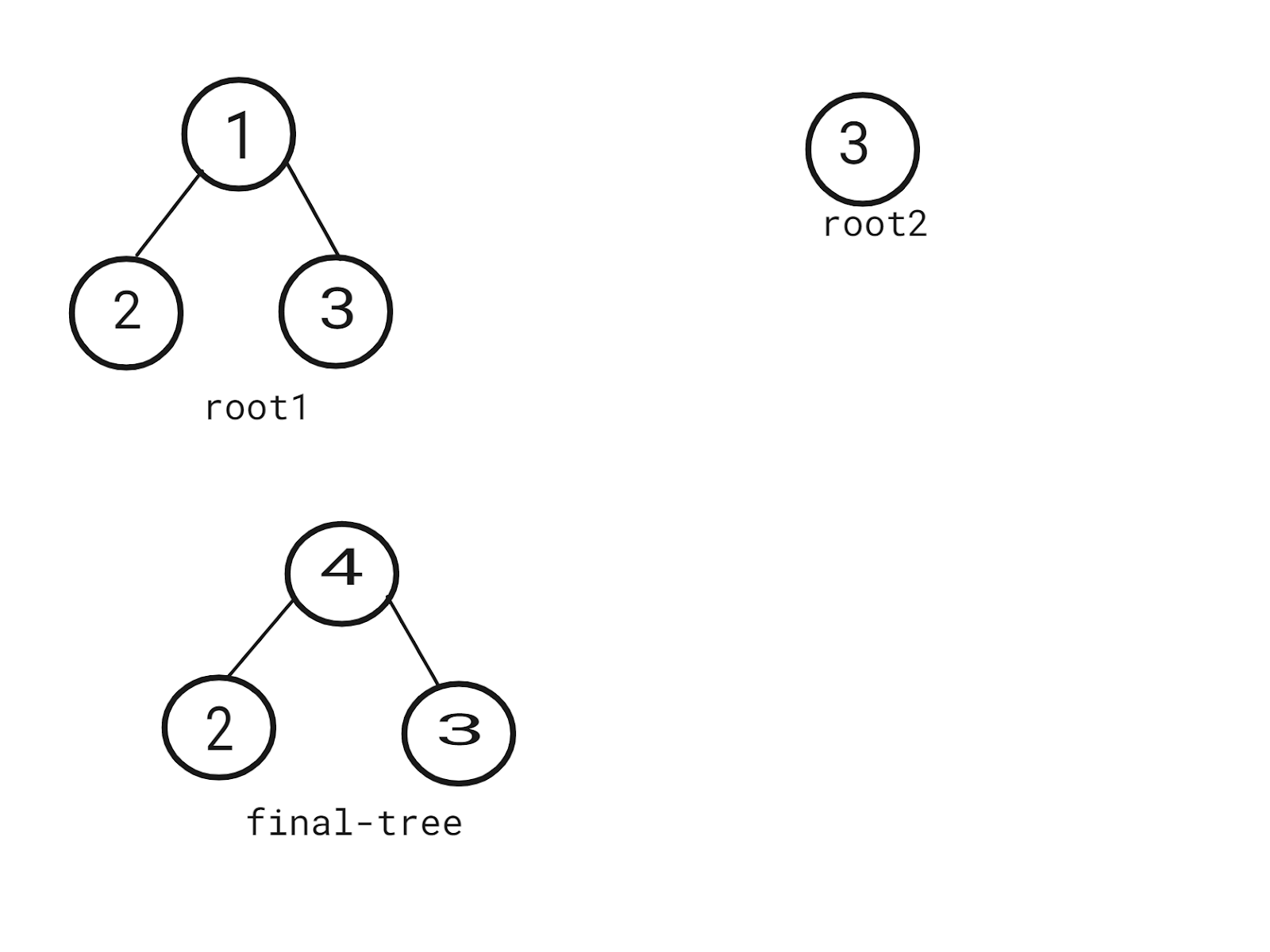
You are given roots of two binary trees, ‘ROOT1’ and ‘ROOT2’. You need to merge the two trees into a new binary tree. The merge rule is that if the two nodes overlap, then the sum of the two nodes values up as the new value of the merged node. Otherwise, the NOT null node will be used as the node of the new tree. Your task is to return the merged tree i.e. head of the new tree.
Note:
The merging process must start from the root nodes of both trees.
For example,
‘ROOT1’ = [1, 2, -1, -1, 3, -1, -1]  ‘ROOT2’ = [3, -1, -1].
The final tree would look like : [3, 2, -1, -1, 3, -1, -1], and the output will be printed in a pre-order way: 4 2 3.
Problem approach
I was able to solve this in O(n) complexity. Initially gave a 2*O(n) approach and then optimized it.
2. Covid Vaccination
Moderate
0/80
Asked in companies



We are suffering from the Second wave of Covid-19. The Government is trying to increase its vaccination drives. Ninja wants to help the Government to plan an effective method to help increase vaccination following safety measures. Time is running out. Can you help the nation?
You are given two positive integers: ‘n,’ ‘maxVaccines’ denoting the number of days for which this vaccination drive will go on and the total number of vaccines available for the drive, respectively. You have to find the number of vaccines administered each day. You are also given a number ‘dayNumber,’ and we are interested to know the maximum number of vaccines that can be administered on ‘dayNumber’ th day.
The rules of the vaccination drive :
1. There should be a positive number of vaccines administered each day during the vaccination drive.
2. The absolute difference between the number of vaccines in two consecutive days should not exceed 1.
3. The sum of all the elements of the vaccines array does not exceed maxVaccines, that is, you cannot administer more vaccines than what is provided to you.
4. Vaccines administered on ‘dayNumber’ th day should be maximized.
Problem approach
Solved it using binary search.
06
Round
Medium
Video Call
Duration50 minutes
Interview date13 May 2021
Coding problem2
It was a technical interview round. It was held in the morning. We had to keep our camera on as it was video proctored. The interviewer did not turned on their camera. Initially I was asked for an introduction in which I told about myself and my projects and internships. He also cross questioned on my projects.
The interviewer gave me 2 coding problem.. The interviewer gave hints whenever I got stuck.
1. Print Nodes at Distance K From a Given Node
Hard
20m average time
80% success
0/120
Asked in companies


You are given an arbitrary binary tree, a node of the tree, and an integer 'K'. You need to find all such nodes which have a distance K from the given node and return the list of these nodes.
Distance between two nodes in a binary tree is defined as the number of connections/edges in the path between the two nodes.
Note:
1. A binary tree is a tree in which each node has at most two children.
2. The given tree will be non-empty.
3. The given tree can have multiple nodes with the same value.
4. If there are no nodes in the tree which are at distance = K from the given node, return an empty list.
5. You can return the list of values of valid nodes in any order. For example if the valid nodes have values 1,2,3, then you can return {1,2,3} or {3,1,2} etc.
Example :
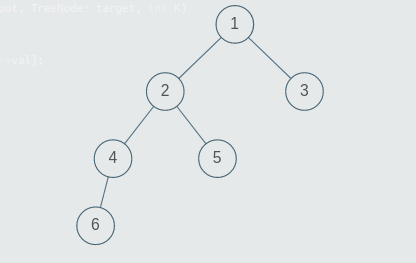
Consider this tree above. The target node is 5 and K = 3. The nodes at distance 1 from node 5 are {2}, nodes at distance 2 from node 5 are {1, 4} and nodes at distance 3 from node 5 are {6, 3}.
Problem approach
First solved it using multiple traversals. Then optimized using a pair class approach. The interviewer then restricted use of another class, so solved it using an additional parameter in the he function.
2. Divide Chocolates
Moderate
30m average time
70% success
0/80
Asked in companies


Ninja bought chocolate consisting of some chunks. The sweetness of each chunk is given in an array ‘ARR’. Ninja has ‘K’ friends, and he wishes to divide the chocolate into 'K' + 1 cut with some consecutive chunks. He wants to divide the chocolate into chunks under the condition that he will take the piece that has the minimum total sweetness.
He is very busy doing other stuff. Can you help him to maximize the total sweetness of the part that you will get under the given condition?
Problem approach
Used a recursive n^2 approach to solve the problem.
07
Round
Easy
HR Round
Duration25
Interview date14 May 2021
Coding problem1
1. Basic HR Questions
Tell me about yourself.
Tell me about your tech journey so far.
How was the experience of previous rounds?


Here's your problem of the day 
Solving this problem will increase your chance to get selected in this company
Skill covered: Programming
How do you remove whitespace from the start of a string?
Choose another skill to practice
Similar interview experiences
SDE - Intern
6 rounds | 14 problems
Interviewed by Josh Technology Group
Selected 
5584 views

0 comments

0 upvotes
SDE - Intern
5 rounds | 6 problems
Interviewed by Josh Technology Group
Selected 3264 views
0 comments
0 upvotes
SDE - Intern
2 rounds | 4 problems
Interviewed by Josh Technology Group
Selected 1140 views
1 comments
0 upvotes
SDE - Intern
6 rounds | 16 problems
Interviewed by Josh Technology Group
 Selected
 4081 views
3 comments
0 upvotes
Companies with similar interview experiences

SDE - Intern
2 rounds | 4 problems
Interviewed by Arcesium
 Selected
 3738 views
0 comments
0 upvotes
SDE - Intern
3 rounds | 5 problems
Interviewed by Arcesium
Selected 2683 views
0 comments
0 upvotes

SDE - Intern
3 rounds | 5 problems
Interviewed by BNY Mellon
 Selected
 2348 views
0 comments
0 upvotes