





JP Morgan interview experience Real time questions & tips from candidates to crack your interview

SDE - Intern
JP Morgan


2 rounds | 4 Coding
problems

Rejected
Interview preparation journey

Preparation
Duration: 3 months
Topics: Data Structures, Pointers, OOPS, System Design, Algorithms, Dynamic Programming,System Design, Link List and Graphs.

Tip 1 - Practice Atleast 250 Questions
Tip 2 - Ex- Do atleast 2 projects
Application process
Where: Company Website
Eligibility: Above 7 CGPA
Tip 1 : Have some projects on resume.
Tip 2 : Do not put false things on resume.
Interview rounds
01
Round
Easy
Video Call
Duration45 minutes
Interview date2 Aug 2021
Coding problem2
1. Shortest path in an unweighted graph
Moderate
25m average time
70% success

0/80
Asked in companies


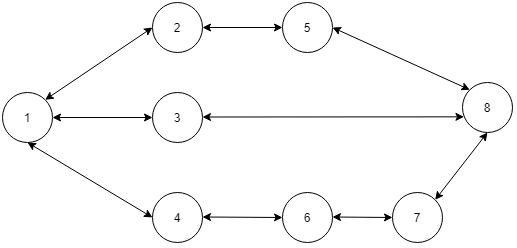
The city of Ninjaland is analogous to the unweighted graph. The city has ‘N’ houses numbered from 1 to ‘N’ respectively and are connected by M bidirectional roads. If a road is connecting two houses ‘X’ and ‘Y’ which means you can go from ‘X’ to ‘Y’ or ‘Y’ to ‘X’. It is guaranteed that you can reach any house from any other house via some combination of roads. Two houses are directly connected by at max one road.
A path between house ‘S’ to house ‘T’ is defined as a sequence of vertices from ‘S’ to ‘T’. Where starting house is ‘S’ and the ending house is ‘T’ and there is a road connecting two consecutive houses. Basically, the path looks like this: (S , h1 , h2 , h3 , ... T). you have to find the shortest path from ‘S’ to ‘T’.
For example
In the below map of Ninjaland let say you want to go from S=1 to T=8, the shortest path is (1, 3, 8). You can also go from S=1 to T=8 via (1, 2, 5, 8) or (1, 4, 6, 7, 8) but these paths are not shortest.
Problem approach
The city of Ninjaland is analogous to the unweighted graph. The city has ‘N’ houses numbered from 1 to ‘N’ respectively and are connected by M bidirectional roads. If a road is connecting two houses ‘X’ and ‘Y’ which means you can go from ‘X’ to ‘Y’ or ‘Y’ to ‘X’. It is guaranteed that you can reach any house from any other house via some combination of roads. Two houses are directly connected by at max one road.
A path between house ‘S’ to house ‘T’ is defined as a sequence of vertices from ‘S’ to ‘T’. Where starting house is ‘S’ and the ending house is ‘T’ and there is a road connecting two consecutive houses. Basically, the path looks like this: (S , h1 , h2 , h3 , ... T). you have to find the shortest path from ‘S’ to ‘T’.
2. K - Sum Path In A Binary Tree
Moderate
35m average time
65% success
0/80
Asked in companies


You are given a binary tree in which each node contains an integer value and a number ‘K’. Your task is to print every path of the binary tree with the sum of nodes in the path as ‘K’.
Note:
1. The path does not need to start or end at the root or a leaf, but it must go downwards (traveling only from parent nodes to child nodes).

2. Output the paths in the order in which they exist in the tree from left to right. Example: In the below example, path {1,3} is followed by {3,1} and so on.
Example:
For K = 4 and tree given below:
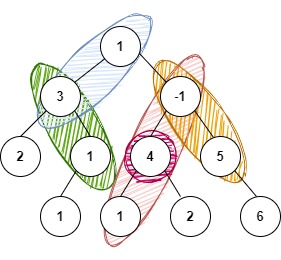
The possible paths are:
1 3
3 1
-1 4 1
4
-1 5

The sum of values of nodes of each of the above-mentioned paths gives a sum of 4.
02
Round
Easy
Video Call
Duration45 minutes
Interview date2 Aug 2021
Coding problem2
1. LRU Cache Implementation
Moderate
25m average time
65% success
0/80
Asked in companies



Design and implement a data structure for Least Recently Used (LRU) cache to support the following operations:
1. get(key) - Return the value of the key if the key exists in the cache, otherwise return -1.

2. put(key, value), Insert the value in the cache if the key is not already present or update the value of the given key if the key is already present. When the cache reaches its capacity, it should invalidate the least recently used item before inserting the new item.
You will be given ‘Q’ queries. Each query will belong to one of these two types:
Type 0: for get(key) operation.
Type 1: for put(key, value) operation.
Note :
1. The cache is initialized with a capacity (the maximum number of unique keys it can hold at a time).

2. Access to an item or key is defined as a get or a put operation on the key. The least recently used key is the one with the oldest access time.
Problem approach
Design and implement a data structure for Least Recently Used (LRU) cache to support the following operations:
2. Excel Column Number
Easy
23m average time
0/40
Asked in companies


You have been given a column title as appears in an Excel sheet, return its corresponding column number.
For example:
A -> 1
B -> 2
C -> 3
...
Z -> 26
AA -> 27
AB -> 28
...
Problem approach
You have been given a column title as appears in an Excel sheet, return its corresponding column number.


Here's your problem of the day 
Solving this problem will increase your chance to get selected in this company
Skill covered: Programming
To make an AI less repetitive in a long paragraph, you should increase:
Choose another skill to practice
Similar interview experiences
SDE - Intern
3 rounds | 5 problems
Interviewed by JP Morgan
 Selected
1279 views

0 comments

0 upvotes
SDE - Intern
2 rounds | 5 problems
Interviewed by JP Morgan
Rejected
0 views
0 comments
0 upvotes
SDE - Intern
3 rounds | 4 problems
Interviewed by JP Morgan
 Selected
 1024 views
0 comments
0 upvotes
SDE - Intern
3 rounds | 3 problems
Interviewed by JP Morgan
 Selected
 1016 views
0 comments
0 upvotes
Companies with similar interview experiences
SDE - Intern
3 rounds | 6 problems
Interviewed by Amazon

Rejected
15447 views
4 comments
0 upvotes
SDE - Intern
4 rounds | 7 problems
Interviewed by Microsoft
 Selected
 15307 views
1 comments
0 upvotes
SDE - Intern
2 rounds | 4 problems
Interviewed by Amazon
Selected 10120 views
2 comments
0 upvotes