





JP Morgan interview experience Real time questions & tips from candidates to crack your interview

SDE - 1
JP Morgan


4 rounds | 13 Coding
problems

 Selected
 Interview preparation journey

Preparation
Duration: 4 Months
Topics: Data Structures, Algorithms, System Design, Aptitude, OOPS

Tip 1 : Must do Previously asked Interview as well as Online Test Questions.
Tip 2 : Go through all the previous interview experiences from Codestudio and Leetcode.
Tip 3 : Do at-least 2 good projects and you must know every bit of them.
Application process
Where: Campus
Eligibility: Above 7 CGPA
Tip 1 : Have at-least 2 good projects explained in short with all important points covered.
Tip 2 : Every skill must be mentioned.
Tip 3 : Focus on skills, projects and experiences more.
Interview rounds
01
Round
Medium
Online Coding Test
Duration65 Minutes
Interview date7 Jun 2021
Coding problem2
This was an online proctured coding test where we had 2 questions to solve under 65 minutes. Both the questions were of difficulty Medium to Hard.
1. Minimum Travel Cost
Moderate
40m average time
65% success

0/80
Asked in companies

Ninjaland is a country having 'N' states numbered from 1 to 'N'. These 'N' states are connected by 'M' bidirectional roads. Each road connects to different states and has some cost to travel from one state to another. Now, the chief wants you to select 'N' - 1 roads in such a way that the tourist bus can travel to every state at least once at minimum 'COST'.
For example :
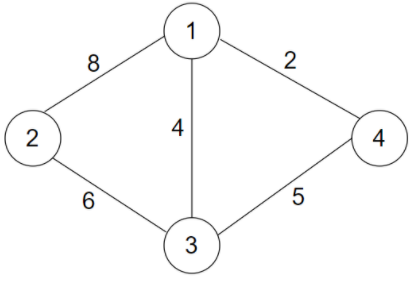
Consider a country having 4 states numbered from 1 to 4. These 4 states are connected by 5 bidirectional roads given as :
1 --- 2 with cost = 8
2 --- 3 with cost = 6
3 --- 4 with cost = 5
1 --- 4 with cost = 2
1 --- 3 with cost = 4

The map of the country can be represented as:
Now, the best way to choose 3 roads is:
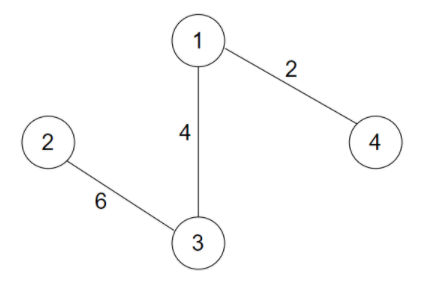
The cost of travelling from any state to all other states is 2 + 4 + 6 i.e. 12.
Problem approach
Approach :
1) Create a visited array that keeps track of states already included in MST. Initially mark all states as unvisited.
2) Create a weight array.Initialize all weight values as INFINITE.
3) Assign the weight value as 0 for the first state so that it is picked first.
4) Create a set of size N where N is the number of states in the country. Every element of the set contains the weight value of state and the state number.
5) Until set is not empty, do the following.
5.1) Extract the min weight value state from the set. Let the extracted state be U.
5.2) Mark this state as visited.
5.3) Update weight of all adjacent states of U which are not visited yet.
5.4) For every adjacent state V, if the cost of the road from U to V is less than the current weight value of V, update the weight value of V.
TC : O( M * log N) , where N is the number of states and M is the number of roads.
SC : O( N + M)
2. Reverse Words In A String
Easy
10m average time
90% success
0/40
Asked in companies


You are given a string 'str' of length 'N'.
Your task is to reverse the original string word by word.
There can be multiple spaces between two words and there can be leading or trailing spaces but in the output reversed string you need to put a single space between two words, and your reversed string should not contain leading or trailing spaces.
Example :
If the given input string is "Welcome to Coding Ninjas", then you should return "Ninjas Coding to Welcome" as the reversed string has only a single space between two words and there is no leading or trailing space.
Problem approach
Approach :
1) Create a String ans to store the reversed string.
2) Initialize a variable i to 0 and iterate the whole string through a while loop.
3) Skip initial spaces by just incrementing i.
4) Create a String that will store the current word.
5) Add the currentword and space at the beginning of ans.
6) After traversing the whole string, check if the length of ans is greater than 0 then return ans after removing the last space otherwise return an empty string.
TC : O(N^2), where N = length of the string
SC : O(N)
02
Round
Medium
Video Call
Duration60 Minutes
Interview date7 Jun 2021
Coding problem4
In this round , the interviewer first asked me two algorithmic questions - the first one related to stacks and the second one was of Dynamic Programming. I was able to find the optimal approach for the both the questions and also discussed the time and space complexities. This was followed by some standard questions from OOPS.
1. Next Greater Element
Moderate
20m average time
90% success
0/80
Asked in companies



You are given an array arr of length N. You have to return a list of integers containing the NGE(next greater element) of each element of the given array. The NGE for an element X is the first greater element on the right side of X in the array. Elements for which no greater element exists, consider the NGE as -1.
For Example :
If the given array is [1, 3, 2], then you need to return [3, -1, -1]. Because for 1, 3 is the next greater element, for 3 it does not have any greater number to its right, and similarly for 2.
Problem approach
Approach 1 (Naive Solution) :
1) Use two loops: The outer loop picks all the elements one by one.
2) The inner loop looks for the first greater element for the element picked by the outer loop.
3) If a greater element is found then that element is printed as next, otherwise, -1 is printed.
TC : O(N^2), where N=size of the array
SC : O(1)
Approach 2 (Using Stack) :
1) Push the first element to stack.
2) Pick rest of the elements one by one and follow the following steps in loop.
2.1) Mark the current element as next.
2.2) If stack is not empty, compare top element of stack with next.
2.3) If next is greater than the top element, Pop element from stack. next is the next greater element for
the popped element.
2.4) Keep popping from the stack while the popped element is smaller than next. next becomes the next
greater element for all such popped elements.
3) Finally, push the next in the stack.
4) After the loop in step 2 is over, pop all the elements from the stack and print -1 as the next element for them.
TC : O(N), where N=size of the array
SC : O(N)
2. Increasing Path In Matrix
Moderate
25m average time
75% success
0/80
Asked in companies


You are given a 2-D matrix ‘mat’, consisting of ’N’ rows and ‘M’ columns. The element at the i-th row and j-th column is ‘mat[i][j]’.
From mat[i][j], you can move to mat[i+1][j] if mat[i+1][j] > mat[i][j], or to mat[i][j+1] if mat[i][j+1] > mat[i][j].
Your task is to find and output the longest path length if you start from (0,0) i.e from mat[0][0] and end at any possible cell (i, j) i.e at mat[i][j].
Note :
Consider 0 based indexing.
Problem approach
Approach (Using DP) :
1) Create a 2D integer matrix ‘dp’ of size n*m, where dp[i][j] stores the length of the longest path ending at ‘mat[i][j]’. Fill the entire matrix ‘dp[][]’ with INT_MIN initially.
2) Assign dp[0][0]:= 1
3) Run a loop where ‘i’ ranges from 1 to ‘m-1’ and for each ‘i’ if ‘mat[0][i]’ > mat[0][i-1], then assign dp[0][i] := dp[0][i-1] + 1, otherwise break the loop.
4) Run a loop where ‘i’ ranges from 1 to ‘n-1’ and for each ‘i’ if ‘mat[i][0]’ > mat[i-1][0]’, then assign dp[i][0] := dp[i-1][0] + 1, otherwise break the loop
5) Run two nested loops, In outer loop ‘i’ ranges from 1 to n-1, and inner loop ‘j’ ranges from 1 to m-1, and for each (i, j) do the following.
5.1) If mat[i][j] > mat[i][j-1], then assign dp[i][j] = max(dp[i][j], dp[i][j-1] + 1).
5.2) If mat[i][j] > mat[i-1][j], then assign dp[i][j] = max(dp[i][j], dp[i-1][j] + 1).
6) The largest value of the matrix ‘dp[][]’ will be the length of the longest path starting from (0, 0), we need to return this value.
TC : O(N*M), where N, M represents the number of rows and columns respectively.
SC : O(N*M)
3. OOPS Question
What is meant by Inheritance?
Problem approach
The term “inheritance” means “receiving some quality or behavior from a parent to an offspring.” In object-oriented programming, inheritance is the mechanism by which an object or class (referred to as a child) is created using the definition of another object or class (referred to as a parent). Inheritance not only helps to keep the implementation simpler but also helps to facilitate code reuse.
4. OOPS Question
What do you mean by virtual functions in C++?
Problem approach
1) A C++ virtual function is a member function in the base class that you redefine in a derived class. It is declared
using the virtual keyword.
2) It is used to tell the compiler to perform dynamic linkage or late binding on the function.
3) When the function is made virtual, C++ determines which function is to be invoked at the runtime based on the
type of the object pointed by the base class pointer.
Some rules regarding virtual function :
i) Virtual functions must be members of some class.
ii) Virtual functions cannot be static members.
iii) They are accessed through object pointers.
iv) They can be a friend of another class.
v) A virtual function must be defined in the base class, even though it is not used.
vi) We cannot have a virtual constructor, but we can have a virtual destructor
03
Round
Medium
Video Call
Duration60 Minutes
Interview date7 Jun 2021
Coding problem5
This round had 2 questions from DSA followed by some questions from basics of DBMS and then I was asked some interesting questions from Probability.
1. Top View Of The Tree
Moderate
25m average time
70% success
0/80
Asked in companies


You are given a Binary Tree of 'n' nodes.
The Top view of the binary tree is the set of nodes visible when we see the tree from the top.
Find the top view of the given binary tree, from left to right.
Example :
Input: Let the binary tree be:
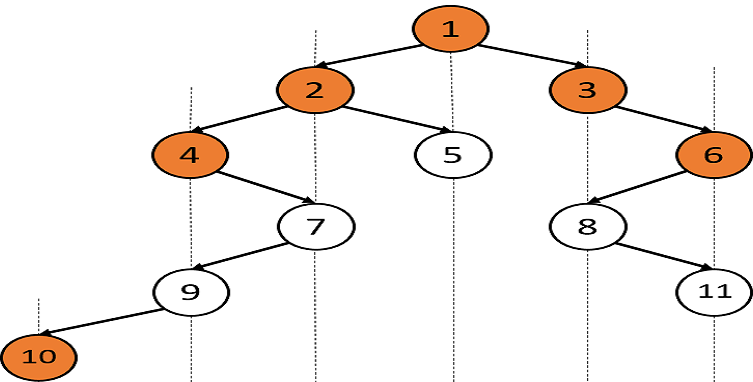
Output: [10, 4, 2, 1, 3, 6]

Explanation: Consider the vertical lines in the figure. The top view contains the topmost node from each vertical line.
Problem approach
The approach is to use the preorder traversal of the tree to traverse the tree and check that we have visited the
current vertical level and if visited then we can check for the smaller horizontal level node and store it. Else we can
just update the vertical level as visited and store the node and horizontal level of the current node.
1) We have to create the map to check whether the horizontal level is visited or not as it will state the horizontal
distance of the node from the root node. Where key will represent the horizontal distance and the value is the pair
containing the value and level of each node.
2) We will traverse the tree using the preorder traversal.
3) Every time we check if the level of the current horizontal distance is less than the max level seen till now then we
will update the value and the level for this horizontal distance.
4) We will pass level-1 for the left child and level+1 for the right child to get the vertical level.
5) Print the values present in the map.
2. LRU Cache Implementation
Moderate
25m average time
65% success
0/80
Asked in companies



Design and implement a data structure for Least Recently Used (LRU) cache to support the following operations:
1. get(key) - Return the value of the key if the key exists in the cache, otherwise return -1.

2. put(key, value), Insert the value in the cache if the key is not already present or update the value of the given key if the key is already present. When the cache reaches its capacity, it should invalidate the least recently used item before inserting the new item.
You will be given ‘Q’ queries. Each query will belong to one of these two types:
Type 0: for get(key) operation.
Type 1: for put(key, value) operation.
Note :
1. The cache is initialized with a capacity (the maximum number of unique keys it can hold at a time).

2. Access to an item or key is defined as a get or a put operation on the key. The least recently used key is the one with the oldest access time.
Problem approach
Answer :
Structure of an LRU Cache :
1) In practice, LRU cache is a kind of Queue — if an element is reaccessed, it goes to the end of the eviction order.
2) This queue will have a specific capacity as the cache has a limited size. Whenever a new element is brought in, it
is added at the head of the queue. When eviction happens, it happens from the tail of the queue.
3) Hitting data in the cache must be done in constant time, which isn't possible in Queue! But, it is possible with
HashMap data structure
4) Removal of the least recently used element must be done in constant time, which means for the implementation of
Queue, we'll use DoublyLinkedList instead of SingleLinkedList or an array.
LRU Algorithm :
The LRU algorithm is pretty easy! If the key is present in HashMap, it's a cache hit; else, it's a cache miss.
We'll follow two steps after a cache miss occurs:
1) Add a new element in front of the list.
2) Add a new entry in HashMap and refer to the head of the list.
And, we'll do two steps after a cache hit:
1) Remove the hit element and add it in front of the list.
2) Update HashMap with a new reference to the front of the list.
Tip : This is a very frequently asked question in interview and its implementation also gets quite cumbersome if you
are doing it for the first time so better knock this question off before your SDE-interviews.
3. DBMS Question
What is the main difference between UNION and UNION ALL?
Problem approach
UNION and UNION ALL are used to join the data from 2 or more tables but UNION removes duplicate rows and picks
the rows which are distinct after combining the data from the tables whereas UNION ALL does not remove the
duplicate rows, it just picks all the data from the tables.
4. Aptitude Question
What is the probability of getting a sum of 22 or more when four dice are thrown?
Problem approach
For four dices in order to get sum >=22 we should get
6,6,6,6 = 1 (6666)
6,6,6,5 = 4C1 = 4 (5666,6566,6656,6665)
6,6,6,4 = 4C1 = 4 (4666,6466,6646,6664)
6,6,5,5 = 4C2 = 6 (5566,5656,5665,6655,6565,6556)
So there are 15 favorable cases.
The total cases is 6*6*6*6=1296.
So we’ll get 15/1296 = 5/432
5. Aptitude Question
A 5 digit number is formed by using digits 1, 2, 3, 4 and 5 with no two digits same. What is the probability that the formed number is divisible by 4?
Problem approach
To be divisible by 4, the number has to end with the last two digits forming a number divisible by 4. Since there are only 5 digits: 1, 2, 3, 4, 5.
So, possible last two digits according to divisibility by 4:
12
24
32
52
For each of them we now have to put the remaining numbers in front: 3x2x1, therefore 6 combinations for each number set = 6×4 (we have 4 sets from above) = 24.
So, required probability is:
P = Number of desired outcomes / number of possible outcomes
= 24 /(5*4*3*2*1)
= 24 / (5!)
= 24 / 120
= 1/5
04
Round
Easy
HR Round
Duration30 Minutes
Interview date7 Jun 2021
Coding problem2
This is a cultural fitment testing round .HR was very frank and asked standard questions. Then we discussed about my
role.
1. Basic HR Question
Why should we hire you ?
Problem approach
Tip 1 : The cross questioning can go intense some time, think before you speak.
Tip 2 : Be open minded and answer whatever you are thinking, in these rounds I feel it is important to have opinion.
Tip 3 : Context of questions can be switched, pay attention to the details. It is okay to ask questions in these round,
like what are the projects currently the company is investing, which team you are mentoring. How all is the work
environment etc.
Tip 4 : Since everybody in the interview panel is from tech background, here too you can expect some technical
questions. No coding in most of the cases but some discussions over the design can surely happen.
2. Basic HR Question
Tell me something not there in your resume.
Problem approach
If you get this question, it's an opportunity to choose the most compelling information to share that is not obvious from
your resume.
Example :
Strength -> I believe that my greatest strength is the ability to solve problems quickly and efficiently, which makes me
unique from others.
Ability to handle Pressure -> I enjoy working under pressure because I believe it helps me grow and become more
efficient.
Tip : Emphasize why you were inspired to apply for the job. You can also explain that you are willing to invest a great
deal of energy if hired.
These are generally very open ended questions and are asked to test how quick wit a candidate is. So there is
nothing to worry about if you have a good command over your communication skills and you are able to propagate
your thoughts well to the interviewer.


Here's your problem of the day 
Solving this problem will increase your chance to get selected in this company
Skill covered: Programming
To make an AI less repetitive in a long paragraph, you should increase:
Choose another skill to practice
Similar interview experiences
SDE - 1
3 rounds | 4 problems
Interviewed by JP Morgan
Selected 
0 views

0 comments

0 upvotes
SDE - 1
2 rounds | 5 problems
Interviewed by JP Morgan
Rejected
1057 views
0 comments
0 upvotes
SDE - 1
4 rounds | 8 problems
Interviewed by JP Morgan

Rejected
3132 views
0 comments
0 upvotes
SDE - 1
1 rounds | 2 problems
Interviewed by JP Morgan
Rejected
3168 views
0 comments
0 upvotes
Companies with similar interview experiences
SDE - 1
5 rounds | 12 problems
Interviewed by Amazon
 Selected
 114453 views
24 comments
0 upvotes
SDE - 1
4 rounds | 5 problems
Interviewed by Microsoft
Selected 57719 views
5 comments
0 upvotes
SDE - 1
3 rounds | 7 problems
Interviewed by Amazon
 Selected
 34914 views
7 comments
0 upvotes