





JP Morgan interview experience Real time questions & tips from candidates to crack your interview

SDE - 1
JP Morgan


4 rounds | 11 Coding
problems

 Selected
 Interview preparation journey

Preparation
Duration: 4 Months
Topics: Data Structures, Algorithms, System Design, Aptitude, OOPS

Tip 1 : Must do Previously asked Interview as well as Online Test Questions.
Tip 2 : Go through all the previous interview experiences from Codestudio and Leetcode.
Tip 3 : Do at-least 2 good projects and you must know every bit of them.
Application process
Where: Campus
Eligibility: Above 7 CGPA
Tip 1 : Have at-least 2 good projects explained in short with all important points covered.
Tip 2 : Every skill must be mentioned.
Tip 3 : Focus on skills, projects and experiences more.
Interview rounds
01
Round
Medium
Online Coding Test
Duration65 Minutes
Interview date6 Sep 2021
Coding problem2
This was an online proctured coding round where we had 2 questions to solve under 1 hour. Both the questions were preety standard and anyone with a decent grip on Data Structures and Algorithms can solve them.
1. Split Binary String
Easy
15m average time
85% success

0/40
Asked in companies

Chintu has a long binary string ‘str’. A binary string is a string that contains only 0 and 1. He considers a string ‘beautiful’ if and only if the number of 0's and 1's in the string are equal.
For example :
0011 , 1100 , 101010 etc are beautiful strings whereas 1110, 0001,10101 etc are not beautiful strings.
Now Chintu wants to split the string into substrings such that each substring is beautiful. Can you help Chintu to find the maximum number of beautiful strings he can split the string into? If it is not possible to split the string in such a way that all strings are beautiful, return -1.
For example :
Let the given string be “101001”
We will return 3 as we can divide the string into 3 beautiful strings “10” “10” and “01’.
Problem approach
Approach :
1) Take two variables ‘cnt0’ and ‘cnt1’ to store the count of 0s and 1s respectively. Also, take a variable ‘cnt’ which stores the count of the number of substrings.
2) Now for each i from 0 to N - 1,
2.1) If str[i] is equal to ‘0’ , We increment ‘cnt0’ by 1.
2.2) If str[i] is equal to ‘1’ , We increment ‘cnt1’ by 1.
3) If ‘cnt0’ and ‘cnt1’ are equal, increment ‘cnt’ by 1.
4) If ‘cnt0’ is equal to ‘cnt1’ we return ‘cnt’.
5) Else, we return -1
TC : O(N), where N = length of the string
SC : O(1)
2. Shortest Path in a Binary Matrix
Moderate
37m average time
65% success
0/80
Asked in companies



You have been given a binary matrix of size 'N' * 'M' where each element is either 0 or 1. You are also given a source and a destination cell, both of them lie within the matrix.
Your task is to find the length of the shortest path from the source cell to the destination cell only consisting of 1s. If there is no path from source to destination cell, return -1.
Note:
1. Coordinates of the cells are given in 0-based indexing.
2. You can move in 4 directions (Up, Down, Left, Right) from a cell.
3. The length of the path is the number of 1s lying in the path.
4. The source cell is always filled with 1.
For example -
1 0 1
1 1 1
1 1 1
For the given binary matrix and source cell(0,0) and destination cell(0,2). Few valid paths consisting of only 1s are

X 0 X     X 0 X
X X X     X 1 X
1 1 1     X X X
The length of the shortest path is 5.
Problem approach
Approach (Using BFS) :
1) Create an empty queue and enqueue source cell and mark it as visited
2) Declare a ‘STEPS’ variable, to keep track of the length of the path so far
3) Loop in level order till the queue is not empty
3.1) Fetch the front cell from the queue
3.2) If the fetched cell is the destination cell, return ‘STEPS’
3.3) Else for each of the 4 adjacent cells of the current cell, we enqueue each valid cell into the queue and mark them visited.
3.4) Increment ‘STEPS’ by 1 when all the cells in the current level are processed.
4) If all nodes in the queue are processed and the destination cell is not reached, we return -1.
TC : O(N * M), where N and M are the number of rows and columns in the Binary Matrix respectively.
SC : O(N * M)
02
Round
Medium
Video Call
Duration60 Minutes
Interview date6 Sep 2021
Coding problem4
This round had 2 coding questions , the first one was related to Sorting and the second one was related to Hashing. After the coding questions, I was asked some concepts related to OOPS in general.
1. Rahul And Minimum Subarray
Moderate
0/80
Asked in companies


Rahul is a programming enthusiast. He is currently learning about arrays/lists. One day his teacher asked him to solve a very difficult problem. The problem was to find the length of the smallest subarray(subarray is a contiguous part of an array/list) in a given array/list ‘ARR’ of size ‘N’ with its sum greater than a given value. If there is no such subarray return 0.
Example: Given an ‘ARR’: [1, 2, 21, 7, 6, 12] and a number ‘X’: 23. The length of the smallest subarray is 2 as the subarray is [21, 7].
Note: Here are multiple subarrays whose sum is greater than ‘X’ such as [1, 2, 21] or [7, 6, 12] but we have to choose the minimum length subarray.
Problem approach
Approach 1 (Brute Force) :
In this approach, we make use of an idea based on selection sort.
1) Traverse over the given numsnums array choosing the elements nums[i]. For every such element chosen, we try to
determine its correct position in the sorted array. For this, we compare nums[i] with every nums[j], such that i < j < n.
2) If any nums[j] is lesser than nums[i], it means both nums[i] and nums[j] aren't at their correct position for the sorted
array. Thus, we need to swap the two elements to bring them at their correct positions.
3) Instead of swapping, just note the position of nums[i] (given by i) and nums[j] (given by j). These two elements now
mark the boundary of the unsorted subarray(atleast for the time being).
4) Out of all the nums[i] chosen, we determine the leftmost nums[i] which isn't at its correct position. This marks the
left boundary of the smallest unsorted subarray(l).
5) Similarly, Out of all the nums[j] considered for all nums[i] we determine the rightmost nums[j] which isn't at its
correct position. This marks the right boundary of the smallest unsorted subarray(r).
6) Therefore, the length of the smallest unsorted subarray = r−l+1.
TC : O(N^2)
SC : O(1)
Approach 2 (Using Sorting) :
1) We can sort a copy of the given array nums, say given by nums_sorted.
2) Then, if we compare the elements of nums and nums_sorted, we can determine the leftmost and rightmost
elements which mismatch.
3) The subarray lying between them is, then, the required shorted unsorted subarray.
TC : O(N*log(N))
SC : O(N)
2. Count all sub-arrays having sum divisible by k
Moderate
15m average time
85% success
0/80
Asked in companies



Given an array ‘ARR’ and an integer ‘K’, your task is to find all the count of all sub-arrays whose sum is divisible by the given integer ‘K’.
Note:
If there exists no subarray in the given sequence whose sum is divisible by ‘K’ then simply return ‘0’.
Example:
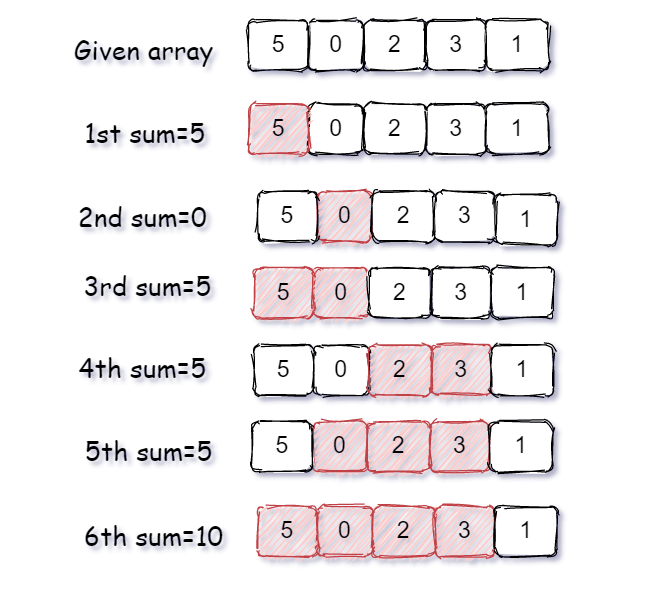
Suppose the given array is ‘ARR’ = { 5, 0, 2, 3, 1} and ‘K = 5’.
As we can see in below image, there are a total of 6 subarrays that have the total sum divisible by ‘K’
So we return the integer 6.
Problem approach
Approach 1 (Naive Solution ) :
One by one calculate sum of all sub-arrays possible and check divisible by K.
TC : O(N^2)
SC : O(1)
Approach 2 (Efficient Solution) :
Observe : Let sum(i,j)=subarray sum from arr[i] to arr[j] (both inclusive) (arr[i]+arr[i+1]...+arr[j])
Now for sum(i,j) to be divisible by k , th following condition must hold :
sum(0,j)%k=sum(0,i-1)%k
Keeping the above points in mind , let's design an efficient algo for this problem :
Algorithm :
1) Make an auxiliary array of size k as Mod[k] . This array holds the count of each remainder we are getting after
dividing cumulative sum till any index in arr[].
2) Now start calculating cumulative sum and simultaneously take it’s mod with K, whichever remainder we get
increment count by 1 for remainder as index in Mod[] auxiliary array.
3) Sub-array by each pair of positions with same value of ( cumSum % k) constitute a continuous range whose sum is
divisible by K.
4) Now traverse Mod[] auxiliary array, for any Mod[i] > 1 we can choose any two pair of indices for sub-array by
(Mod[i]*(Mod[i] – 1))/2 number of ways .
5) Do the same for all remainders < k and sum up the result that will be the number all possible sub-arrays divisible
by K.
TC : O(N) where N=size of the array
SC : O(k)
3. OOPS Question
What are Virtual Destructors in C++?
Problem approach
Answer :
Destructor : A destructor in C++ is a member function of a class used to free the space occupied by or delete an
object of the class that goes out of scope. A destructor has the same name as the name of the constructor function in
a class, but the destructor uses a tilde (~) sign before its function name.
Virtual Destructor : A virtual destructor is used to free up the memory space allocated by the derived class object or
instance while deleting instances of the derived class using a base class pointer object. A base or parent class
destructor use the virtual keyword that ensures both base class and the derived class destructor will be called at run
time, but it called the derived class first and then base class to release the space occupied by both destructors.
4. OOPS Question
Difference between Constructor and Method?
Problem approach
Answer :
Constructors :
1) A Constructor is a block of code that initializes a newly created object.
2) A Constructor can be used to initialize an object.
3) A Constructor is invoked implicitly by the system
4) A Constructor is invoked when a object is created using the keyword new.
5) A Constructor doesn’t have a return type.
6) A Constructor’s name must be same as the name of the class.
7) A Constructor cannot be inherited by subclasses.
Method :
1) A Method is a collection of statements which returns a value upon its execution.
2) A Method consists of Java/C++ code to be executed.
3) A Method is invoked by the programmer.
4) A Method is invoked through method calls.
5) A Method must have a return type.
6) A Method’s name can be anything.
7) A Method can be inherited by subclasses.
03
Round
Medium
Video Call
Duration60 Minutes
Interview date6 Sep 2021
Coding problem4
This round had 2 coding questions both related to Linked List followed by an interesting puzzle and then a question related to Probability.
1. Divide Linked List In Two
Easy
20m average time
78% success
0/40
Asked in companies

You have been given a singly Linked List of integers. Your task is to divide this list into two smaller singly-linked lists in which the nodes appear in alternating fashion from the original list.
For example:
If the given linked list is 1 -> 2 -> 3 -> 4 -> 5 -> NULL

The first sub-list is 1 -> 3 -> 5 -> NULL.
The second sub-list is 2 -> 4 -> NULL.
If it is impossible to make any of the two smaller sub-lists, return an empty list i.e. NULL.
Problem approach
Approach :
1) We will maintain two tail pointers to the end of each linked list.
2) When we will traverse in the original linked list, we alternatingly append the current node to the end of each list.
3) For that, we will point the next of the tail node to the current node and move the tail pointer forward.
TC : O(N), where N = number of nodes in the linked list.
SC : O(1)
2. Intersection of Linked List
Easy
25m average time
73% success
0/40
Asked in companies



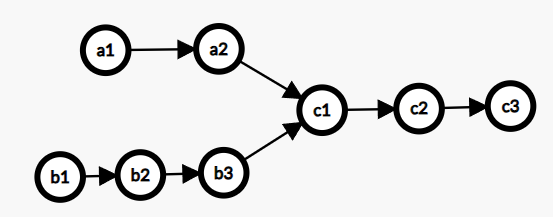
You are given two Singly Linked Lists of integers, which may have an intersection point.
Your task is to return the first intersection node. If there is no intersection, return NULL.
Example:-
The Linked Lists, where a1, a2, c1, c2, c3 is the first linked list and b1, b2, b3, c1, c2, c3 is the second linked list, merging at node c1.
Problem approach
Approach :
1) Calculate the length of both the lists, say len1 and len2
2) Get the absolute difference of the lengths, diff = |len1 – len2|
3) Now traverse the long list from the first node till ‘diff’ nodes so that from there onwards both the lists have equal number of nodes
4) Then traverse both the lists in parallel and check whether a common node is reached (Note that getting a common node is done by comparing the address of the nodes, not the data)
4.1) If yes, return that node’s data
4.2) If no, return -1
TC : O(N) , where N = maximum length of the linked list
SC : O(1)
3. Puzzle
Given two hourglass of 4 minutes and 7 minutes, the task is to measure 9 minutes.
Problem approach
Approach :
1) Start both hourglasses at the same time.
2) At 4 minutes 4 minutes hourglass runs out and flip it. 7 minutes hourglass is left with 3 minutes.
3) At 7 minutes 4 minutes hourglass is left with 1 minute. 7 minutes hourglass runs out and flip it.
4) At 8 minutes: 4 minutes hourglass runs out and 7 is filled with 6 minutes and 1 minute on the other side. Flip it as the sand is left with 1 minute.
5) At 9 minutes: 7 minutes hourglass becomes empty from above side.
4. Aptitude Question
15 people sit around a circular table. What are odds against two particular people sitting together?
Problem approach
15 people can sit around a circular table total in (14!) no. of ways . Out of these total ways only those ways favors for
the happening of the required event in which the two particular persons sit together , which can be done in
(13! ×2!) no. of ways . Hence the required probability = 13! × 2!/(14!) = 2/14 = 1/7 .
So odds in favor 1 : 6 and odds against 6 : 1 .
04
Round
Easy
HR Round
Duration30 Minutes
Interview date6 Sep 2021
Coding problem1
This is a cultural fitment testing round .HR was very frank and asked standard questions. Then we discussed about my role.
1. Basic HR Question
Why should we hire you ?
Problem approach
Tip 1 : The cross questioning can go intense some time, think before you speak.
Tip 2 : Be open minded and answer whatever you are thinking, in these rounds I feel it is important to have opinion.
Tip 3 : Context of questions can be switched, pay attention to the details. It is okay to ask questions in these round,
like what are the projects currently the company is investing, which team you are mentoring. How all is the work
environment etc.
Tip 4 : Since everybody in the interview panel is from tech background, here too you can expect some technical
questions. No coding in most of the cases but some discussions over the design can surely happen.


Here's your problem of the day 
Solving this problem will increase your chance to get selected in this company
Skill covered: Programming
To make an AI less repetitive in a long paragraph, you should increase:
Choose another skill to practice
Similar interview experiences
SDE - 1
3 rounds | 4 problems
Interviewed by JP Morgan
Selected 
0 views

0 comments

0 upvotes
SDE - 1
2 rounds | 5 problems
Interviewed by JP Morgan
Rejected
1058 views
0 comments
0 upvotes
SDE - 1
4 rounds | 8 problems
Interviewed by JP Morgan

Rejected
3132 views
0 comments
0 upvotes
SDE - 1
1 rounds | 2 problems
Interviewed by JP Morgan
Rejected
3168 views
0 comments
0 upvotes
Companies with similar interview experiences
SDE - 1
5 rounds | 12 problems
Interviewed by Amazon
 Selected
 114453 views
24 comments
0 upvotes
SDE - 1
4 rounds | 5 problems
Interviewed by Microsoft
Selected 57719 views
5 comments
0 upvotes
SDE - 1
3 rounds | 7 problems
Interviewed by Amazon
 Selected
 34914 views
7 comments
0 upvotes