





Jupiter Money interview experience Real time questions & tips from candidates to crack your interview

SDE - Intern
Jupiter Money


2 rounds | 2 Coding
problems

 Selected
 Interview preparation journey

Preparation
Duration: 8 months
Topics: Data Structures and Algorithms, Spring Boot with java, Operating Systems, Database Management System, Amazon Web Services

Tip 1 : Please have a strong hold on data structures mainly linked lists, arrays, maths, stacks, trees
Tip 2 : Must explore about DBMS. Means SQL, writing efficient queries, about indexing and other SQL backend process.
Tip 3 : Should work on spring boot. try build some project using spring boot with java (Gradle) as Jupiter's backend tech is mainly based on spring boot with java.
Application process
Where: Campus
Eligibility: none
Tip 1 : Mention only those skills on which you have worked on properly. no need to flood the resume with skills about which you need a little.
Tip 2 : Must mention the links of projects which you have worked on.

Interview rounds
01
Round
Medium
Online Coding Test
Duration90 minutes
Interview date23 Apr 2021
Coding problem1
Timings: it was late night. I started the test at 10 pm
1. Partial BST
Moderate
25m average time
70% success

0/80
Asked in companies



Given a binary tree with N number of nodes, check if that input tree is Partial BST (Binary Search Tree) or not. If yes, return true, return false otherwise.
A binary search tree (BST) is said to be a Partial BST if it follows the following properties.
• The left subtree of a node contains only nodes with data less than and equal to the node’s data.
• The right subtree of a node contains only nodes with data greater than and equal to the node’s data.
• Both the left and right subtrees must also be partial binary search trees.
Example:
Input:
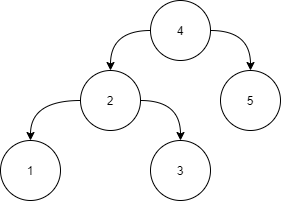
Answer:
Level 1:

All the nodes in the left subtree of 4 (2, 1, 3) are smaller
than 4, all the nodes in the right subtree of the 4 (5) are
larger than 4.

Level 2 :

For node 2:
All the nodes in the left subtree of 2 (1) are smaller than
2, all the nodes in the right subtree of the 2 (3) are larger than 2.
For node 5:
The left and right subtree for node 5 is empty.

Level 3:

For node 1:
The left and right subtree for node 1 are empty.
For node 3:
The left and right subtree for node 3 are empty.
Because all the nodes follow the property of a Partial binary
search tree, the above tree is a Partial binary search tree.
Problem approach
Method 2 above runs slowly since it traverses over some parts of the tree many times. A better solution looks at each node only once. The trick is to write a utility helper function isBSTUtil(struct node* node, int min, int max) that traverses down the tree keeping track of the narrowing min and max allowed values as it goes, looking at each node only once. The initial values for min and max should be INT_MIN and INT_MAX — they narrow from there.
02
Round
Medium
Video Call
Duration45 minutes
Interview date25 May 2022
Coding problem1
It was the interviw round.
the environment was good.
the interviewer was very nice to me.
1. Merge two sorted linked lists
Moderate
15m average time
80% success
0/80
Asked in companies


You are given two sorted linked lists. You have to merge them to produce a combined sorted linked list. You need to return the head of the final linked list.
Note:
The given linked lists may or may not be null.
For example:
If the first list is: 1 -> 4 -> 5 -> NULL and the second list is: 2 -> 3 -> 5 -> NULL

The final list would be: 1 -> 2 -> 3 -> 4 -> 5 -> 5 -> NULL
Problem approach
Merge is one of those nice recursive problems where the recursive solution code is much cleaner than the iterative code. You probably wouldn’t want to use the recursive version for production code, however, because it will use stack space which is proportional to the length of the lists.


Here's your problem of the day 
Solving this problem will increase your chance to get selected in this company
Skill covered: Programming
How do you remove whitespace from the start of a string?
Choose another skill to practice
Similar interview experiences
SDE - Intern
2 rounds | 2 problems
Interviewed by Jupiter Money

Rejected

2459 views

2 comments

0 upvotes
SDE - 1
1 rounds | 3 problems
Interviewed by Jupiter Money
Rejected
1904 views
0 comments
0 upvotes
SDE - Intern
2 rounds | 2 problems
Interviewed by Jupiter Money
Selected 1240 views
0 comments
0 upvotes
Data Analyst
3 rounds | 3 problems
Interviewed by Jupiter Money
Selected 1064 views
0 comments
0 upvotes
Companies with similar interview experiences
SDE - Intern
3 rounds | 6 problems
Interviewed by Amazon

Rejected
15605 views
4 comments
0 upvotes
SDE - Intern
4 rounds | 7 problems
Interviewed by Microsoft
Selected 15499 views
1 comments
0 upvotes
SDE - Intern
2 rounds | 4 problems
Interviewed by Amazon
Selected 10216 views
2 comments
0 upvotes