





JUSPAY interview experience Real time questions & tips from candidates to crack your interview

SDE - Intern
JUSPAY


3 rounds | 7 Coding
problems

Rejected
Interview preparation journey

Preparation
Duration: 5 Months
Topics: Data Structures, Pointers, OOPS, System Design, Algorithms, Dynamic Programming

Tip 1 : Practice Atleast 250 Questions
Tip 2 : Ex- Do atleast 2 projects
Application process
Where: Referral
Eligibility: 7 CGPA
Tip 1 : Have some projects on resume.
Tip 2 : Highlight your major skills.

Interview rounds
01
Round
Hard
Online Coding Test
Duration90 minutes
Interview date14 Sep 2021
Coding problem3
This round consists of 3 DSA-based questions
1. Word Ladder
Hard
10m average time
90% success

0/120
Asked in companies



You are given two strings BEGIN and END and an array of strings DICT. Your task is to find the length of the shortest transformation sequence from BEGIN to END such that in every transformation you can change exactly one alphabet and the word formed after each transformation must exist in DICT.
Note:
1. If there is no possible path to change BEGIN to END then just return -1.
2. All the words have the same length and contain only lowercase english alphabets.
3. The beginning word i.e. BEGIN will always be different from the end word i.e. END (BEGIN != END).
Problem approach
The idea to solve the problem is to use BFS. To find the shortest path through BFS, start from the start word and push it in a queue. And once the target is found for the first time, then return that level of BFS traversal. In each step of BFS one can get all the words that can be formed using that many steps. So whenever the target word is found for the first time that will be the length of the shortest chain of words.
Start from the given start word.
Push the word in the queue
Run a loop until the queue is empty
Traverse all words that adjacent (differ by one character) to it and push the word in a queue (for BFS)
Keep doing so until we find the target word or we have traversed all words.
2. Shortest Unique Prefix
Moderate
15m average time
85% success
0/80
Asked in companies

You are given an array containing ‘N’ words. For each word, you need to find its shortest prefix which can uniquely identify it. For example “abcd” and “abdc” both have the prefix “ab” in common so we can’t uniquely find a word using the prefix “ab”. To uniquely identify both the words we need the prefix “abc” from “abcd” and “abd” from “abdc”.
Note:
You can assume that the words are unique. It means that it is always possible to find a unique prefix for each word.
Problem approach
A Simple Solution is to consider every prefix of every word (starting from the shortest to largest), and if a prefix is not prefix of any other string, then print it.
An Efficient Solution is to use Trie. The idea is to maintain a count in every node. Below are steps.
1) Construct a Trie of all words. Also maintain frequency of every node (Here frequency is number of times node is visited during insertion). Time complexity of this step is O(N) where N is total number of characters in all words.
2) Now, for every word, we find the character nearest to the root with frequency as 1. The prefix of the word is path from root to this character. To do this, we can traverse Trie starting from root. For every node being traversed, we check its frequency. If frequency is one, we print all characters from root to this node and don’t traverse down this node.
Time complexity if this step also is O(N) where N is total number of characters in all words
3. Unique Paths II
Moderate
25m average time
70% success
0/80
Asked in companies



Given a ‘N’ * ’M’ maze with obstacles, count and return the number of unique paths to reach the right-bottom cell from the top-left cell. A cell in the given maze has a value '-1' if it is a blockage or dead-end, else 0. From a given cell, we are allowed to move to cells (i+1, j) and (i, j+1) only. Since the answer can be large, print it modulo 10^9 + 7.
For Example :
Consider the maze below :
0 0 0
0 -1 0
0 0 0

There are two ways to reach the bottom left corner -

(1, 1) -> (1, 2) -> (1, 3) -> (2, 3) -> (3, 3)
(1, 1) -> (2, 1) -> (3, 1) -> (3, 2) -> (3, 3)

Hence the answer for the above test case is 2.
Problem approach
The idea is to modify the given grid[][] so that grid[i][j] contains count of paths to reach (i, j) from (0, 0) if (i, j) is not a blockage, else grid[i][j] remains -1.
02
Round
Easy
Online Coding Test
Duration150 minutes
Interview date16 Sep 2021
Coding problem3
Technical round -1
1. Job Sequencing Problem
Moderate
30m average time
70% success
0/80
Asked in companies


You are given a 'Nx3' 2-D array 'Jobs' describing 'N' jobs where 'Jobs[i][0]' denotes the id of 'i-th' job, 'Jobs[i][1]' denotes the deadline of 'i-th' job, and 'Jobs[i][2]' denotes the profit associated with 'i-th job'.
You will make a particular profit if you complete the job within the deadline associated with it. Each job takes 1 unit of time to be completed, and you can schedule only one job at a particular time.
Return the number of jobs to be done to get maximum profit.
Note :
If a particular job has a deadline 'x', it means that it needs to be completed at any time before 'x'.

Assume that the start time is 0.
For Example :
'N' = 3, Jobs = [[1, 1, 30], [2, 3, 40], [3, 2, 10]].

All the jobs have different deadlines. So we can complete all the jobs.

At time 0-1, Job 1 will complete.
At time 1-2, Job 3 will complete.
At time 2-3, Job 2 will complete.

So our answer is [3 80].
2. Count Subarrays Having Product Less Than K
Moderate
25m average time
75% success
0/80
Asked in companies


You are given an array ‘ARR’ consist of ‘N’ positive integers, and a positive integer ‘K’.
Your task is to count and return the number of contiguous subarrays having products of their elements strictly less than ‘K’.
Example:
Consider an array ARR = [1, 2, 3, 4, 5], and K = 7, then all the subarrays having product less than 7 are [1], [2], [3], [4], [5], [1, 2], [2,3], [1,2,3] i.e there is total 8 subarays having product less than 7.
Problem approach
naive approach to this problem is to generate all subarrays of the array and then count the number of arrays having product less than K.
3. 0 1 Knapsack
Easy
15m average time
85% success
0/40
Asked in companies



A thief is robbing a store and can carry a maximal weight of W into his knapsack. There are N items and the ith item weighs wi and is of value vi. Considering the constraints of the maximum weight that a knapsack can carry, you have to find and return the maximum value that a thief can generate by stealing items.
03
Round
Easy
Assignment
Duration90 minutes
Interview date18 Sep 2021
Coding problem1
1. Chocolate Problem
Moderate
15m average time
85% success
0/80
Asked in companies


Given an array/list of integer numbers 'CHOCOLATES' of size 'N', where each value of the array/list represents the number of chocolates in the packet. There are ‘M’ number of students and the task is to distribute the chocolate to their students. Distribute chocolate in such a way that:
1. Each student gets at least one packet of chocolate.
2. The difference between the maximum number of chocolate in a packet and the minimum number of chocolate in a packet given to the students is minimum.
Example :
Given 'N' : 5 (number of packets) and 'M' : 3 (number of students)
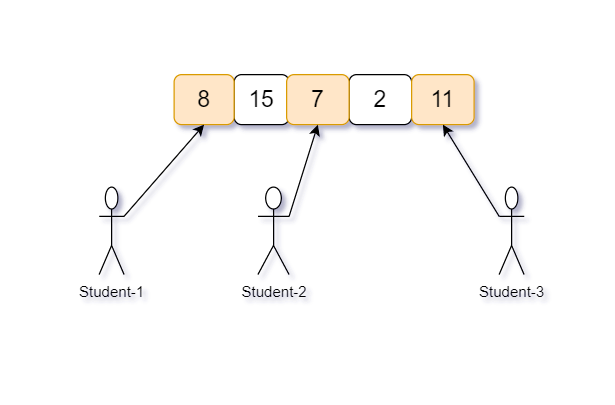
And chocolates in each packet is : {8, 11, 7, 15, 2}

All possible way to distribute 5 packets of chocolates among 3 students are -

( 8,15, 7 ) difference of maximum-minimum is ‘15 - 7’ = ‘8’
( 8, 15, 2 ) difference of maximum-minimum is ‘15 - 2’ = ‘13’
( 8, 15, 11 ) difference of maximum-minimum is ‘15 - 8’ = ‘7’
( 8, 7, 2 ) difference of maximum-minimum is ‘8 - 2’ = ‘6’
( 8, 7, 11 ) difference of maximum-minimum is ‘11 - 7’ = ‘4’
( 8, 2, 11 ) difference of maximum-minimum is ‘11 - 2’ = ‘9’
( 15, 7, 2 ) difference of maximum-minimum is ‘15 - 2’ = 13’
( 15, 7, 11 ) difference of maximum-minimum is ‘15 - 7’ = ‘8’
( 15, 2, 11 ) difference of maximum-minimum is ‘15 - 2’ = ‘13’
( 7, 2, 11 ) difference of maximum-minimum is ‘11 - 2’ = ‘9’

Hence there are 10 possible ways to distribute ‘5’ packets of chocolate among the ‘3’ students and difference of combination (8, 7, 11) is ‘maximum - minimum’ = ‘11 - 7’ = ‘4’ is minimum in all of the above.


Here's your problem of the day 
Solving this problem will increase your chance to get selected in this company
Skill covered: Programming
What does dict.keys() return?
Choose another skill to practice
Similar interview experiences
SDE - Intern
1 rounds | 2 problems
Interviewed by JUSPAY
Rejected

3644 views

0 comments

0 upvotes
SDE - Intern
4 rounds | 3 problems
Interviewed by JUSPAY

 Selected
 4137 views
1 comments
0 upvotes
SDE - Intern
3 rounds | 4 problems
Interviewed by JUSPAY
Selected 0 views
0 comments
0 upvotes
SDE - Intern
3 rounds | 5 problems
Interviewed by JUSPAY

Rejected
2020 views
0 comments
0 upvotes
Companies with similar interview experiences
SDE - Intern
3 rounds | 6 problems
Interviewed by Amazon

Rejected
16227 views
4 comments
0 upvotes
SDE - Intern
4 rounds | 7 problems
Interviewed by Microsoft
 Selected
 16245 views
1 comments
0 upvotes
SDE - Intern
2 rounds | 4 problems
Interviewed by Amazon
Selected 10549 views
2 comments
0 upvotes