





Leena AI interview experience Real time questions & tips from candidates to crack your interview

SDE - 1
Leena AI


5 rounds | 11 Coding
problems

 Selected
 Interview preparation journey

Journey
When I began my journey into the world of technology, I had no idea where it would take me. Like most beginners, I started with the basics—learning programming languages, understanding algorithms, and building simple projects. But what truly kept me going was my passion for coding and curiosity to explore more.
I completed my B.Tech in Software Engineering at Delhi Technological University, where I got my first real taste of coding. I delved into various programming languages and technologies, eventually gravitating toward the MERN stack and Python, which became my go-to tech stack. During this time, I worked on several projects—some as part of my coursework, and others out of sheer curiosity. These projects not only sharpened my skills but also taught me the importance of problem-solving and thinking outside the box.
A turning point in my journey came when I began working on generative AI. This area fascinated me due to its potential to revolutionize industries, and I spent countless hours learning and experimenting. This hands-on experience was crucial in shaping my technical understanding and preparing me for my future roles.
After graduation, I joined Leena AI as a Software Development Engineer 1 (Backend), where I had the opportunity to work on building autonomous agents that help reduce HR-related queries in enterprises. It was an incredible learning experience that honed my backend development skills and gave me the chance to solve real-world problems. One of my significant contributions was integrating various in-house products with these autonomous agents, making them more efficient and user-friendly.
The journey wasn’t without challenges. Balancing multiple technologies, staying updated with the latest trends, and ensuring that my solutions were scalable and efficient required constant learning and adaptation. However, it was all worth it when I received recognition from my company—a significant milestone in my career.
Cracking the job interview at Leena AI wasn’t easy either. It required not only technical knowledge but also the ability to think critically and solve problems on the fly. What helped me succeed was my hands-on experience with various technologies, my understanding of backend systems, and my ability to articulate my thought process during the interview.
To anyone on a similar journey, my advice is to stay curious and never stop learning. Work on projects that excite you, take on challenges that push your limits and always strive to improve. The road may be tough, but with persistence and passion, you’ll get where you want to be.
Application story
Leena AI visited our campus at Delhi Technological University (DTU) for the first time. The recruitment process began with an online assessment, which was open to all eligible students. After clearing this initial round, I advanced to the first interview, which focused on Data Structures and Algorithms (DSA).
The second round was a mix of basic system design, another DSA question, and some core subject questions. This round tested both my theoretical knowledge and practical problem-solving abilities.
The final round was with the CTO and was entirely project-based. We discussed the projects I had worked on, and I was asked to tackle some real-world problems relevant to the company’s work. This round allowed me to demonstrate my technical skills in a practical context and how I could contribute to their ongoing projects.
Why selected/rejected for the role?
I believe I was selected for the role because of my strong technical skills and problem-solving abilities. My experience in backend development, particularly with the MERN stack, Python, and FastAPI, aligned well with the company’s needs. During the interview, I focused on clearly explaining my approach to problem-solving, which helped me stand out.
In addition to my technical skills, I thoroughly researched the company before the interview. I learned about their mission, projects, and the challenges they were addressing. I showed genuine interest in how I could contribute to solving their problem statements, which I believe made a strong impression. Demonstrating curiosity and eagerness to work on the company’s specific challenges shows that you're not just looking for any job, but are genuinely interested in what they do.
Preparation
Duration: 6 months
Topics: Data Structures, OOPS, DBMS, Operating System, System Design

Tip 1: The number of questions solved doesn't matter; your thinking ability does. For some people, 150 questions are enough, while for others, even 1,000 may not be sufficient. Just focus on improving your problem-solving skills. On average, solving 250 questions should be enough.
Tip 2: CGPA matters. Keep your CGPA above 9 to at least get shortlisted by most companies. I've seen people with an 8.8 CGPA miss opportunities because of their score.
Tip 3: Complete at least two projects. Ensure that each project includes at least one problem you genuinely solved—even if it's a simple one. Be prepared to discuss these projects in detail.
Application process
Where: Campus
Eligibility: 7.5 CGPA (Salary Package - 15 LPA)
Tip 1: You should have at least two good projects on your resume where you've solved at least one real-world problem. If you're adding GitHub links to the projects, make sure you’ve worked with Git and there are commits. This shows that you’ve truly worked on the project yourself and have knowledge of how the SDLC (Software Development Life Cycle) works.
Tip 2: Do not list random skills or false information on your resume. Only include skills you’re confident enough to answer at least basic questions about.

Interview rounds
01
Round
Medium
Online Coding Interview
Duration60 minutes
Interview date10 Dec 2023
Coding problem3
1. Rotate matrix by 90 degrees
Easy
15m average time
85% success

0/40
Asked in companies



You are given a square matrix of non-negative integers 'MATRIX'. Your task is to rotate that array by 90 degrees in an anti-clockwise direction using constant extra space.
For example:
For given 2D array :

    [    [ 1,  2,  3 ],
         [ 4,  5,  6 ],
         [ 7,  8,  9 ]  ]

After 90 degree rotation in anti clockwise direction, it will become:

    [   [ 3,  6,  9 ],
        [ 2,  5,  8 ],
        [ 1,  4,  7 ]   ]
Problem approach
1. Transpose the Matrix: Imagine your matrix as a grid. The first thing you need to do is swap the rows with the columns. For example, if you have a number in the first row and second column, you move it to the second row and first column. You repeat this for all the elements in the matrix. Essentially, you're flipping the grid over its diagonal.
2. Flip Each Row: After transposing, the next step is to reverse the order of elements in each row. Think of it like reading the row backwards. So, you take the first element of the row and swap it with the last one, then move to the next pair of elements and keep swapping until you've reversed the entire row.
By doing these two steps, you effectively rotate the matrix by 90 degrees clockwise, and you do it without using any extra space—just by modifying the matrix in place.
2. Fine Calculation Logic
An if-else problem involves calculating a fine based on two dates with certain conditions.
Problem approach
It was a simple task where you had to extract the year, month, and day from a string and compare it with another date to calculate a fine based on certain conditions. For example, if the book is returned in the same month, the fine is 50. If it’s returned in the same year but a different month, the fine is 200. If it’s returned in a different year, the fine is 1,000.
3. Excel Column Number
Easy
23m average time
0/40
Asked in companies



Find Excel column name from a given column number for example 1-A, 2-B, 26-Z, 51-AY
Problem approach
Just apply a loop until n becomes 0, divide n/26 each time and append "A" + n%26 - 1 to the ans string each time in the loop.
02
Round
Easy
HR Round
Duration5 minutes
Interview date13 Dec 2023
Coding problem1
1. HR question
Basic HR questions, What do you know about Leena AI? Why are you interested in this role?
Problem approach
Tip 1: Just read the job description very well.
Tip 2: Be confident.
03
Round
Easy
Video Call
Duration45 minutes
Interview date15 Dec 2023
Coding problem2
1. Maximum Difference Between Node And Ancestor
Easy
10m average time
90% success
0/40
Asked in companies

Given a binary tree, return the maximum absolute difference between a node and its ancestor, for any ancestor-node pair in the binary tree.
The ancestor of any node is defined as the node/nodes which come above the current node in the binary tree. For example, the root node is ancestor of every node in the binary tree.
For example :
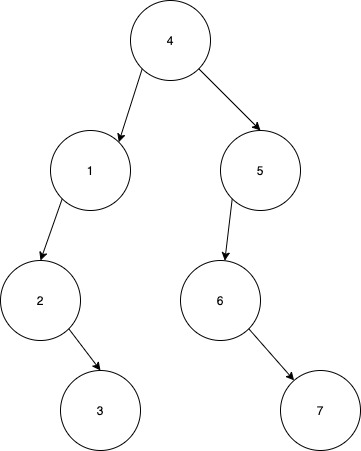
In the above figure, we have many nodes which have a node and ancestor relationship.
Some of them are, and their difference is:
|1-4|=3
|2-4|=2
|3-4|=1
|6-4|=2
|7-4|=3
And more
Out of all the possible parent ancestor pairs, the one with the maximum absolute difference is between nodes (7 and 4) and (1 and 4) which is 3. Therefore, the answer to this case is 3.
Problem approach
The approach is to have one variable holding the maximum value of one leg (left) and another holding the minimum value of the same leg. The difference between the two should be stored in another variable, one for each leg. Finally, the maximum of the differences for both legs (a, b) should be returned.
2. Count the Number of Complete Components
Hard
40m average time
65% success
0/120
Asked in companies



You are given an unweighted directed graph having 'V' vertices and 'E' edges. Your task is to count the number of strongly connected components (SCCs) present in the graph.
A directed graph is said to be strongly connected if every vertex is reachable from every other vertex. The strongly connected components of a graph are the subgraphs which are themselves strongly connected.
Note :
Use zero-based indexing for the vertices.

The given graph doesn’t contain any self-loops.
Problem approach
DFS-based solution.
04
Round
Easy
Video Call
Duration60 minutes
Interview date19 Dec 2023
Coding problem1
1. System Design
I have to design a database for a question bank for a test platform.
- Need to identify either to use SQL/NoSQL
- Creating different models required
- Finding out time complexity for various types of db queries
Problem approach
Tip 1: Study dbms SQL/NoSQL
Tip 2: Practice creating db schemas for real-world software platforms
05
Round
Easy
Video Call
Duration30 minutes
Interview date24 Dec 2023
Coding problem4
It was the final round with the CTO of the company. It was completely project-based.
1. Time complexity
The time complexity of binary search in an unsorted array.
Problem approach
first sorting and then binary search so, O(nlogn + logn)
2. Operating System
How does multithreading work? Difference between concurrent and parallel. (Learn)
3. Computer Network
What happens when you search on Google.com? The interviewer focused on each term you used in your answer and asked for more details. For example:
- What is DNS?
- What is the 3-way handshake?
- What is TCP?
4. Project-based questions
Project-based questions such as: How did you improve the performance time of your website? How did you measure response time? And many more.
Problem approach
Tip 1: Keep your project on your tips.


Here's your problem of the day 
Solving this problem will increase your chance to get selected in this company
Skill covered: Programming
How do you remove whitespace from the start of a string?
Choose another skill to practice
Similar interview experiences

SDE - 1
3 rounds | 7 problems
Interviewed by OYO
Selected 
6182 views

0 comments

0 upvotes

SDE - 1
2 rounds | 5 problems
Interviewed by Meesho
Rejected
7245 views
0 comments
0 upvotes

SDE - 1
3 rounds | 9 problems
Interviewed by Salesforce
 Selected
 4552 views
0 comments
0 upvotes
SDE - 1
3 rounds | 9 problems
Interviewed by Leena AI
Selected 794 views
0 comments
0 upvotes
Companies with similar interview experiences
SDE - 1
5 rounds | 12 problems
Interviewed by Amazon
 Selected
 117552 views
24 comments
0 upvotes
SDE - 1
4 rounds | 5 problems
Interviewed by Microsoft
Selected 60143 views
5 comments
0 upvotes
SDE - 1
3 rounds | 7 problems
Interviewed by Amazon
 Selected
 36138 views
7 comments
0 upvotes