





Lemnisk interview experience Real time questions & tips from candidates to crack your interview
SDE - Intern
Lemnisk


2 rounds | 2 Coding
problems

Rejected
Interview preparation journey

Journey
My journey as a Software Development Engineer (SDE) began during my first year of college. Driven by a passion for technology and a desire to create impactful solutions, I embarked on a path that has shaped both my career and personal growth. My journey as a Software Development Engineer (SDE) began during my first year of college. Driven by a passion for technology and a desire to create impactful solutions, I embarked on a path that has shaped both my career and personal growth. Through dedication, perseverance, and continuous learning, I navigated the various challenges and opportunities that came my way, ultimately leading me to where I stand today as an SDE. Along the way, I practiced coding on popular online platforms and actively participated in coding competitions, which strengthened my problem-solving skills and deepened my understanding of algorithms and data structures.
Application story
I messaged a recruiter on LinkedIn, and she reviewed my resume and gave me a call to schedule the interview rounds.
Why selected/rejected for the role?
I was rejected due to poor internet connectivity, which frustrated the interviewer and made it difficult for him to understand what I was saying.
Preparation
Duration: 6 Months
Topics: Data Structures, Algorithms, Operating System, OOPS

Tip 1: Prepare Data Structures and Algorithms thoroughly from popular coding platforms.
Tip 2: Add at least two CRUD-based projects to your resume.
Application process
Where: Other
Eligibility: No Criteria
Tip 1: Add two projects based on CRUD operations to your resume.
Tip 2: Mention all your achievements from coding platforms.

Interview rounds
01
Round
Medium
Video Call
Duration60 Minutes
Interview date29 Mar 2023
Coding problem2
He asked me two data structures and algorithms questions and one question about my projects.
1. Container With Most Water
Moderate
15m average time
90% success

0/80
Asked in companies



Given a sequence of ‘N’ space-separated non-negative integers A[1],A[2],A[3],......A[i]…...A[n]. Where each number of the sequence represents the height of the line drawn at point 'i'. Hence on the cartesian plane, each line is drawn from coordinate ('i',0) to coordinate ('i', 'A[i]'), here ‘i’ ranges from 1 to ‘N’. Find two lines, which, together with the x-axis forms a container, such that the container contains the most area of water.
Note :
1. You can not slant the container i.e. the height of the water is equal to the minimum height of the two lines which define the container.

2. Do not print anything, you just need to return the area of the container with maximum water.
Example
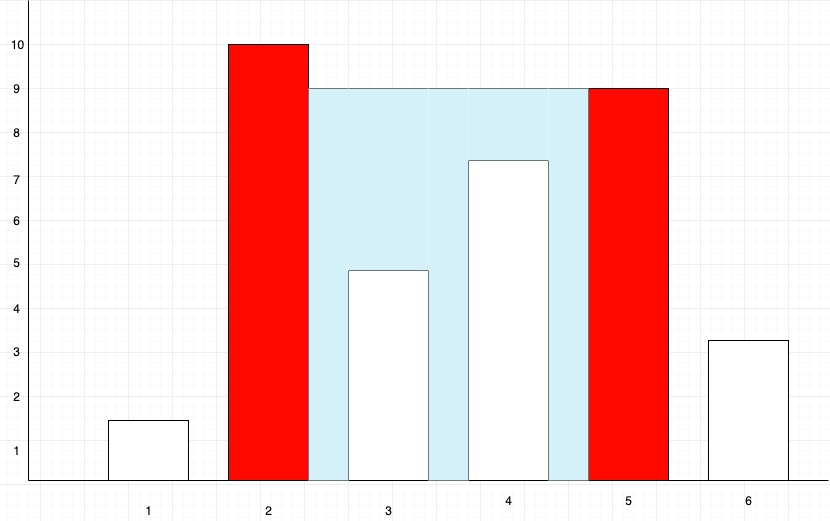
For the above Diagram, the first red marked line is formed between coordinates (2,0) and (2,10), and the second red-marked line is formed between coordinates (5,0) and (5,9). The area of water contained between these two lines is (height* width) = (5-2)* 9 = 27, which is the maximum area contained between any two lines present on the plane. So in this case, we will return 3* 9=27.
Problem approach
Given an array representing the heights of boundary lines of a container, the task is to find the maximum amount of water that can be stored in the container. Start by considering the first and the last element of the array, and calculate the amount of water that can be stored between these two boundaries. Store this value as the current maximum.
Now, the important question is — can there be better boundary pairs that can hold more water? There is a smart approach to find this. Initially, two pointers are placed: one at the first element (left boundary) and the other at the last element (right boundary). If the height at the left pointer is smaller than the height at the right pointer, move the left pointer one step to the right. Otherwise, move the right pointer one step to the left.
Since the width decreases with every step, this process ensures that the optimal solution is found efficiently.
2. LCA Of Binary Tree
Moderate
10m average time
90% success
0/80
Asked in companies



You have been given a Binary Tree of distinct integers and two nodes ‘X’ and ‘Y’. You are supposed to return the LCA (Lowest Common Ancestor) of ‘X’ and ‘Y’.
The LCA of ‘X’ and ‘Y’ in the binary tree is the shared ancestor of ‘X’ and ‘Y’ that is located farthest from the root.
Note :
You may assume that given ‘X’ and ‘Y’ definitely exist in the given binary tree.
For example :
For the given binary tree
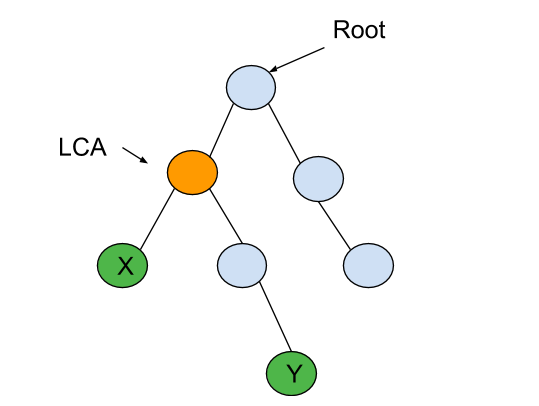
LCA of ‘X’ and ‘Y’ is highlighted in yellow colour.
Problem approach
Start from the root node and traverse the tree.
Until we find both nodes p and q, keep storing the parent pointers in a dictionary.
Once we have found both p and q, retrieve all ancestors for node p using the parent dictionary and add them to a set called ancestors.
Next, traverse the ancestors of node q. If any ancestor of q is already present in the ancestors set, it means this is the first common ancestor between p and q (while moving upwards), and therefore, this is the Lowest Common Ancestor (LCA) node.
02
Round
Medium
Video Call
Duration60 Minutes
Interview date3 Apr 2023
Coding problem0
It was based on my SDE internship experience at Groww, which I explained to him in detail. He then asked me to create a high-level design for my projects.


Here's your problem of the day 
Solving this problem will increase your chance to get selected in this company
Skill covered: Programming
How do you remove whitespace from the start of a string?
Choose another skill to practice
Similar interview experiences

SDE - 1
3 rounds | 7 problems
Interviewed by OYO
 Selected
6182 views

0 comments

0 upvotes
SDE - Intern
2 rounds | 3 problems
Interviewed by Amazon
Rejected
1566 views
0 comments
0 upvotes

SDE - 1
2 rounds | 5 problems
Interviewed by Meesho
Rejected
7246 views
0 comments
0 upvotes

SDE - 1
3 rounds | 9 problems
Interviewed by Salesforce
 Selected
 4552 views
0 comments
0 upvotes
Companies with similar interview experiences
SDE - Intern
3 rounds | 6 problems
Interviewed by Amazon

Rejected
16213 views
4 comments
0 upvotes

SDE - Intern
4 rounds | 7 problems
Interviewed by Microsoft
 Selected
 16224 views
1 comments
0 upvotes
SDE - Intern
2 rounds | 4 problems
Interviewed by Amazon
Selected 10541 views
2 comments
0 upvotes