





LinkedIn interview experience Real time questions & tips from candidates to crack your interview

SDE - Intern
LinkedIn


2 rounds | 5 Coding
problems

 Selected
 Interview preparation journey

Preparation
Duration: 6 months
Topics: Data Structures, Pointers, OOPS, System Design, Algorithms, Dynamic Programming, OS, DBMS

Tip 1 : Practice at least 250 Questions from coding websites
Tip 2 : Do at least 2 good projects
Application process
Where: Campus
Eligibility: Above 7 CGPA
Tip 1 : Have some projects on your resume.
Tip 2 : Do not put false things on your resume and be confident.

Interview rounds
01
Round
Easy
Online Coding Test
Duration60 minutes
Interview date2 Feb 2019
Coding problem3
3 coding questions to be solved in 60 minutes
1. Minimum steps to reach target by a Knight
Moderate
25m average time
60% success

0/80
Asked in companies



You have been given a square chessboard of size ‘N x N’. The position coordinates of the Knight and the position coordinates of the target are also given.
Your task is to find out the minimum steps a Knight will take to reach the target position.
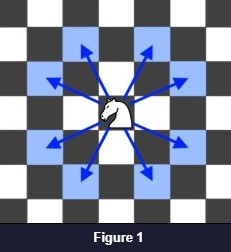
Example:
knightPosition: {3,4}
targetPosition: {2,1}
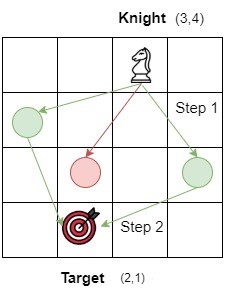
The knight can move from position (3,4) to positions (1,3), (2,2) and (4,2). Position (4,2) is selected and the ‘stepCount’ becomes 1. From position (4,2), the knight can directly jump to the position (2,1) which is the target point and ‘stepCount’ becomes 2 which is the final answer.
Note:
1. The coordinates are 1 indexed. So, the bottom left square is (1,1) and the top right square is (N, N).

2. The knight can make 8 possible moves as given in figure 1.

3. A Knight moves 2 squares in one direction and 1 square in the perpendicular direction (or vice-versa).
Problem approach
This problem can be seen as the shortest path in an unweighted graph. Therefore we use BFS to solve this problem. We try all 8 possible positions that a Knight can reach from its position. If the reachable position is not already visited and is inside the board, we push this state into the queue with a distance of 1 more than its parent state. Finally, we return the distance of the target position, when it gets popped out from the queue
2. Longest Palindromic Subsequence
Hard
45m average time
50% success
0/120
Asked in companies



You have been given a string ‘A’ consisting of lower case English letters. Your task is to find the length of the longest palindromic subsequence in ‘A’.
A subsequence is a sequence generated from a string after deleting some or no characters of the string without changing the order of the remaining string characters. (i.e. “ace” is a subsequence of “abcde” while “aec” is not).
A string is said to be palindrome if the reverse of the string is the same as the actual string. For example, “abba” is a palindrome, but “abbc” is not a palindrome.
Problem approach
The naive solution for this problem is to generate all subsequences of the given sequence and find the longest palindromic subsequence.
3. Validate BST
Moderate
25m average time
0/80
Asked in companies



You have been given a binary tree of integers with N number of nodes. Your task is to check if that input tree is a BST (Binary Search Tree) or not.
A binary search tree (BST) is a binary tree data structure which has the following properties.
• The left subtree of a node contains only nodes with data less than the node’s data.
• The right subtree of a node contains only nodes with data greater than the node’s data.
• Both the left and right subtrees must also be binary search trees.
Example :
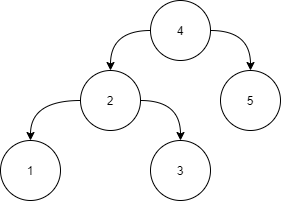
Answer :
Level 1:

All the nodes in the left subtree of 4 (2, 1, 3) are smaller
than 4, all the nodes in the right subtree of the 4 (5) are
larger than 4.

Level 2 :

For node 2:
All the nodes in the left subtree of 2 (1) are smaller than
2, all the nodes in the right subtree of the 2 (3) are larger than 2.
For node 5:
The left and right subtrees for node 5 are empty.

Level 3:

For node 1:
The left and right subtrees for node 1 are empty.
For node 3:
The left and right subtrees for node 3 are empty.

Because all the nodes follow the property of a binary search tree, the above tree is a binary search tree.
Problem approach
Find the first greater value on right side of current node.
Let the index of this node be j. Return true if following
conditions hold. Else return false
(i) All values after the above found greater value are
greater than current node.
(ii) Recursive calls for the subarrays pre[i+1..j-1] and
pre[j+1..n-1] also return true.
02
Round
Medium
Face to Face
Duration60 minutes
Interview date14 Feb 2019
Coding problem2
Firstly interviewer asked me about myself. Then 2 coding questions were asked.
1. Count Complete Binary Tree Nodes
Easy
10m average time
90% success
0/40
Asked in companies

Given a complete binary tree, you are supposed to return the number of nodes in the given tree.
In a complete binary tree every level, except possibly the last, is completely filled, and all nodes in the last level are as far left as possible.
For example:
For the binary trees in the image below.
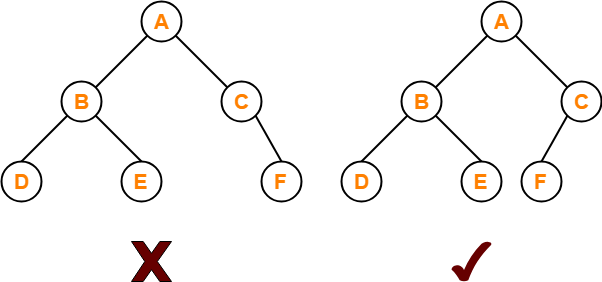
The left tree in the image is not a complete binary tree that’s why it is invalid and the right tree in the image is a valid complete binary tree which contains total 6 nodes.
Problem approach
The idea is to first traverse the tree. Since we need to see the maximum value in the given path, the pre-order traversal is used to traverse the given binary tree. While traversing the tree, we need to keep the track of the maximum value of the node that we have seen so far. If the current node is greater or equal to the max value, then increment the count of the visible node and update the max value with the current node value.
2. Stack using queue
Moderate
25m average time
65% success
0/80
Asked in companies

Implement a Stack Data Structure specifically to store integer data using two Queues.
There should be two data members, both being Queues to store the data internally. You may use the inbuilt Queue.
Implement the following public functions :
1. Constructor:
It initializes the data members(queues) as required.

2. push(data) :
This function should take one argument of type integer. It pushes the element into the stack and returns nothing.

3. pop() :
It pops the element from the top of the stack and, in turn, returns the element being popped or deleted. In case the stack is empty, it returns -1.

4. top :
It returns the element being kept at the top of the stack. In case the stack is empty, it returns -1.

5. size() :
It returns the size of the stack at any given instance of time.

6. isEmpty() :
It returns a boolean value indicating whether the stack is empty or not.
Operations Performed on the Stack:
Query-1(Denoted by an integer 1): Pushes an integer data to the stack. (push function)

Query-2(Denoted by an integer 2): Pops the data kept at the top of the stack and returns it to the caller. (pop function)

Query-3(Denoted by an integer 3): Fetches and returns the data being kept at the top of the stack but doesn't remove it, unlike the pop function. (top function)

Query-4(Denoted by an integer 4): Returns the current size of the stack. (size function)

Query-5(Denoted by an integer 5): Returns a boolean value denoting whether the stack is empty or not. (isEmpty function)
Example
Operations:
1 5
1 10
2
3
4

Enqueue operation 1 5: We insert 5 at the back of the queue.
  Queue: [5]

Enqueue operation 1 10: We insert 10 at the back of the queue.
  Queue: [5, 10]

Dequeue operation 2: We remove the element from the front of the queue, which is 5, and print it.
  Output: 5
  Queue: [10]

Peek operation 3: We return the element present at the front of the queue, which is 10, without removing it.
  Output: 10
  Queue: [10]

IsEmpty operation 4: We check if the queue is empty.
  Output: False
  Queue: [10]


Here's your problem of the day 
Solving this problem will increase your chance to get selected in this company
Skill covered: Programming
How do you remove whitespace from the start of a string?
Choose another skill to practice
Similar interview experiences
SDE - Intern
2 rounds | 2 problems
Interviewed by LinkedIn
Selected 
1681 views

0 comments

0 upvotes
SDE - Intern
2 rounds | 4 problems
Interviewed by LinkedIn
 Selected
 3228 views
0 comments
0 upvotes
SDE - Intern
2 rounds | 4 problems
Interviewed by LinkedIn
Rejected
1028 views
0 comments
0 upvotes
SDE - Intern
2 rounds | 6 problems
Interviewed by LinkedIn
Selected 1542 views
0 comments
0 upvotes
Companies with similar interview experiences

SDE - Intern
2 rounds | 4 problems
Interviewed by Arcesium
 Selected
 3739 views
0 comments
0 upvotes
SDE - Intern
3 rounds | 5 problems
Interviewed by Arcesium
Selected 2683 views
0 comments
0 upvotes

SDE - Intern
3 rounds | 5 problems
Interviewed by BNY Mellon
 Selected
 2348 views
0 comments
0 upvotes