





MakeMyTrip interview experience Real time questions & tips from candidates to crack your interview

SDE - 1
MakeMyTrip


4 rounds | 7 Coding
problems

 Selected
 Interview preparation journey

Preparation
Duration: 4 Months
Topics: Data Structures, DBMS, Operating System, OOPS, Algorithms.

Tip 1 : Cover all the programming topics first(like array, string, maths, stack etc) from any interview preparation website.
Tip 2 : Always go though previous interview experiences.
Tip 3 : Projects/CGPA are important for resume shortlisting.
Application process
Where: Campus
Eligibility: CGPA 6 above.
Tip 1 : Have some projects on resume.
Tip 2 : Resume should always be short & to the point.(One page only).

Interview rounds
01
Round
Medium
Face to Face
Duration60 Minutes
Interview date27 Dec 2018
Coding problem2
Face to face
1. Top View Of Binary Tree
Moderate
25m average time
70% success

0/80
Asked in companies


You are given a Binary Tree of 'n' nodes.
The Top view of the binary tree is the set of nodes visible when we see the tree from the top.
Find the top view of the given binary tree, from left to right.
Example :
Input: Let the binary tree be:
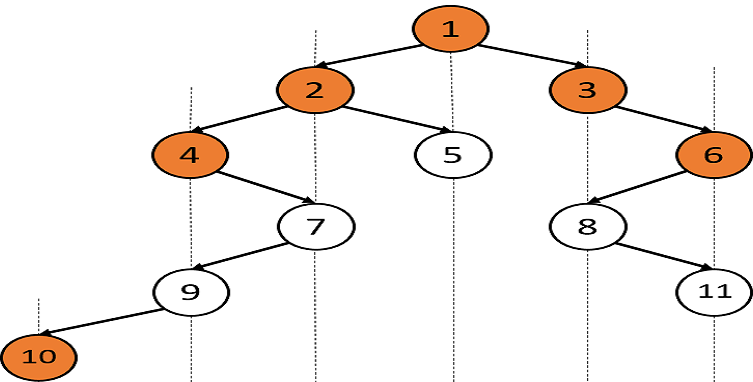
Output: [10, 4, 2, 1, 3, 6]

Explanation: Consider the vertical lines in the figure. The top view contains the topmost node from each vertical line.
Problem approach
Used map to store the top view in ordered map.
2. Puzzle
Get 120 using five zeros.
Problem approach
Tip 1 : Tried to break 120 into different factors.
02
Round
Medium
Face to Face
Duration60 Minutes
Interview date27 Dec 2018
Coding problem2
Face to face interview.
1. Implement a Queue
Easy
20m average time
80% success
0/40
Asked in companies


Implement a Queue Data Structure specifically to store integer data using a Singly Linked List or an array.
You need to implement the following public functions :
1. Constructor: It initializes the data members as required.

2. enqueue(data): This function should take one argument of type integer. It enqueues the element into the queue.

3. dequeue(): It dequeues/removes the element from the front of the queue and in turn, returns the element being dequeued or removed. In case the queue is empty, it returns -1.

4. front(): It returns the element being kept at the front of the queue. In case the queue is empty, it returns -1.

5. isEmpty(): It returns a boolean value indicating whether the queue is empty or not.
Operations Performed on the Queue :
Query-1(Denoted by an integer 1): Enqueues integer data to the queue.

Query-2(Denoted by an integer 2): Dequeues the data kept at the front of the queue and returns it to the caller, return -1 if no element is present in the queue.

Query-3(Denoted by an integer 3): Fetches and returns the data being kept at the front of the queue but doesn't remove it, unlike the dequeue function, return -1 if no element is present in the queue.

Query-4(Denoted by an integer 4): Returns a boolean value denoting whether the queue is empty or not.
Problem approach
Used two pointer to keep track of first & last pointer.
2. Implement a Queue
Easy
20m average time
80% success
0/40
Asked in companies
Implement a Queue Data Structure specifically to store integer data using a Singly Linked List or an array.
You need to implement the following public functions :
1. Constructor: It initializes the data members as required.

2. enqueue(data): This function should take one argument of type integer. It enqueues the element into the queue.

3. dequeue(): It dequeues/removes the element from the front of the queue and in turn, returns the element being dequeued or removed. In case the queue is empty, it returns -1.

4. front(): It returns the element being kept at the front of the queue. In case the queue is empty, it returns -1.

5. isEmpty(): It returns a boolean value indicating whether the queue is empty or not.
Operations Performed on the Queue :
Query-1(Denoted by an integer 1): Enqueues integer data to the queue.

Query-2(Denoted by an integer 2): Dequeues the data kept at the front of the queue and returns it to the caller, return -1 if no element is present in the queue.

Query-3(Denoted by an integer 3): Fetches and returns the data being kept at the front of the queue but doesn't remove it, unlike the dequeue function, return -1 if no element is present in the queue.

Query-4(Denoted by an integer 4): Returns a boolean value denoting whether the queue is empty or not.
03
Round
Medium
Face to Face
Duration60 Minutes
Interview date27 Dec 2018
Coding problem2
Face to face interview.
1. Given a string, find the next smallest palindrome
Easy
12m average time
80% success
0/40
Asked in companies


You are given a number 'N' in the form of a string 'S', your task is to find the smallest number strictly greater than the given number 'N' which is a palindrome.
Note:
1) A palindrome is a word, number, phrase, or another sequence of characters that reads the same backward as forward, such as 'naman', 'abcba', '1234321', etc
2) The numerical value of the given string 'S' will be greater than 0.
3) A single-digit number is also considered as a palindrome.
4) Note that the length of the string 'S' is nothing but the number of digits in the number 'N'.
Problem approach
Used the principal of palindrome, checking which digits needs to be equal.
2. Look-And-Say Sequence
Easy
15m average time
85% success
0/40
Asked in companies

The Look-And-Say sequence is a sequence of positive integers. The sequence is as follows:
1, 11, 21, 1211, 111221, 312211, 13112221,...
This sequence is constructed in the following way:
The first number is 1.

This is read as “One 1”.
Hence, the second number will be 11.

The second number is read as “Two 1s”.
Hence, the third number will be 21.

The third number is read as “One 2, One 1”.
Hence, the fourth number will be 1211. And so on.

The fourth term is read as “One 1, One 2, Two 1s”.

Hence, the fifth term will be 111221. And so on.
Given an integer N, find the Nth term of the sequence.
Problem approach
Used two variables, one to store the number other to store the count.
04
Round
Easy
HR Round
Duration60 Minutes
Interview date27 Dec 2018
Coding problem1
General behaviour questions.
1. Basic HR Questions
What sports do you like and why?
Are you a team player?


Here's your problem of the day 
Solving this problem will increase your chance to get selected in this company
Skill covered: Programming
How do you remove whitespace from the start of a string?
Choose another skill to practice
Similar interview experiences
SDE - 1
3 rounds | 3 problems
Interviewed by MakeMyTrip
 Selected
1210 views

0 comments

0 upvotes
SDE - 1
4 rounds | 13 problems
Interviewed by MakeMyTrip
Selected 1494 views
0 comments
0 upvotes
SDE - 1
2 rounds | 5 problems
Interviewed by MakeMyTrip
Rejected
875 views
0 comments
0 upvotes
SDE - 1
3 rounds | 5 problems
Interviewed by MakeMyTrip
Rejected
727 views
0 comments
0 upvotes
Companies with similar interview experiences
SDE - 1
5 rounds | 12 problems
Interviewed by Amazon
 Selected
 115097 views
24 comments
0 upvotes
SDE - 1
4 rounds | 5 problems
Interviewed by Microsoft
Selected 58238 views
5 comments
0 upvotes
SDE - 1
3 rounds | 7 problems
Interviewed by Amazon
 Selected
 35147 views
7 comments
0 upvotes