





MAQ Software interview experience Real time questions & tips from candidates to crack your interview

SE-1
MAQ Software


2 rounds | 4 Coding
problems

 Selected
 Interview preparation journey

Journey
My journey started with learning the basics and gradually building a strong foundation in programming and problem-solving. Initially, things felt overwhelming, but consistent practice and revisiting fundamentals helped me improve. I focused on understanding concepts instead of memorizing solutions and applied my learning through small projects and regular practice.
Over time, this approach boosted my confidence and clarity. The journey taught me that consistency, patience, and a strong grasp of fundamentals matter more than shortcuts. With the right mindset and continuous effort, moving from the basics to cracking an interview is absolutely achievable.
Application story
I applied through a shared application link and began my preparation seriously. I focused on learning from each stage of the process and improving step by step. Clearing every round boosted my confidence, and consistent effort eventually led to receiving the offer letter.
Why selected/rejected for the role?
I was selected because of my strong fundamentals, consistent problem-solving approach, and clear understanding of core concepts. I was able to communicate my thought process effectively and showed a positive learning attitude throughout the process.
Preparation
Duration: 1 month
Topics: Data Structures & Algorithms, SQL & Database Concepts, Problem Solving & Logical Thinking, Object-Oriented Programming

Tip 1: Focus on strengthening fundamentals instead of memorizing solutions.
Tip 2: Practice consistently and analyse mistakes to improve problem-solving skills.
Application process
Where: Linkedin
Eligibility: BE/B. Tech (IT/ CSE branches), (Salary Package: 6 LPA)
Tip 1: Keep your resume concise and focused on strong fundamentals, projects, and problem-solving skills.
Tip 2: Highlight relevant technical skills and hands-on project experience rather than listing everything.

Interview rounds
01
Round
Medium
Video Call
Duration60 minutes
Interview date22 Mar 2024
Coding problem2
1. Cycle Detection in a Singly Linked List
Moderate
15m average time
80% success

0/80
Asked in companies



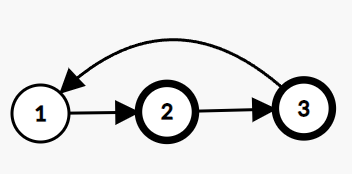
You are given a Singly Linked List of integers. Return true if it has a cycle, else return false.
A cycle occurs when a node's next points back to a previous node in the list.
Example:
In the given linked list, there is a cycle, hence we return true.
Problem approach
Step 1: I first thought of a basic approach where I would store visited nodes and check if a node appears again while traversing the linked list.
Step 2: The interviewer asked me to optimize the solution and reduce extra space usage.
Step 3: I then applied Floyd’s Cycle Detection Algorithm using slow and fast pointers, where the slow pointer moves one step and the fast pointer moves two steps. If a cycle exists, both pointers eventually meet.
Step 4: I explained the time complexity as O(n) and space complexity as O(1), which satisfied the interviewer.
2. Longest Substring Without Repeating Characters
Moderate
30m average time
65% success
0/80
Asked in companies


Given a string input of length n, find the length of the longest substring without repeating characters i.e return a substring that does not have any repeating characters.
Substring is the continuous sub-part of the string formed by removing zero or more characters from both ends.
Problem approach
Step 1: I initially considered checking all possible substrings and verifying whether they contain unique characters, but this approach was inefficient.
Step 2: The interviewer asked me to optimize the solution.
Step 3: I used the sliding window technique with a data structure to track visited characters, expanding the window when characters are unique and shrinking it when repetition occurs.
Step 4: I explained how this approach works in linear time O(n), and the interviewer was satisfied with the optimized solution.
02
Round
Medium
Video Call
Duration40 minutes
Interview date22 Mar 2024
Coding problem2
Timing: The second round was conducted during regular working hours and was not a late-night interview.
Environment: The environment was professional and calm, which helped in focusing on solving linked list and SQL problems effectively.
Significant Activity: This round focused on hands-on problem solving using linked list concepts along with SQL-based questions that tested both practical query writing and theoretical understanding.
Interviewer: The interviewer was knowledgeable, patient, and supportive. They encouraged a step-by-step explanation of the approach and asked follow-up questions to test depth of understanding.
1. Delete a Node from Linked List
Moderate
40m average time
67% success
0/80
Asked in companies



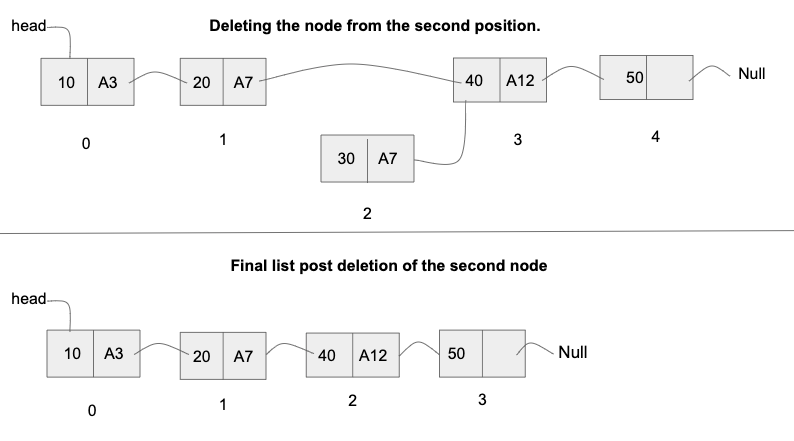
You have been given a linked list of integers. Your task is to write a function that deletes a node from a given position, 'POS'.
Note :
Assume that the Indexing for the linked list always starts from 0.

If the position is greater than or equal to the length of the linked list, you should return the same linked list without any change.
Illustration :
The following images depict how the deletion has been performed.
Image-I :
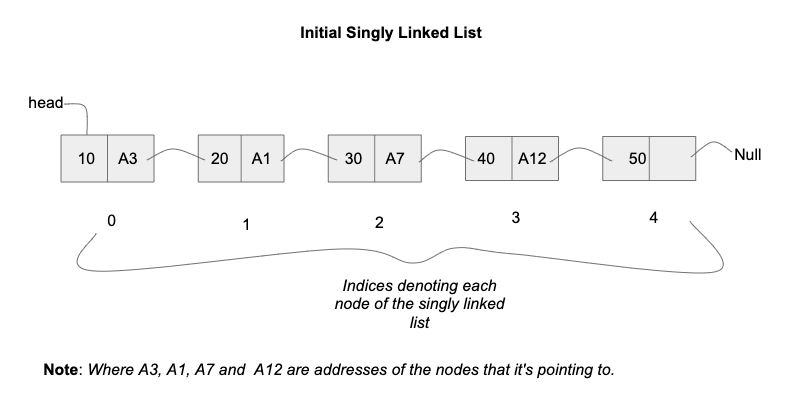
Image-II :
Problem approach
Step 1: I first understood the problem and considered a simple approach of traversing the linked list until the Nth node and deleting it, but this required careful handling of edge cases.
Step 2: The interviewer asked me to optimize and handle cases like deleting the head node efficiently.
Step 3: I used a two-pointer approach where one pointer is moved N steps ahead, and then both pointers are moved together until the first pointer reaches the end.
Step 4: At that point, the second pointer points to the node just before the Nth node, which can be removed by updating the next pointer.
Step 5: I explained the time complexity as O(n) and space complexity as O(1), and discussed edge cases like N equal to the list length.
2. Second Highest Salary
Given a table Employee with a column Salary, write a SQL query to find the second highest salary from the table. (Practice)
Problem approach
Tip 1: Focus on understanding core concepts and logic before jumping to code or queries.
Tip 2: Practice problem-solving regularly, especially linked list problems and SQL queries.
Tip 3: Analyse edge cases and explain your approach clearly while solving problems.


Here's your problem of the day 
Solving this problem will increase your chance to get selected in this company
Skill covered: Programming
How do you remove whitespace from the start of a string?
Choose another skill to practice
Similar interview experiences
Associate Software Developer
2 rounds | 6 problems
Interviewed by MAQ Software
Selected 
1061 views

0 comments

0 upvotes
SDE - 1
2 rounds | 4 problems
Interviewed by MAQ Software
Selected 1208 views
0 comments
0 upvotes
SE-1
3 rounds | 8 problems
Interviewed by MAQ Software
Selected 251 views
0 comments
0 upvotes
Frontend Engineer
2 rounds | 4 problems
Interviewed by MAQ Software
Selected 351 views
0 comments
0 upvotes