





Mathworks interview experience Real time questions & tips from candidates to crack your interview

Software Engineer
Mathworks


5 rounds | 7 Coding
problems

 Selected
 Interview preparation journey

Journey
I come from an electronics background. During the lockdown, I realized that electronics did not interest me as much. Not much coding was taught in my curriculum. So, at the end of my second year, I took a course from Coding Ninjas. This course has been my only source of study, and I was always satisfied with the way the tutors explained the concepts. Later on, two months before my placements, I started doing questions from coding platforms and eventually secured the job of my dreams.
Application story
My application journey began when I applied through campus recruitment. Out of the many applicants, I was among the 1,800 students shortlisted for the technical test. After the test, I advanced to the interview rounds along with just nine other candidates.
The process started with a group discussion (GD) where I engaged in collaborative discussions with the other candidates. Following that, I faced a technical interview, which tested my knowledge, problem-solving abilities, and coding skills. The managers then interviewed me to assess my fit within the organization, and finally, I had an HR interview to evaluate my overall compatibility.
Out of the initial pool, only four students, including myself, received offers.
Why selected/rejected for the role?
My strong technical skills, demonstrated through the test and interview, played a key role in my selection. Additionally, my effective communication and teamwork abilities, as evidenced in the group discussion and interviews, set me apart from other candidates. I am aligned with the company culture and values, and I believe that my overall performance and potential for growth contributed to my selection.
Preparation
Duration: 3 months
Topics: Data structures, OOPS, Pointers, OS, DBMS(SQL commands majorly)

Tip 1 : Make sure you have a solid understanding of common data structures like arrays, linked lists, stacks, queues, trees, and graphs.
Tip 2 : Study key algorithms such as sorting, searching, and graph traversal algorithms.
Tip 3 : Regularly solve coding problems and make sure to give time yourself.
Application process
Where: Campus
Eligibility: 7 CGPA
Tip 1 : Customize your resume for each job application by highlighting relevant skills, experiences, and accomplishments that align with the specific job requirements.
Tip 2 : Ensure that your resume is concise and easy to read.

Interview rounds
01
Round
Medium
Online Coding Interview
Duration90 minutes
Interview date17 Aug 2022
Coding problem2
It was a monitored round, with access to a webcam and microphone. It happened in the afternoon, and we were required to solve 45 questions. For the coding questions, both questions had to be answered in 2 different languages.
1. Count Smaller or Equal elements in array
Moderate
25m average time
70% success

0/80
Asked in companies


You are given two arrays of integers. Let's call the first array A and the second array B. A finds the number of elements in array B that are smaller than or equal to that element for every array element.
For example:
A = [2, 3, 0] , B = [5, 1]

For the first index, A[0] = 2
In array B only 1 is less than 2. Therefore the answer for the first index is 1.

For the second index, A[1] = 3
In array B only 1 is less than 3. Therefore the answer for the second index is also 1.

For the third index, A[2] = 0
Both the elements of array B are greater than 0.
Therefore the answer for the third index is 0.

Hence, the final answer is [1,1,0] in this case.
Problem approach
Traverse through the elements of the first array from start to end.
For every element in the first array.
Traverse through the elements in the second array and find the count of elements that are less than or equal to the element of the first array.
Print the count for every index.
2. Minimum Knight Moves
Hard
0/120
Asked in companies


You are given an infinite chessboard (ie: the x-coordinates and y-coordinates can be anything between -infinity to +infinity).
You have a knight placed at coordinates ‘(0, 0)’. Find the minimum number of steps needed to move the knight to ‘(X, Y)’.
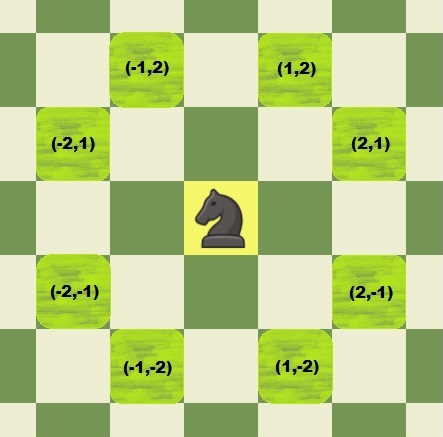
The knight has 8 possible moves, each move is two units in a cardinal direction, then one unit in an orthogonal direction.
For example :
As depicted in the photo below, the knight currently at (0, 0) can move to any of the 8 positions: (1, 2), (2, 1), (2, -1), (1, -2), (-1, -2), (-2, -1), (-2, 1), (-1, 2).
Example :
If X = 1 and Y = -1, then we need to find out the minimum number of steps to move the knight from (0, 0) to (1, -1).

We need at least 2 steps to move the knight to the desired position.

First move: (0, 0) -> (2, 1)

Second move: (2,1) -> (1, -1)

Here we can see that there are many ways, but we need at least 2 steps. Therefore we will return the value 2.
Problem approach
I used BFS to solve this problem.
02
Round
Easy
Group Discussion
Duration20 minutes
Interview date22 Aug 2022
Coding problem1
This was the first round of the day. There was one GD moderator and 6 participants discussed upon the EDG at Mathworks.
1. GD Question
Discuss about EDG at Mathworks.
Problem approach
I started the discussion by giving it a strong beginning. I made sure I listen and acknowledge every candidate's points. I took a positive approach and made a good balance of not speaking too much or too less.
03
Round
Medium
Video Call
Duration50 minutes
Interview date22 Aug 2022
Coding problem2
After qualifying the GD, we moved to technical interview. This started with introduction and then directly to the coding question.
1. Binary Linked List To Integer
Easy
0/40
Asked in companies


You are given a singly linked list containing ‘n’ nodes, where every node in the linked list contains a pointer “next” which points to the next node in the list and having values either 0 or 1. Your task is to return the decimal representation of the given number in the linked list.
For Example:
n = 4, list: 1 -> 0 -> 1 -> 0.

Now in this example, the value in the linked list is 1010, which is 10 in Decimal.
Hence the answer is 10.
Problem approach
Initialize result number to be equal to head value: num = head.val.
This operation is safe because the list is guaranteed to be non-empty.
Parse linked list starting from the head: while head.next:
The current value is head.next.val. Update the result by shifting
it by one to the left and adding the current value using logical OR:
num = (num << 1) | head.next.val.
Return num.
2. OOPs Question
This was an OOPS problem. A car class was given, we had to inherit other classes and make other car objects. (Learn)
Problem approach
Tip 1 : Study well about the 4 pillars of OOPS.
Tip 2 : Study pointers well too.
Tip 3 : Make sure to not only study the theory but also know how to apply those principles in coding.
04
Round
Easy
HR Round
Duration40 minutes
Interview date22 Aug 2022
Coding problem1
This was a managerial round.
1. Project based questions
Explain your projects in deep.
Why did you use this particular tech stack?
What challenges did you face while implementation?
05
Round
Easy
HR Round
Duration70 minutes
Interview date22 Aug 2022
Coding problem1
This round focused more on how much I knew about the company. The HR also focused on knowing more about me, and how I perform in different situations.
1. Basic HR Questions
Introduce yourself.
Some situation-based questions.
How will you perform in different situations, suppose sometimes the situation is supporting your decision and sometimes it isn't?
Why mathworks?


Here's your problem of the day 
Solving this problem will increase your chance to get selected in this company
Skill covered: Programming
What does dict.keys() return?
Choose another skill to practice
Similar interview experiences
Software Engineer
4 rounds | 6 problems
Interviewed by Mathworks
Selected 
818 views

0 comments

0 upvotes
SDE - 1
4 rounds | 16 problems
Interviewed by Mathworks
Selected 640 views
0 comments
0 upvotes
Associate in EDG
3 rounds | 3 problems
Interviewed by Mathworks
 Selected
 511 views
0 comments
0 upvotes
SDE - Intern
5 rounds | 7 problems
Interviewed by Mathworks
 Selected
 211 views
0 comments
0 upvotes
Companies with similar interview experiences

Software Engineer
3 rounds | 7 problems
Interviewed by Optum
 Selected
 8623 views
1 comments
0 upvotes
Software Engineer
5 rounds | 5 problems
Interviewed by Microsoft
 Selected
 11145 views
1 comments
0 upvotes
Software Engineer
2 rounds | 4 problems
Interviewed by Amazon
Selected 5216 views
1 comments
0 upvotes