





Meesho interview experience Real time questions & tips from candidates to crack your interview

SDE - Intern
Meesho


2 rounds | 4 Coding
problems

Rejected
Interview preparation journey

Preparation
Duration: 3 months
Topics: Data Structures, Pointers, OOPS, System Design, Algorithms, Dynamic Programming

Tip 1 : Regarding DSA preparation, I have a theory. 20 percent of the questions will be asked in 80 percent of the interview and 80 percent of the questions will be asked in 20 percent of the interviews. In short, some questions have a very high chance of coming up during the interviews and some have very low chance. We should focus more on the questions that have more chance of coming up in the interview. You can find these questions on Striver SDE Sheet, InterviewBit, Leetcode 100 most liked, Leetcode 100 most important.
Tip 2 : Try to find patterns in the questions. Group them according to a pattern for better understanding. Make notes in Excel, word or hand written and revise them.
Tip 3 : Try to solve the questions that have more chance of coming up in the interview with many different approaches.
Application process
Where: Campus
Eligibility: Above 7 CGPA
Tip 1 : Make Sure that your resume is simple and also try to fit all the information in only one page.
Tip 2 : Have at least 2 projects with the latest technologies,Github link of projects should be provided

Interview rounds
01
Round
Medium
Video Call
Duration45 minutes
Interview date6 Oct 2021
Coding problem2
1. Disjoint Intervals
Moderate
30m average time
70% success

0/80
Asked in companies


Given a 2D array of size Nx2 which contains a set of ‘N’ intervals. Each interval contains a starting point and an ending point. You need to find the size of the maximal set of mutually disjoint intervals.
Two sets [a,b] and [c,d] are disjoint intervals if there is no common point between these two intervals.
For example: [5,7] and [8,10] are disjoint intervals but the intervals [5,7] and [7,10] is not a disjoint interval as they have a common point, 7 in them.
Problem approach
Given a 2D array of size Nx2 which contains a set of ‘N’ intervals. Each interval contains a starting point and an ending point. You need to find the size of the maximal set of mutually disjoint intervals.
Two sets [a,b] and [c,d] are disjoint intervals if there is no common point between these two intervals.
For example: [5,7] and [8,10] are disjoint intervals but the intervals [5,7] and [7,10] is not a disjoint interval as they have a common point, 7 in them.
2. Copy List with Random Pointer
Easy
10m average time
90% success
0/40
Asked in companies


Given a linked list having two pointers in each node. The first one points to the next node of the list, however, the other pointer is random and can point to any node of the list or null. The task is to create a deep copy of the given linked list and return its head. We will validate whether the linked list is a copy of the original linked list or not.
A deep copy of a Linked List means we do not copy the references of the nodes of the original Linked List rather for each node in the original Linked List, a new node is created.
For example,
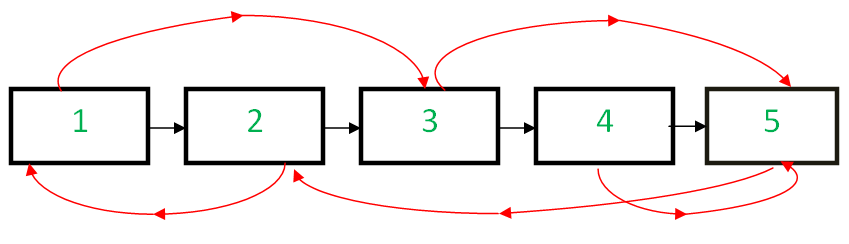
Random pointers are shown in red and next pointers in black.
Problem approach
Given a linked list having two pointers in each node. The first one points to the next node of the list, however, the other pointer is random and can point to any node of the list or null. The task is to create a deep copy of the given linked list and return its head. We will validate whether the linked list is a copy of the original linked list or not.
A deep copy of a Linked List means we do not copy the references of the nodes of the original Linked List rather for each node in the original Linked List, a new node is created.
02
Round
Medium
Video Call
Duration45 minutes
Interview date6 Oct 2021
Coding problem2
1. Trapping Rain Water
Moderate
15m average time
80% success
0/80
Asked in companies



You have been given a long type array/list 'arr’ of size 'n’.
It represents an elevation map wherein 'arr[i]’ denotes the elevation of the 'ith' bar.
Print the total amount of rainwater that can be trapped in these elevations.
Note :
The width of each bar is the same and is equal to 1.
Example:
Input: ‘n’ = 6, ‘arr’ = [3, 0, 0, 2, 0, 4].

Output: 10

Explanation: Refer to the image for better comprehension:

Note :
You don't need to print anything. It has already been taken care of. Just implement the given function.
Problem approach
You have been given a long type array/list 'ARR' of size 'N'. It represents an elevation map wherein 'ARR[i]' denotes the elevation of the 'ith' bar. Print the total amount of rainwater that can be trapped in these elevations.
2. Merge Sort Linked List
Moderate
10m average time
90% success
0/80
Asked in companies


You are given a Singly Linked List of integers. Sort the Linked List using merge sort.
Merge Sort is a Divide and Conquer algorithm. It divides the input into two halves, calls itself for the two halves, and then merges the two sorted halves. The merge() function is used for merging two halves. The merge(arr, L, M, R) is a key process that assumes that arr[L..M] and arr[M + 1...R] are sorted and merges the two sorted subarrays into one.
Problem approach
You are given a Singly Linked List of integers. Sort the Linked List using merge sort.
Merge Sort is a Divide and Conquer algorithm. It divides the input into two halves, calls itself for the two halves, and then merges the two sorted halves. The merge() function is used for merging two halves. The merge(arr, L, M, R) is a key process that assumes that arr[L..M] and arr[M + 1...R] are sorted and merges the two sorted subarrays into one.


Here's your problem of the day 
Solving this problem will increase your chance to get selected in this company
Skill covered: Programming
How do you remove whitespace from the start of a string?
Choose another skill to practice
Similar interview experiences
SDE - Intern
2 rounds | 3 problems
Interviewed by Meesho
Rejected

3817 views

0 comments

0 upvotes
SDE - Intern
3 rounds | 5 problems
Interviewed by Meesho
 Selected
 2042 views
0 comments
0 upvotes
SDE - 1
2 rounds | 5 problems
Interviewed by Meesho
Rejected
6638 views
0 comments
0 upvotes
SDE - Intern
3 rounds | 5 problems
Interviewed by Meesho
Rejected
1240 views
0 comments
0 upvotes
Companies with similar interview experiences
SDE - Intern
3 rounds | 6 problems
Interviewed by Amazon

Rejected
15605 views
4 comments
0 upvotes
SDE - Intern
4 rounds | 7 problems
Interviewed by Microsoft
 Selected
 15499 views
1 comments
0 upvotes
SDE - Intern
2 rounds | 4 problems
Interviewed by Amazon
Selected 10216 views
2 comments
0 upvotes