





Meesho interview experience Real time questions & tips from candidates to crack your interview

SDE - 1
Meesho


2 rounds | 5 Coding
problems

Rejected
Interview preparation journey

Journey
I was in my final year of college when companies came for campus recruitment, and I was preparing for my placement. During this time, I learned many topics such as data structures, SQL queries, DBMS, Java, Python, JavaScript, etc. I applied to many companies, but due to the recession, the company that offered me a position backed out.
Application story
Meesho conducted a Virtual Recruitment Drive for students of the B.Tech (CSE/IT) 2024 Batch. I participated, got shortlisted, and appeared for interviews.
Why selected/rejected for the role?
I was rejected as I messed up my two interview rounds due to nervousness, despite practicing some of these questions beforehand.
Preparation
Duration: 4 months
Topics: Data Structures, OOPS, System Design, JavaScript, React, HTML, CSS

Tip 1: Practice the most important DSA questions, as they are often repeated on sites like CodeStudio.
Tip 2: Have a deep understanding of the projects you are building.
Application process
Where: Campus
Eligibility: Exclusively for B.E/B.Tech or MCA graduates from the 2023 and 2024 batches.
Tip 1: Include at least 2 good projects explained briefly, covering all important points.
Tip 2: Mention every skill.
Tip 3: Prioritize skills, projects, and experiences.

Interview rounds
01
Round
Easy
Online Coding Test
Duration105 minutes
Interview date17 Jan 2024
Coding problem3
The online coding test consisted of three standard coding problems.
1. Chocolate Problem
Moderate
15m average time
85% success

0/80
Asked in companies



Given an array/list of integer numbers 'CHOCOLATES' of size 'N', where each value of the array/list represents the number of chocolates in the packet. There are ‘M’ number of students and the task is to distribute the chocolate to their students. Distribute chocolate in such a way that:
1. Each student gets at least one packet of chocolate.
2. The difference between the maximum number of chocolate in a packet and the minimum number of chocolate in a packet given to the students is minimum.
Example :
Given 'N' : 5 (number of packets) and 'M' : 3 (number of students)
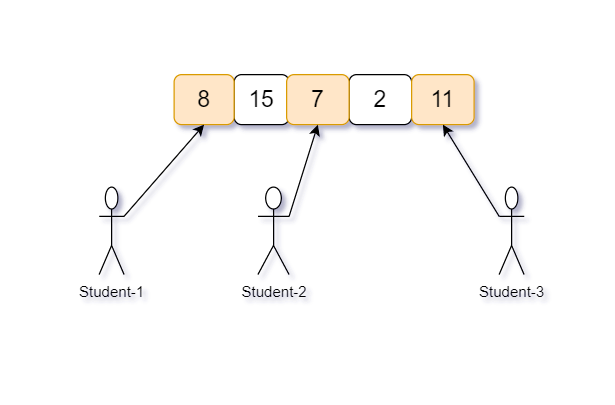
And chocolates in each packet is : {8, 11, 7, 15, 2}

All possible way to distribute 5 packets of chocolates among 3 students are -

( 8,15, 7 ) difference of maximum-minimum is ‘15 - 7’ = ‘8’
( 8, 15, 2 ) difference of maximum-minimum is ‘15 - 2’ = ‘13’
( 8, 15, 11 ) difference of maximum-minimum is ‘15 - 8’ = ‘7’
( 8, 7, 2 ) difference of maximum-minimum is ‘8 - 2’ = ‘6’
( 8, 7, 11 ) difference of maximum-minimum is ‘11 - 7’ = ‘4’
( 8, 2, 11 ) difference of maximum-minimum is ‘11 - 2’ = ‘9’
( 15, 7, 2 ) difference of maximum-minimum is ‘15 - 2’ = 13’
( 15, 7, 11 ) difference of maximum-minimum is ‘15 - 7’ = ‘8’
( 15, 2, 11 ) difference of maximum-minimum is ‘15 - 2’ = ‘13’
( 7, 2, 11 ) difference of maximum-minimum is ‘11 - 2’ = ‘9’

Hence there are 10 possible ways to distribute ‘5’ packets of chocolate among the ‘3’ students and difference of combination (8, 7, 11) is ‘maximum - minimum’ = ‘11 - 7’ = ‘4’ is minimum in all of the above.
Problem approach
The idea is based on the observation that to minimize the difference, we must choose consecutive elements from a sorted packet. We first sort the array arr[0..n-1], then find the subarray of size m with the minimum difference between the last and first elements.
2. Longest Increasing Subsequence
Moderate
0/80
Asked in companies


'N' students are standing in a row. You are given the height of every student standing in the row. Your task is to find the longest strictly increasing subsequence of heights from the row such that the relative order of the students does not change.
A subsequence is a sequence that can be derived from another sequence by deleting zero or more elements without changing the order of the remaining elements.
Problem approach
Due to optimal substructure and overlapping subproblem property, we can also utilise Dynamic programming to solve the problem. Instead of memoization, we can use the nested loop to implement the recursive relation.
The outer loop will run from i = 1 to N and the inner loop will run from j = 0 to i and use the recurrence relation to solve the problem.
3. Colour The Graph
Moderate
20m average time
80% success
0/80
Asked in companies


You are given a graph with 'N' vertices numbered from '1' to 'N' and 'M' edges. You have to colour this graph in two different colours, say blue and red such that no two vertices connected by an edge are of the same colour.
Note :
The given graph may have connected components.
Problem approach
Use BFS traversal to start traversing the graph.
Pick any vertex and give different colors to all of the edges connected to it, and mark those edges as colored.
Traverse one of it’s edges.
Repeat step to with a new vertex until all edges are colored.
02
Round
Easy
Video Call
Duration90 minutes
Interview date22 Jan 2024
Coding problem2
This round comprised a mix of DSA and system design for me.
1. Merge overlapping intervals
Easy
10m average time
90% success
0/40
Asked in companies


Given 'N' number of intervals, where each interval contains two integers denoting the boundaries of the interval. The task is to merge all the overlapping intervals and return the list of merged intervals sorted in ascending order.
Two intervals will be considered to be overlapping if the starting integer of one interval is less than or equal to the finishing integer of another interval, and greater than or equal to the starting integer of that interval.
Example:
for the given 5 intervals - [1,4], [3,5], [6,8], [10,12], [8,9].
Since intervals [1,4] and [3,5] overlap with each other, we will merge them into a single interval as [1,5].

Similarly [6,8] and [8,9] overlaps, we merge them into [6,9].

Interval [10,12] does not overlap with any interval.

Final List after merging overlapping intervals: [1,5], [6,9], [10,12]
Problem approach
Construct the intervals, denoted by pair (a,b), to form an array, say I. And sort I w.r.t. a.
Then find the initial interval that covers 0 the most.
Open the tap with the right most range whose range has intersection with the ones already opened; if there is no such tap which means there is a gap and return -1;
2. System Design
Design a Web Crawler.
Problem approach
Tip 1: Practice a lot of question from online sites like coding ninjas.
Tip 2: Ask if you have any doubts from the interviewer instead of assuming things.


Here's your problem of the day 
Solving this problem will increase your chance to get selected in this company
Skill covered: Programming
How do you remove whitespace from the start of a string?
Choose another skill to practice
Similar interview experiences
SDE - 1
4 rounds | 11 problems
Interviewed by Meesho
 Selected
5183 views

0 comments

0 upvotes
SDE - 1
4 rounds | 9 problems
Interviewed by Meesho
Selected 3155 views
0 comments
0 upvotes
SDE - 1
2 rounds | 3 problems
Interviewed by Meesho
Rejected
2825 views
0 comments
0 upvotes
SDE - 1
2 rounds | 2 problems
Interviewed by Meesho
Rejected
1570 views
0 comments
0 upvotes
Companies with similar interview experiences
SDE - 1
5 rounds | 12 problems
Interviewed by Amazon
 Selected
 117552 views
24 comments
0 upvotes

SDE - 1
4 rounds | 5 problems
Interviewed by Microsoft
Selected 60143 views
5 comments
0 upvotes
SDE - 1
3 rounds | 7 problems
Interviewed by Amazon
 Selected
 36138 views
7 comments
0 upvotes