





MindTickle interview experience Real time questions & tips from candidates to crack your interview

SDE - 1
MindTickle


2 rounds | 4 Coding
problems

Rejected
Interview preparation journey

Preparation
Duration: 4 months
Topics: Data Structures, Algorithms, OOPS, OS, DBMS

Tip 1 : Work on Competitive Programming skills. That is one thing most companies look out for during hiring. Solve at least 100
questions from every topic.
Tip 2 : You should have at least 2 good projects on your resume. Only write the things that you are completely sure of.
Tip 3 : Work on CS fundamentals as well like -OOPS, OS, and DBMS. There will be MCQ questions from this in the coding round as well as in the 1:1 round
Application process
Where: Referral
Tip 1 : Need at least 2 good projects on the resume. Write a short 2-3 lines summary of the project and the tech stack
used.
Tip 2 : Resume should be 1 page only. Try to keep the Resume short with useful information only.
Tip 3 : Your Resume should clearly mention the skillset you have. Companies sometimes filter out Resume based on
skillset only

Interview rounds
01
Round
Easy
Face to Face
Duration60 minutes
Interview date5 Feb 2021
Coding problem2
It was a pure DSA round. 2 coding questions were asked of medium difficulty. I was able to solve both the questions.
1. Minimum Number of Platform Needed
Easy
23m average time
85% success

0/40
Asked in companies



You are given the arrival and departure times of N trains at a railway station in a day. You need to find the minimum of platforms required for the railway station such that no train waits i.e No train should wait for the platform to be clear or free.
Problem approach
We can take a map and store all the times in it with 'A' and 'D' as value respectively for Arrival time and Departure time. Then sort this map based on keys and iterate the map, if value is 'A' add 1 to the ans otherwise subtract 1. Max value of ans will be the min no. of platforms needed
2. Bottom View Of Binary Tree
Moderate
10m average time
90% success
0/80
Asked in companies



You are given a 'Binary Tree'.
Return the bottom view of the binary tree.
Note :
1. A node will be in the bottom-view if it is the bottom-most node at its horizontal distance from the root.

2. The horizontal distance of the root from itself is 0. The horizontal distance of the right child of the root node is 1 and the horizontal distance of the left child of the root node is -1.

3. The horizontal distance of node 'n' from root = horizontal distance of its parent from root + 1, if node 'n' is the right child of its parent.

4. The horizontal distance of node 'n' from root = horizontal distance of its parent from the root - 1, if node 'n' is the left child of its parent.

5. If more than one node is at the same horizontal distance and is the bottom-most node for that horizontal distance, including the one which is more towards the right.
Example:
Input: Consider the given Binary Tree:
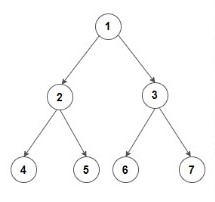
Output: 4 2 6 3 7

Explanation:
Below is the bottom view of the binary tree.

1 is the root node, so its horizontal distance = 0.
Since 2 lies to the left of 0, its horizontal distance = 0-1= -1
3 lies to the right of 0, its horizontal distance = 0+1 = 1
Similarly, horizontal distance of 4 = Horizontal distance of 2 - 1= -1-1=-2
Horizontal distance of 5 = Horizontal distance of 2 + 1=  -1+1 = 0
Horizontal distance of 6 = 1-1 =0
Horizontal distance of 7 = 1+1 = 2

The bottom-most node at a horizontal distance of -2 is 4.
The bottom-most node at a horizontal distance of -1 is 2.
The bottom-most node at a horizontal distance of 0 is 5 and 6. However, 6 is more towards the right, so 6 is included.
The bottom-most node at a horizontal distance of 1 is 3.
The bottom-most node at a horizontal distance of 2 is 7.

Hence, the bottom view would be 4 2 6 3 7
Problem approach
Its a simple standard tree question
I applied the standard approach
02
Round
Hard
Face to Face
Duration55 minutes
Interview date10 Feb 2021
Coding problem2
It was a coding round. Two problems from DSA basic level questions were asked in this round. I was able to solve only one, which was obviously the easier one. I was not able to solve second questions
1. Serialize and Deserialize Binary Tree
Hard
15m average time
85% success
0/120
Asked in companies



You have been given a binary tree of integers. You are supposed to serialize and deserialize (refer to notes) the given binary tree.
You can choose any algorithm to serialize/deserialize the given binary tree. You only have to ensure that the serialized string can be deserialized to the original binary tree.
Note :
Serialization is the process of translating a data structure or object state into a format that can be stored or transmitted (for example, across a computer network) and reconstructed later. The opposite operation, that is, extracting a data structure from stored information, is deserialization.
Problem approach
I was not able to solve this question.
2. Cycle Detection in a Singly Linked List
Moderate
15m average time
80% success
0/80
Asked in companies



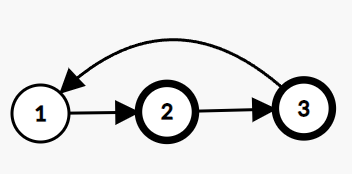
You are given a Singly Linked List of integers. Return true if it has a cycle, else return false.
A cycle occurs when a node's next points back to a previous node in the list.
Example:
In the given linked list, there is a cycle, hence we return true.
Problem approach
- Traverse linked list using two pointers.
- Move one pointer(slow_p) by one and another pointer(fast_p) by two.
- If these pointers meet at the same node then there is a loop. If pointers do not meet then linked list doesn’t have a loop.


Here's your problem of the day 
Solving this problem will increase your chance to get selected in this company
Skill covered: Programming
How do you remove whitespace from the start of a string?
Choose another skill to practice
Similar interview experiences
SDE - 1
2 rounds | 3 problems
Interviewed by MindTickle
 Selected
1540 views

0 comments

0 upvotes
SDE - 1
2 rounds | 2 problems
Interviewed by MindTickle
 Selected
 1535 views
0 comments
0 upvotes
SDE - Intern
1 rounds | 3 problems
Interviewed by Amazon
Selected 4456 views
0 comments
0 upvotes
SDE - 1
3 rounds | 5 problems
Interviewed by MindTickle
Selected 631 views
0 comments
0 upvotes
Companies with similar interview experiences
SDE - 1
5 rounds | 12 problems
Interviewed by Amazon
 Selected
 117552 views
24 comments
0 upvotes
SDE - 1
4 rounds | 5 problems
Interviewed by Microsoft
Selected 60142 views
5 comments
0 upvotes
SDE - 1
3 rounds | 7 problems
Interviewed by Amazon
 Selected
 36138 views
7 comments
0 upvotes