





MobiKwik interview experience Real time questions & tips from candidates to crack your interview

SDE
MobiKwik


2 rounds | 5 Coding
problems

Rejected
Interview preparation journey

Preparation
Duration: 3 months
Topics: Data Structures, Pointers, OOPS, Algorithms, Dynamic Programming, My SQL, Database, Operating System

Tip 1 : Practice Atleast 250 Questions on GFG/Leetcode
Tip 2 : For DSA questions in interviews, start explaining from the brute force approach and then move to the optimal one. Convey your thought process to the interviewers, so that they can help you out if you get stuck.
Tip 3 : Do not write anything that you are not confident of in resume
Tip 4 : Do atleast 2 projects
Application process
Where: Campus
Eligibility: 7 CGPA
Tip 1 : Try to include at least one development project in your resume.
Tip 2 : Interviewer will ask anything from your resume so be prepared for it.
Tip 3 : Don't mention some random projects which you are not sure about or copied from Google or somewhere else.

Interview rounds
01
Round
Medium
Online Coding Interview
Duration120 minutes
Interview date1 Oct 2021
Coding problem3
MCQs were based upon DS Algo, Code output, OOPS, DS Fundamentals and 3 Coding Problems
1. Puzzle Question
In climbing a round pole of n meters height, a monkey climbs 5 meters in a minute and slips 2 meters in the alternate minute. How much time would the monkey take to get to the top of the pole?
Problem approach
(Up) 5 meter — 1 minute
(Down) 2 meter — (another) 1 minute
Overall total 3 meter — 2 minutes
(n-5) meter = ((n-5)*2)/3 minuntes
n meter = ((n-5)*2)/3 + 1 min
Ans : ((n-5)*2)/3 + 1 min
2. Kth Smallest Element
Easy
15m average time
85% success

0/40
Asked in companies



You are given an array of integers 'ARR' of size 'N' and another integer 'K'.
Your task is to find and return 'K'th smallest value present in the array.
Note: All the elements in the array are distinct.
Example
If 'N' is 5 and 'K' is 3 and the array is 7, 2, 6, 1, 9

Sorting the array we get 1, 2, 6, 7, 9

Hence the 3rd smallest number is 6.
Problem approach
Follow the given steps to solve the problem:
1. Sort the input array in the increasing order.
2. Return the element at the K-1 index (0 – Based indexing) in the sorted array
3. Top View Of Binary Tree
Moderate
25m average time
70% success
0/80
Asked in companies



You are given a Binary Tree of 'n' nodes.
The Top view of the binary tree is the set of nodes visible when we see the tree from the top.
Find the top view of the given binary tree, from left to right.
Example :
Input: Let the binary tree be:
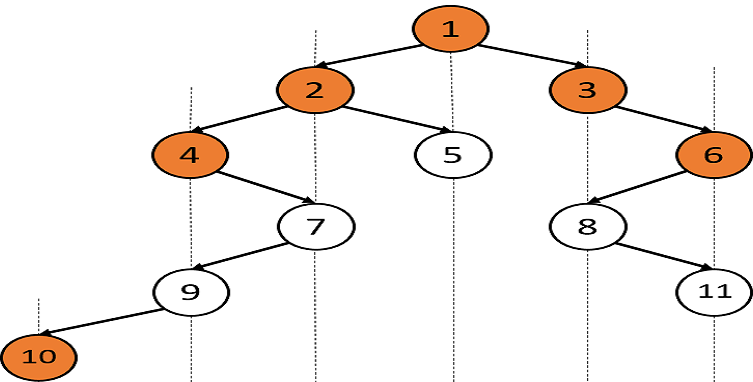
Output: [10, 4, 2, 1, 3, 6]

Explanation: Consider the vertical lines in the figure. The top view contains the topmost node from each vertical line.
Problem approach
The idea is to do something similar to vertical Order Traversal. Like vertical Order Traversal, we need to put nodes of the same horizontal distance together. We do a level order traversal so that the topmost node at a horizontal node is visited before any other node of the same horizontal distance below it. Hashing is used to check if a node at a given horizontal distance is seen or not.
02
Round
Hard
Video Call
Duration60 minutes
Interview date3 Oct 2021
Coding problem2
Started with the introduction than he jumped in to the dsa problems.
1. Cycle Detection in a Singly Linked List
Moderate
15m average time
80% success
0/80
Asked in companies



You are given a Singly Linked List of integers. Return true if it has a cycle, else return false.
A cycle occurs when a node's next points back to a previous node in the list.
Example:
In the given linked list, there is a cycle, hence we return true.
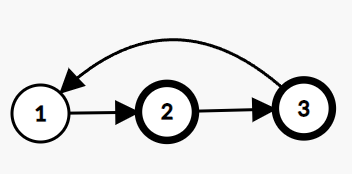
Problem approach
I explained to him the brute force approach as well as the optimal approach, after which he asked me to write the code for the optimal approach. He asked me to write the code from scratch, so first I wrote the code to insert the nodes in the linked list and then the code to detect a loop in the linked list.
2. Maximum Sum Rectangle
Hard
25m average time
70% success
0/120
Asked in companies


You are given an M X N matrix of integers ARR. Your task is to find the maximum sum rectangle.
Maximum sum rectangle is a rectangle with the maximum value for the sum of integers present within its boundary, considering all the rectangles that can be formed from the elements of that matrix.
A rectangle is a 2-D polygon with opposite sides parallel and equal to each other.
For example:
Consider following matrix:

 1  2 -1 -4 -20
-8 -3  4  2   1
 3  8  10 1   3
-4 -1  1  7  -6

The rectangle (1,1) to (3,3) is the rectangle with the maximum sum, i.e. 29.

 1   2 -1 -4  -20
-8 |-3  4  2 |  1
 3 | 8  10 1 |  3
-4 |-1  1  7 | -6
Problem approach
wasn't able to solve this problem.


Here's your problem of the day 
Solving this problem will increase your chance to get selected in this company
Skill covered: Programming
How do you remove whitespace from the start of a string?
Choose another skill to practice
Similar interview experiences
SDE - 1
2 rounds | 5 problems
Interviewed by MobiKwik
 Selected
1509 views

0 comments

0 upvotes
SDE
3 rounds | 4 problems
Interviewed by MobiKwik
 Selected
 1286 views
0 comments
0 upvotes
SDE - 1
5 rounds | 8 problems
Interviewed by MobiKwik

Rejected
1564 views
0 comments
0 upvotes
SDE - 1
3 rounds | 7 problems
Interviewed by MobiKwik
Rejected
1229 views
0 comments
0 upvotes
Companies with similar interview experiences

SDE
3 rounds | 6 problems
Interviewed by PhonePe
Selected 0 views
0 comments
0 upvotes

SDE
5 rounds | 8 problems
Interviewed by Mathworks
Selected 1324 views
0 comments
0 upvotes
SDE
4 rounds | 7 problems
Interviewed by PhonePe
Selected 0 views
0 comments
0 upvotes