





Morgan Stanley interview experience Real time questions & tips from candidates to crack your interview

SDE - Intern
Morgan Stanley


3 rounds | 9 Coding
problems

 Selected
 Interview preparation journey

Preparation
Duration: 2.5 months
Topics: Data structures, Algorithms, Operating systems, OOPS, DBMS

Tip 1 : Code as many as questions as you can if you have time, even if you think you know the answer.
Tip 2 : Know the projects which you mention.
Application process
Where: Campus
Eligibility: 7 CGPA
Tip 1 : Have 1-2 programming projects on resume.
Tip 2 : Know about the projects in detail (not necessarily in deep).

Interview rounds
01
Round
Medium
Online Coding Interview
Duration100 minutes
Interview date1 Aug 2018
Coding problem3
Online Exam
It was an online round of 100 minutes on Amcat.
It was divided into 3 sections with fixed time and the time left of one section didn't roll over to another -
Debugging and Code completion(20 mins)-6 debugging and 1 code completion questions. Time management was very important in this section. These were very basic.
Example question - Given a Point class, and a member function which calculates distance between 2 points. Complete the function check(Point P1, Point P2, Point P3) which should return True if the triangle is right angled.
Aptitude(20 mins)-10 aptitude questions were asked which were easy to moderate difficulty. This section didn't require any extra preparation and the time allotted was quite sufficient. No negative marking.
1. Missing Vertex In Parallelogram
Easy
10m average time
90% success

0/40
Asked in companies

Euclid, Pythagoras, Pascal and Monte plan to play in a park. Pascal, Monte and Euclid enter the park first and stand at three different arbitrary positions. As Pythagoras is the last one to reach the park, he decides to stand in such a way that the four points form a parallelogram if joined with each other. The positions of Euclid and Monte form one of the two diagonals of the parallelogram.
Your task is to help Pythagoras determine the coordinates of the point where he must stand so that a parallelogram is formed.
A parallelogram is a simple quadrilateral with two pairs of parallel sides. The opposite or facing sides of a parallelogram are of equal length and the opposite angles of a parallelogram are of equal measure
For example, consider the scenario shown below. The coordinates of Euclid, Pascal, and Monte have been shown in the figure.
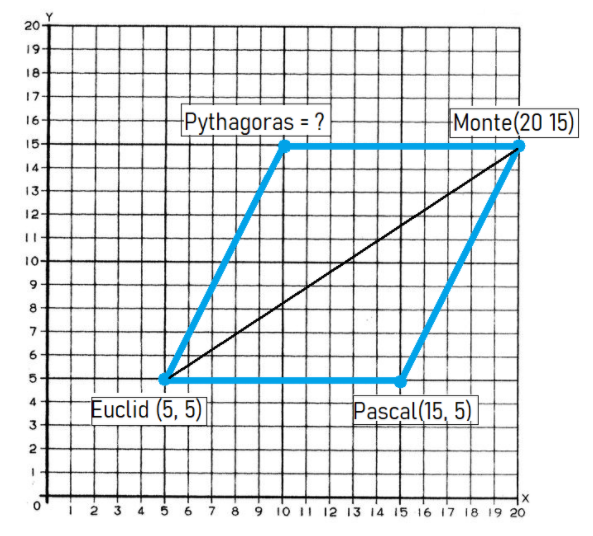
Euclid and Monte are standing at the endpoints of a diagonal and Pascal is standing at one vertex of the other diagonal. Using the coordinates of Pascal, Euclid and Monte, figure out the coordinates of Pythagoras, which will be (10, 15).
Note:
The coordinates of Pythagoras will be unique for the unique values of the other three coordinates.
Problem approach
sum of opposite coordinate is same. So in a parallelogram ABCD, A+C = B+D (A, B, C, D denote the position vectors)
2. Vertex Cover Problem
Moderate
25m average time
75% success
0/80
Asked in companies

You have been given an undirected graph having ‘N’ nodes. A matrix ‘E’ of size 'M' x 2 is given which represents the ‘M’ edges such that there is an edge directed from node 'E[i][0]' to node 'E[i][1]'. You are supposed to return the size of the set of the minimum number of nodes from which all the other nodes are reachable (set of nodes/ vertices which contains at least one point of every edge in the given graph).
Example :
In the graph given below:

2 ---- 4 ---- 6
|      |
|      |
|      |
3 ---- 5

Here, the minimum vertex cover involves vertices 3 and 4. All the edges of the graphs are incident on either 3 or 4 vertex of the graph.
Note:
1. Nodes are numbered from 1 to 'N'.

2. Your solution will run on multiple test cases. If you are using global variables make sure to clear them.
3. 0 1 Knapsack
Moderate
0/80
Asked in companies



A thief is robbing a store and can carry a maximum weight of ‘W’ into his knapsack. There are 'N' items available in the store and the weight and value of each item is known to the thief. Considering the constraints of the maximum weight that a knapsack can carry, you have to find the maximum profit that a thief can generate by stealing items.
Note: The thief is not allowed to break the items.
For example, N = 4, W = 10 and the weights and values of items are weights = [6, 1, 5, 3] and values = [3, 6, 1, 4]. Then the best way to fill the knapsack is to choose items with weight 6, 1 and 3. The total value of knapsack = 3 + 6 + 4 = 13.
Problem approach
Did not get full marks in it.
Used DP[idx][weight1][weight2] where this denotes that we are on bag number idx and we can have weight1 more weight in knapsack 1 and weight2 more weight in knapsack 2. Now the transition is just like normal knapsack.
02
Round
Medium
Face to Face
Duration50 minutes
Interview date5 Aug 2018
Coding problem2
Basic operating systems questions like what is concurrency.
Travelling salesman problem.
Convert a number to string - example 102 to one hundred two (didn't need the complete code).
Some other easy array questions.
1. Travelling salesman problem
Hard
50m average time
50% success
0/120
Asked in companies


Given a list of cities numbered from 0 to N-1 and a matrix 'DISTANCE' consisting of 'N' rows and 'N' columns denoting the distances between each pair of cities, what is the shortest possible route that visits each city exactly once and returns to the starting city?
2. Convert number to words
Hard
40m average time
75% success
0/120
Asked in companies


You are given an Integer ‘N’ you have to convert the integer to words.
For example you are given integer N = 2234 then you have to return the string “two thousand two hundred and thirty four”.
Problem approach
Explained the approach like above, it is a implementation based problem. Interviewer didn't ask for whole code.
03
Round
Medium
Face to Face
Duration50 minutes
Interview date5 Aug 2018
Coding problem4
4 coding questions.
Asked for the written code only for the third one.
Also asked me about my weaknesses and strengths.
1. Min stack
Easy
0/40
Asked in companies


Design a stack that supports push, pop, top, and retrieving the minimum element in constant time.
1. Push(num): Push the given number in the stack.
2. Pop: Remove and return the top element from the stack if present, else return -1.
3. Top: return the top element of the stack if present, else return -1.
4. getMin: Returns minimum element of the stack if present, else return -1.
For Example:
For the following input:
1
5
1 1
1 2
4
2
3

For the first two operations, we will just insert 1 and then 2 into the stack which was empty earlier. So now the stack is => [2,1]
In the third operation, we need to return the minimum element of the stack, i.e., 1. So now the stack is => [2,1]
For the fourth operation, we need to pop the topmost element of the stack, i.e., 2. Now the stack is => [1]
In the fifth operation, we return the top element of the stack, i.e. 1 as it has one element. Now the stack is => [1]

So, the final output will be:
1 2 1
Problem approach
Told him I knew the question already so he switched to the next question.
2. The Celebrity problem
Moderate
30m average time
60% success
0/80
Asked in companies



There are ‘N’ people at a party. Each person has been assigned a unique id between 0 to 'N' - 1(both inclusive). A celebrity is a person who is known to everyone but does not know anyone at the party.
Given a helper function ‘knows(A, B)’, It will returns "true" if the person having id ‘A’ know the person having id ‘B’ in the party, "false" otherwise. Your task is to find out the celebrity at the party. Print the id of the celebrity, if there is no celebrity at the party then print -1.
Note:
1. The helper function ‘knows’ is already implemented for you.
2. ‘knows(A, B)’ returns "false", if A doesn't know B.
3. You should not implement helper function ‘knows’, or speculate about its implementation.
4. You should minimize the number of calls to function ‘knows(A, B)’.
5. There are at least 2 people at the party.
6. At most one celebrity will exist.
Problem approach
I told the solution same as in the above URL.
3. Populating Next Right Pointers In Each Node
Moderate
25m average time
75% success
0/80
Asked in companies

You have been given a complete binary tree of ‘N’ nodes. The nodes are numbered 1 to ‘N’.
You need to find the ‘next’ node that is immediately right in the level order form for each node in the given tree.
Note :
1. A complete binary tree is a binary tree in which nodes at all levels except the last level have two children and nodes at the last level have 0 children.
2. Node ‘U’ is said to be the next node of ‘V’ if and only if  ‘U’ is just next to ‘V’ in tree representation.
3. Particularly root node and rightmost nodes have ‘next’ node equal to ‘Null’
4. Each node of the binary tree has three-pointers, ‘left’, ‘right’, and ‘next’. Here ‘left’ and ‘right’ are the children of node and ‘next’ is one extra pointer that we need to update.
For Example :
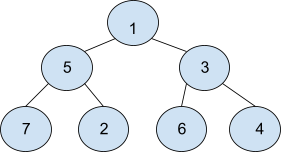
The‘next’ node for ‘1’ is ‘Null’, ‘2’ has ‘next’ node ‘6’, ‘5’ has ‘next’ node ‘3’, For the rest of the nodes check below.
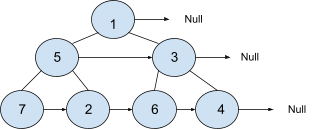
Problem approach
I had done this question on interview bit already so used the same approach.
4. Search In A Row Wise And Column Wise Sorted Matrix
Moderate
15m average time
80% success
0/80
Asked in companies



You are given an 'N * N' matrix of integers where each row and each column is sorted in increasing order. You are given a target integer 'X'.
Find the position of 'X' in the matrix. If it exists then return the pair {i, j} where 'i' represents the row and 'j' represents the column of the array, otherwise return {-1,-1}
For example:
If the given matrix is:
[ [1, 2, 5],
  [3, 4, 9],
  [6, 7, 10]]
We have to find the position of 4. We will return {1,1} since A[1][1] = 4.
Problem approach
I also had done this question on interview bit already so used the same approach.


Here's your problem of the day 
Solving this problem will increase your chance to get selected in this company
Skill covered: Programming
How do you remove whitespace from the start of a string?
Choose another skill to practice
Similar interview experiences
SDE - Intern
3 rounds | 4 problems
Interviewed by Morgan Stanley
 Selected
1783 views

0 comments

0 upvotes
SDE - Intern
3 rounds | 5 problems
Interviewed by Morgan Stanley
 Selected
 2242 views
0 comments
0 upvotes
SDE - Intern
3 rounds | 10 problems
Interviewed by Morgan Stanley

Rejected
0 views
0 comments
0 upvotes
SDE - Intern
3 rounds | 5 problems
Interviewed by Morgan Stanley
Selected 1221 views
0 comments
0 upvotes
Companies with similar interview experiences
SDE - Intern
3 rounds | 6 problems
Interviewed by Amazon

Rejected
15605 views
4 comments
0 upvotes
SDE - Intern
4 rounds | 7 problems
Interviewed by Microsoft
 Selected
 15499 views
1 comments
0 upvotes
SDE - Intern
2 rounds | 4 problems
Interviewed by Amazon
Selected 10216 views
2 comments
0 upvotes