





Morgan Stanley interview experience Real time questions & tips from candidates to crack your interview

Software Developer
Morgan Stanley


2 rounds | 6 Coding
problems

Rejected
Interview preparation journey

Preparation
Duration: 6 months
Topics: Data Structures, Algorithms, System Design, Aptitude, OOPS

Tip 1 : Must do Previously asked Interview as well as Online Test Questions.
Tip 2 : Go through all the previous interview experiences from Codestudio and Leetcode.
Tip 3 : Do at-least 2 good projects and you must know every bit of them.
Application process
Where: Campus
Eligibility: Above 7 CGPA
Tip 1 : Have at-least 2 good projects explained in short with all important points covered.
Tip 2 : Every skill must be mentioned.
Tip 3 : Focus on skills, projects and experiences more.

Interview rounds
01
Round
Medium
Face to Face
Duration60 minutes
Interview date11 Aug 2015
Coding problem3
Technical Interview round with questions based on DSA.
1. Duplicate In Array
Easy
15m average time
85% success

0/40
Asked in companies



You are given an array ‘ARR’ of size ‘N’ containing each number between 1 and ‘N’ - 1 at least once. There is a single integer value that is present in the array twice. Your task is to find the duplicate integer value present in the array.
For example:
Consider ARR = [1, 2, 3, 4, 4], the duplicate integer value present in the array is 4. Hence, the answer is 4 in this case.
Note :
A duplicate number is always present in the given array.
Problem approach
Concept of indexing can be used to solve this question.
Traverse the array. For every element at index i,visit a[i]. If a[i] is positive, then change it to negative. If a[i] is negative, it means the element has already been visited and thus it is repeated. Print that element.
Pseudocode :
findRepeating(arr[], n)
{
missingElement = 0
for (i = 0; i < n; i++){
element = arr[abs(arr[i])]
if(element < 0){
missingElement = arr[i]
break
}
arr[abs(arr[i])] = -arr[abs(arr[i])]
}
return abs(missingElement)
}
2. Sum root to leaf
Easy
10m average time
90% success
0/40
Asked in companies

You are given an arbitrary binary tree consisting of N nodes where each node is associated with a certain integer value from 1 to 9. Consider each root to leaf path as a number.
For example:
       1
      /  \
     2    3

The root to leaf path 1->2 represents the number 12.
The root to leaf path 1->3 represents the number 13.
Your task is to find the total sum of all the possible root to leaf paths.
In the above example,
The total sum of all the possible root to leaf paths is 12+13 = 25
Note:
The output may be very large, return the answer after taking modulus with (10^9+7).
Problem approach
This can be solved using recursion. The basic idea is to subtract the value of current node from sum until it reaches a leaf node and the subtraction equals 0, then we know that we got a hit. Keep checking for left or right child path sum equal to target sum – value at current node.
Time complexity : O(n)
3. Topological Sort
Easy
0/40
Asked in companies


You are given a directed acyclic graph. Your task is to find any topological sorting of the graph.
A directed acyclic graph is a directed graph with no directed cycles.
Topological sorting for Directed Acyclic Graph (DAG) is a linear ordering of vertices such that for every directed edge from u to v, vertex u comes before v in the ordering.
For example-
For the given DAG-
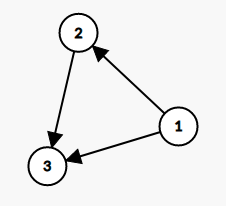
One of the possible topological sort will be-
1  2  3
Problem approach
Backtracking can be used to solve this problem.
Steps :
1. Initialize all vertices as unvisited.
2. Now choose the vertex which is unvisited and has zero indegree and decrease indegree of all those vertices by 1 (corresponding to removing edges) now add this vertex to result and call the recursive function again and backtrack.
3. After returning from function , reset values of visited, result and indegree for enumeration of other possibilities.
02
Round
Easy
Face to Face
Duration60 minutes
Interview date11 Aug 2015
Coding problem3
Technical interview round with questions based on DSA.
1. LCA Of Binary Tree
Moderate
10m average time
90% success
0/80
Asked in companies



You have been given a Binary Tree of distinct integers and two nodes ‘X’ and ‘Y’. You are supposed to return the LCA (Lowest Common Ancestor) of ‘X’ and ‘Y’.
The LCA of ‘X’ and ‘Y’ in the binary tree is the shared ancestor of ‘X’ and ‘Y’ that is located farthest from the root.
Note :
You may assume that given ‘X’ and ‘Y’ definitely exist in the given binary tree.
For example :
For the given binary tree
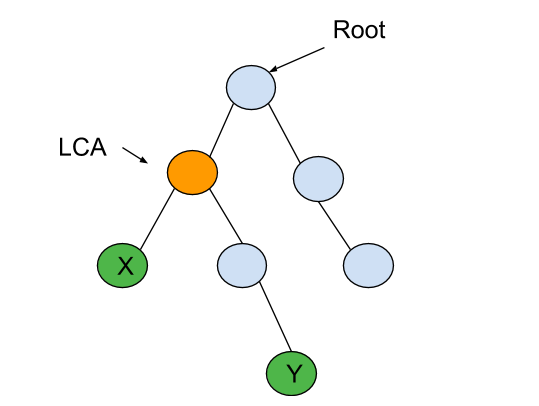
LCA of ‘X’ and ‘Y’ is highlighted in yellow colour.
Problem approach
The recursive approach is to traverse the tree in a depth-first manner. The moment you encounter either of the nodes node1 or node2, return the node. The least common ancestor would then be the node for which both the subtree recursions return a non-NULL node. It can also be the node which itself is one of node1 or node2 and for which one of the subtree recursions returns that particular node.
Pseudo code :
LowestCommonAncestor(root, node1, node2) {
if(not root)
return NULL
if (root == node1 or root == node2)
return root
left = LowestCommonAncestor(root.left, node1, node2)
right = LowestCommonAncestor(root.right, node1, node2)
if(not left)
return right
else if(not right)
return left
else
return root
}
2. Rotated Array
Moderate
10m average time
90% success
0/80
Asked in companies


You are given an array 'arr' of size 'n' having unique elements that has been sorted in ascending order and rotated between 1 and 'n' times which is unknown.
The rotation involves shifting every element to the right, with the last element moving to the first position. For example, if 'arr' = [1, 2, 3, 4] was rotated one time, it would become [4, 1, 2, 3].
Your task is to find the minimum number in this array.
Note :
All the elements in the array are distinct.
Example :
Input: arr = [3,4,5,1,2]

Output: 1

Explanation: The original array was [1,2,3,4,5] and it was rotated 3 times.
Problem approach
On careful observation, it can be concluded that the number of rotations is equal to index of minimum element. So, the brute force solution is to find minimum element and returns its index.
Time Complexity : O(n)
Auxiliary Space : O(1)
An efficient approach can be built using Binary Search. We can find the index of minimum element using Binary Search. The idea is based on the below facts :
• The minimum element is the only element whose previous is greater than it. If there is no previous element, then there is no rotation (first element is minimum). We check this condition for middle element by comparing it with (mid-1)’th and (mid+1)’th elements.
• If the minimum element is not at the middle (neither mid nor mid + 1), then minimum element lies in either left half or right half.
1. If middle element is smaller than last element, then the minimum element lies in left half
2. Else minimum element lies in right half.
3. Maximum Binary Tree
Moderate
10m average time
90% success
0/80
Asked in companies

You have been given an array/list ‘TREE’ having ‘N’ unique integers. You need to make a maximum binary tree recursively from ‘TREE’ using the following conditions:
1. Create a root of the maximum binary tree whose value is the maximum value present in the ‘TREE’.
2. Recursively build the left subtree on the subarray prefix to the left of the maximum value.
3. Recursively build the right subtree on the subarray suffix to the right of the maximum value.
For example:
For ‘TREE’ = [6, 1, 8, 2, 5],see the maximum binary tree in the below picture for reference:
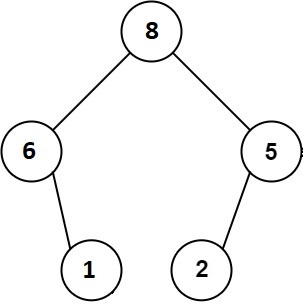
As we can see the root of the maximum binary tree as shown in the picture is ‘8’ which is the maximum value in the ‘TREE’. The left subtree contains all the values which are present in the left of 8 in ‘TREE’ and the right subtree contains all the values which are present in the right of ‘8’ in ‘TREE’. Similarly, the maximum value in the left subarray of 8 is 6 so 6 becomes the root of the left subtree, 5 is the maximum value in the right subarray of the 8 so 5 becomes the root of the right subarray, and so on.
Problem approach
Every node has to be visited to figure out the maximum. So the idea is to traverse the given tree and for every node return maximum of 3 values.
1. Node’s data.
2. Maximum in node’s left subtree.
3. Maximum in node’s right subtree.
Pseudocode :
findMax(Node root)
{
// Base case
if (root is NULL)
return INT_MIN;
// Return maximum of 3 values:
// 1) Root's data 2) Max in Left Subtree 3) Max in right subtree
res = root->data;
lres = findMax(root->left);
rres = findMax(root->right);
if (lres > res)
res = lres;
if (rres > res)
res = rres;
return res;
}


Here's your problem of the day 
Solving this problem will increase your chance to get selected in this company
Skill covered: Programming
How do you remove whitespace from the start of a string?
Choose another skill to practice
Similar interview experiences
Software Developer
1 rounds | 3 problems
Interviewed by Morgan Stanley

Rejected

983 views

0 comments

0 upvotes
SDE - 1
2 rounds | 4 problems
Interviewed by Morgan Stanley
Rejected
0 views
0 comments
0 upvotes
Software Engineer
2 rounds | 6 problems
Interviewed by Morgan Stanley
 Selected
 1057 views
0 comments
0 upvotes
SDE - 1
3 rounds | 6 problems
Interviewed by Morgan Stanley
Selected 903 views
0 comments
0 upvotes
Companies with similar interview experiences
Software Developer
5 rounds | 14 problems
Interviewed by Microsoft
 Selected
 4029 views
1 comments
0 upvotes

Software Developer
6 rounds | 12 problems
Interviewed by SAP Labs
Selected 2912 views
0 comments
0 upvotes
Software Developer
3 rounds | 3 problems
Interviewed by Amazon
Selected 1271 views
0 comments
0 upvotes