





Morgan Stanley interview experience Real time questions & tips from candidates to crack your interview

Technology Analyst Intern
Morgan Stanley


3 rounds | 6 Coding
problems

 Selected
 Interview preparation journey

Journey
I applied for the Summer Internship at Morgan Stanley. The duration of the internship is 2 months, and the role offered by the firm is Technology Analyst Intern. I completed this internship during the summer break after my 6th semester.
To prepare for the interview, I started with the basics. I focused on improving my coding skills and familiarized myself with financial concepts by attending workshops and taking relevant courses to gain practical experience. Additionally, I worked on various related projects. I also joined a tech club where we worked on projects involving data analysis and machine learning, and I participated in a few hackathons, which sharpened my problem-solving skills and helped me learn to work under pressure. These experiences allowed me to build a solid portfolio to showcase in my applications.
I crafted a tailored resume and cover letter, highlighting my technical skills, teamwork experiences, and projects relevant to the firm. I made sure to emphasize my proficiency in programming languages and my understanding of data analysis. I also brushed up on technical concepts, algorithms, and coding challenges, and practiced behavioral interview questions. Keeping up with the latest trends in fintech helped me discuss how technology is shaping the industry during the interview.
The interview process included both technical and behavioral components. I was asked to solve coding problems on a whiteboard, which required clear communication of my thought process. I focused on explaining my approach and reasoning as I tackled the challenges. During the behavioral portion, I used the STAR method to discuss my past experiences, emphasizing my teamwork and adaptability. I also made sure to ask insightful questions about the team’s projects and the role technology plays at Morgan Stanley, demonstrating my genuine interest in contributing to their goals.
Application story
It was an on-campus placement drive opportunity organized by my college.
I learned about the prestigious firm through my college seniors.
Morgan Stanley also conducted a presentation on the "benefits of joining the firm" before the placement drive.
Why selected/rejected for the role?
I was able to clear all the rounds for the job profile.
The rounds included an aptitude test, coding test, and debugging test, followed by technical and professional interviews.
Preparation
Duration: 2 months
Topics: Operating Systems, Database Management Systems, OOP, Linked Lists, Arrays, Computer Networks, Dynamic Programming, Cybersecurity, Graphs, and Tree Algorithms.

Tip 1: For Data Structures & Algorithms, you could go with 450 DSA (recommended) or Striver’s list.
Tip 2: For OS, understand the concepts behind the topic. You can learn the concepts from the OS playlist and the theory.
Tip 3: For DBMS, again, focus on understanding the concepts behind the topic using Sanchit Jain’s playlist and the theory from here.
Application process
Where: Campus
Eligibility: 7.5+ CGPA, (Internship Stipend: 87000)
Tip 1: Don’t choose an overly fancy resume format.
Tip 2: Keep the resume crisp, short, and as formal as possible.

Interview rounds
01
Round
Medium
Online Coding Interview
Duration90 minutes
Interview date3 Sep 2021
Coding problem2
1. Longest Valid Substring
Moderate
15m average time
85% success

0/80
Asked in companies


You are given a string 'STR' consisting only of opening and closing parenthesis i.e. '(' and ')', your task is to find out the length of the longest valid parentheses substring.
Note:
The length of the smallest valid substring '()' is 2.
For example:
'STR' = “()()())” here we can see that except the last parentheses all the brackets are making a valid parenthesis. Therefore, the answer for this will be 6.
Problem approach
The idea is to use a stack-based approach to track the indices of unmatched parentheses. It determines the length of valid (well-formed) parentheses substrings by keeping track of the position of the last unmatched closing parenthesis or the starting position of a valid substring.
2. Closest Distance Pair
Easy
20m average time
0/40
Asked in companies


You are given an array containing 'N' points in the plane. The task is to find out the distance of the closest points.
Note :
Where distance between two points (x1, y1) and (x2, y2) is calculated as [(x1 - x2) ^ 2] + [(y1 - y2) ^ 2].
Problem approach
Using Sort
To solve this problem optimally, we first need to sort the intervals according to their starting times. Once the intervals are sorted, we can merge them in a single traversal. The idea is that in a sorted array of intervals, if arr[i] doesn’t overlap with arr[i-1], then arr[i+1] cannot overlap with arr[i-1] because the starting time of arr[i+1] must be greater than or equal to that of arr[i].
Follow the steps below to implement the approach:
- Sort the intervals in increasing order of their starting times.
- Push the first interval into a stack.
- For each interval, do the following:
- If the current interval does not overlap with the top of the stack, push the current interval onto the stack.
- If the current interval overlaps with the top of the stack, update the top of the stack with the ending time of the current interval.
- The stack at the end will contain the merged intervals.
02
Round
Medium
Video Call
Duration45 minutes
Interview date6 Sep 2021
Coding problem1
1. Dijkstra's shortest path
Moderate
25m average time
65% success
0/80
Asked in companies



You have been given an undirected graph of ‘V’ vertices (labeled 0,1,..., V-1) and ‘E’ edges. Each edge connecting two nodes (‘X’,’Y’) will have a weight denoting the distance between node ‘X’ and node ‘Y’.
Your task is to find the shortest path distance from the source node, which is the node labeled as 0, to all vertices given in the graph.
Example:
Input:
4 5
0 1 5
0 2 8
1 2 9
1 3 2
2 3 6
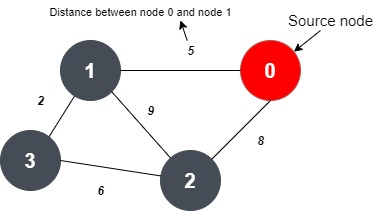
In the given input, the number of vertices is 4, and the number of edges is 5.

In the input, following the number of vertices and edges, three numbers are given. The first number denotes node ‘X’, the second number denotes node ‘Y’ and the third number denotes the distance between node ‘X’ and ‘Y’.

As per the input, there is an edge between node 0 and node 1 and the distance between them is 5.

The vertices 0 and 2 have an edge between them and the distance between them is 8.
The vertices 1 and 2 have an edge between them and the distance between them is 9.
The vertices 1 and 3 have an edge between them and the distance between them is 2.
The vertices 2 and 3 have an edge between them and the distance between them is 6.
Note:
1. There are no self-loops(an edge connecting the vertex to itself) in the given graph.

2. There can be parallel edges i.e. two vertices can be directly connected by more than 1 edge.
Problem approach
The idea is to generate a Shortest Path Tree (SPT) with a given source as the root. Maintain an adjacency matrix and two sets: one set contains the vertices included in the shortest path tree, while the other set includes the vertices not yet included. At every step of the algorithm, find a vertex from the latter set (the set of vertices not yet included) that has the minimum distance from the source.
03
Round
Medium
HR Round
Duration45 minutes
Interview date6 Sep 2021
Coding problem3
1. HR question
How much of a risk-taking person you are?
2. HR question
Suppose you are not comfortable with working with a person or that person not working according to what you want, how would you behave in this situation? Did this happen before?
3. HR question
Would you lead others or are willing to follow others?


Here's your problem of the day 
Solving this problem will increase your chance to get selected in this company
Skill covered: Programming
How do you remove whitespace from the start of a string?
Choose another skill to practice
Similar interview experiences
SDE - 2
3 rounds | 3 problems
Interviewed by Morgan Stanley
Selected 
3464 views

0 comments

0 upvotes
Senior Associate
4 rounds | 5 problems
Interviewed by Morgan Stanley
 Selected
 1435 views
0 comments
0 upvotes
Technology Analyst
2 rounds | 3 problems
Interviewed by Morgan Stanley
Rejected
1434 views
0 comments
0 upvotes
SDE - 2
4 rounds | 10 problems
Interviewed by Morgan Stanley
 Selected
 2602 views
0 comments
0 upvotes