





MountBlue Technologies interview experience Real time questions & tips from candidates to crack your interview

SDE - 1
MountBlue Technologies


3 rounds | 5 Coding
problems

 Selected
 Interview preparation journey

Journey
I started my coding journey in Feb 2020. Firstly, I solved approximately 50-60 questions on the Hackkerank platform to brush up on my programming syntax and warmup. Then, I start coding on CodeStudio platforms simultaneously. I picked each data structure topic and started solving questions from easy to medium. Firstly, I picked LinkedList data structures and coded approximately 40 questions for the same, and then I picked Hashing, Stack, Queue, and Trees. Graphs I solved limited questions (only BFS, DFS, and topological sort-based questions). Dynamic programming: I solved approximately 20-25 questions. These are the generic ones only, like LCS, Knapsack, etc. My approach for solving the question was to spend around 10-15 mins first to try building the solution. If I could not build the solution, I used to refer to some posts or YouTube to understand the same. And after that, I kept this question on my to-do list. Then, the following day, I used to code the approach I watched on post/YouTube.
Application story
I got this opportunity through an off-campus opportunity. I prepare moderate data structures like linked lists, trees, graphs, and arrays.
Why selected/rejected for the role?
I had a moderate level of coding and a deep understanding of programming skills. I was able to solve questions asked me during the selection process. Also, good communication skill is more than required.
Preparation
Duration: 6 Months
Topics: Data Structures, OOPS, Trees, Graphs, LinkedList, Arrays, Queue, Stack, Hashmap, Searching, Sorting, Recursion, Strings

Tip 1: Practice At least 20 questions from each topic like LinkedList, Graphs, Trees, and HashMap and all medium data structures.
Tip 2: try to complete the medium code in 30 mins of durations.
Tip 3: Prepare one coding language with which you are more comfortable.
Application process
Where: Hackerrank
Eligibility: 7 CGPA
Tip 1: Have some projects on your resume.
Tip 2: Never put false things.

Interview rounds
01
Round
Medium
Online Coding Interview
Duration60 mins
Interview date8 Oct 2020
Coding problem2
1. Construct Binary Tree From Inorder and Preorder Traversal
Easy
10m average time
90% success

0/40
Asked in companies



You have been given the preorder and inorder traversal of a binary tree. Your task is to construct a binary tree using the given inorder and preorder traversals.
Note:
You may assume that duplicates do not exist in the given traversals.
For example :
For the preorder sequence = [1, 2, 4, 7, 3] and the inorder sequence = [4, 2, 7, 1, 3], we get the following binary tree.
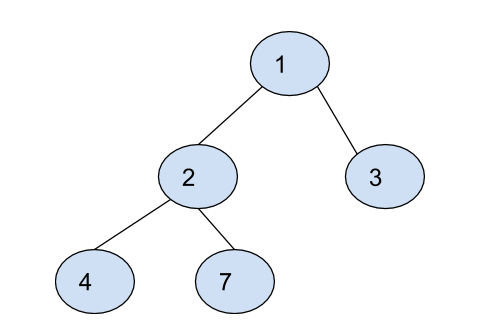
Problem approach
Given two integer arrays preorder and inorder where preorder is the preorder traversal of a binary tree and inorder is the inorder traversal of the same tree, construct and return the binary tree.
2. Valid Parentheses
Easy
10m average time
80% success
0/40
Asked in companies



You're given a string 'S' consisting of "{", "}", "(", ")", "[" and "]" .
Return true if the given string 'S' is balanced, else return false.
For example:
'S' = "{}()".

There is always an opening brace before a closing brace i.e. '{' before '}', '(' before ').
So the 'S' is Balanced.
Problem approach
Tip 1: Do not submit too much, sometimes IDE consumes much time for compilation.
Tip 2: Check for hidden test cases as well, some test cases maybe hidden.
02
Round
Hard
Video Call
Duration90 mins
Interview date12 Oct 2020
Coding problem2
Level 2 assessment is scheduled to be held on Mon, 12th October at 6 PM.
1. LRU Cache Implementation
Moderate
25m average time
65% success
0/80
Asked in companies



Design and implement a data structure for Least Recently Used (LRU) cache to support the following operations:
1. get(key) - Return the value of the key if the key exists in the cache, otherwise return -1.

2. put(key, value), Insert the value in the cache if the key is not already present or update the value of the given key if the key is already present. When the cache reaches its capacity, it should invalidate the least recently used item before inserting the new item.
You will be given ‘Q’ queries. Each query will belong to one of these two types:
Type 0: for get(key) operation.
Type 1: for put(key, value) operation.
Note :
1. The cache is initialized with a capacity (the maximum number of unique keys it can hold at a time).

2. Access to an item or key is defined as a get or a put operation on the key. The least recently used key is the one with the oldest access time.
Problem approach
Tip 1: Try to optimize your solution as time-limit errors may occur.
Tip 2: Most imp while solving the problem keep speak-up your thought process for building your solution.
2. Min Stack
Easy
0/40
Asked in companies


Design a stack that supports push, pop, top, and retrieving the minimum element in constant time.
1. Push(num): Push the given number in the stack.
2. Pop: Remove and return the top element from the stack if present, else return -1.
3. Top: return the top element of the stack if present, else return -1.
4. getMin: Returns minimum element of the stack if present, else return -1.
For Example:
For the following input:
1
5
1 1
1 2
4
2
3

For the first two operations, we will just insert 1 and then 2 into the stack which was empty earlier. So now the stack is => [2,1]
In the third operation, we need to return the minimum element of the stack, i.e., 1. So now the stack is => [2,1]
For the fourth operation, we need to pop the topmost element of the stack, i.e., 2. Now the stack is => [1]
In the fifth operation, we return the top element of the stack, i.e. 1 as it has one element. Now the stack is => [1]

So, the final output will be:
1 2 1
03
Round
Easy
HR Round
Duration10 mins
Interview date19 Oct 2020
Coding problem1
It was around 10 AM.
1. Basic HR Questions
Simple location preference, any other offers in hand, etc.
Problem approach
Tip 1: Do not speak to much.


Here's your problem of the day 
Solving this problem will increase your chance to get selected in this company
Skill covered: Programming
How do you remove whitespace from the start of a string?
Choose another skill to practice
Similar interview experiences
SDE - 1
2 rounds | 4 problems
Interviewed by MountBlue Technologies
Rejected

1226 views

1 comments

0 upvotes
SDE - 1
4 rounds | 8 problems
Interviewed by Amazon
Selected 11210 views
0 comments
0 upvotes
SDE - Intern
1 rounds | 3 problems
Interviewed by Amazon
Selected 4456 views
0 comments
0 upvotes
Software Engineer
2 rounds | 15 problems
Interviewed by MountBlue Technologies
Selected 234 views
0 comments
0 upvotes
Companies with similar interview experiences

SDE - 1
2 rounds | 3 problems
Interviewed by BNY Mellon
 Selected
 6786 views
3 comments
0 upvotes
SDE - 1
3 rounds | 6 problems
Interviewed by BNY Mellon
 Selected
 0 views
0 comments
0 upvotes

SDE - 1
3 rounds | 5 problems
Interviewed by CIS - Cyber Infrastructure
Selected 2418 views
0 comments
0 upvotes