





MountBlue Technologies interview experience Real time questions & tips from candidates to crack your interview

Software Engineer
MountBlue Technologies


2 rounds | 15 Coding
problems

 Selected
 Interview preparation journey

Journey
I started my preparation by focusing on the fundamentals of programming and core computer science subjects such as Data Structures, DBMS, and Operating Systems. Initially, I practiced basic coding problems to improve my problem-solving skills and gradually moved on to more structured interview preparation.
Along the way, I also worked on improving my ability to explain solutions clearly during technical discussions. Consistent practice, learning from previous interview experiences, and staying focused on strengthening my fundamentals helped me perform confidently during the MountBlue Technologies recruitment process.
Application story
I applied for the opportunity through the eLitmus off-campus hiring platform after coming across the opening for MountBlue Technologies.
After registering and completing the required profile details, I appeared for the selection process conducted by the company. Candidates who performed well in the initial screening stages were shortlisted for further interview rounds.
The overall process was conducted online, and communication regarding shortlisting and interview schedules was shared through email. The recruitment process was well-structured and focused on evaluating problem-solving skills and technical fundamentals.
Why selected/rejected for the role?
I believe I was selected because I demonstrated strong problem-solving skills, a good understanding of data structures and core concepts, and the ability to clearly explain my approach during discussions.
I focused on thinking aloud while solving problems and maintained confidence throughout the process. Consistent coding practice and clarity in fundamentals played an important role in helping me perform well during the selection process.
Preparation
Duration: 3 months
Topics: Data Structures and Algorithms, Pointers, OOPS, System Design, Algorithms, Dynamic Programming

Tip 1: Build strong fundamentals in Data Structures, Algorithms, and core subjects like DBMS and Operating Systems.
Tip 2: Practice coding problems regularly and focus on explaining your approach clearly during interviews.
Application process
Where: Other
Eligibility: Above 60% (Salary Package: 4.2 LPA)
Tip 1: Keep your resume concise and highlight relevant projects, programming languages, and technical skills related to the role.
Tip 2: Ensure you thoroughly understand everything mentioned on your resume, as interviewers may ask detailed questions about your projects and technologies.

Interview rounds
01
Round
Medium
Online Coding Interview
Duration60 minutes
Interview date1 Nov 2023
Coding problem8
Timing: Conducted online during scheduled hours (not late at night).
Environment: A smooth and moderately challenging online assessment environment with a mix of MCQs and coding questions.
Significant Activity: The focus was on solving coding problems within the time limit, along with a few concept-based MCQs on core subjects.
Interviewer: There was no interviewer interaction in this round, as it was an automated online test.
1. FCFS Scheduling Algorithm with Different Arrival Time
Moderate
15m average time
85% success

0/80
Asked in companies

There are ‘N’ numbers of processes with process id ‘0’ to ‘N - 1’. You are given two arrays ‘arrival’ and ‘burst’, representing the arrival time and burst time of each of these processes.
If the CPU uses the FCFS process scheduling algorithm, you need to find waiting time, turnaround time, and completion time for each process. Finally, find the average waiting time and average turnaround time for the given processes.
Note:
1. All the processes will have different arrival times.

2. In the FCFS scheduling algorithm, processes that come first ( i.e have lesser arrival time) will be executed first.

3. Turn around time of a Process is the time difference between arrival time and the time at which the process completed.

4. The waiting time of a process is the total time, the process is waiting, i.e. difference between turnaround time and burst time.

5. Completion time is the time at which a process completes.
Example:
Let there be 4 Processes with the following arrival time and burst time.
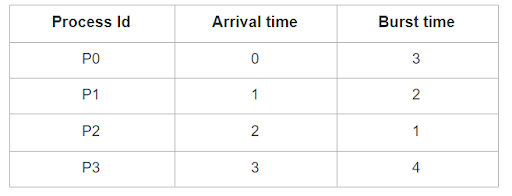
Wait time, turnaround, and completion time for each process are:
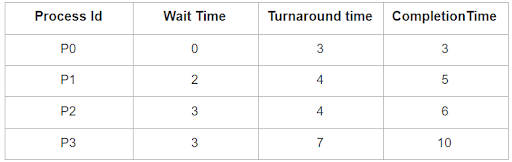
Problem approach
Arrange the processes by arrival time and compute the waiting time using cumulative burst times.
2. Deadlock Prevention
What is deadlock prevention, and how is it implemented in operating systems? (Learn)
Problem approach
Prevention eliminates at least one Coffman condition, while avoidance uses algorithms like the Banker’s Algorithm.
3. Second Highest Salary
Write an SQL query to find the second-highest salary from the Employee table. (Practice)
Problem approach
Use a subquery or ORDER BY salary DESC LIMIT 1 OFFSET 1.
4. DB Transactions
Transactions in DBMS and ACID properties.
Problem approach
Atomicity, Consistency, Isolation, Durability ensure reliable database transactions.
5. Load Balancing
What is the primary purpose of a load balancer in a distributed system?
Problem approach
A load balancer improves availability, reliability, and scalability by distributing requests across multiple servers.
6. Data Sharding
Which technique is commonly used to improve database scalability by distributing data across multiple machines?
Problem approach
Sharding splits a large database into smaller parts (shards) that are stored across different servers to handle large-scale data and traffic.
7. 2 Sum
Moderate
0/80
Asked in companies



Given an integer array Arr of size N and an integer target, your task is to find the indices of two elements of the array such that their sum is equal to target. Return <-1,-1> if no such pair exists.
Note:
If more than one such pair of indices exist, return the lexicographically smallest pair
You may not use the same element twice.
Problem approach
Use a HashMap to store visited elements and check target − current.
8. Longest Consecutive Sequence
Moderate
40m average time
70% success
0/80
Asked in companies



You are given an unsorted array/list 'ARR' of 'N' integers. Your task is to return the length of the longest consecutive sequence.
The consecutive sequence is in the form ['NUM', 'NUM' + 1, 'NUM' + 2, ..., 'NUM' + L] where 'NUM' is the starting integer of the sequence and 'L' + 1 is the length of the sequence.
Note:
If there are any duplicates in the given array we will count only one of them in the consecutive sequence.
For example-
For the given 'ARR' [9,5,4,9,10,10,6].

Output = 3
The longest consecutive sequence is [4,5,6].
Follow Up:
Can you solve this in O(N) time and O(N) space complexity?
Problem approach
Use a HashSet and start counting only when the previous element does not exist.
Time Complexity: O(N)
02
Round
Medium
Video Call
Duration45 minutes
Interview date7 Nov 2023
Coding problem7
Timing: Conducted via a scheduled video call during normal working hours (not late at night).
Environment: Professional and focused, with an emphasis on solving problems and clearly explaining the approach.
Significant Activity: The interviewer asked DSA-related problems and expected the candidate to explain the logic, discuss time and space complexity, and consider edge cases.
Interviewer: Friendly but analytical; encouraged step-by-step thinking and occasionally provided hints to guide toward the correct approach.
1. BST Complexity
What is the time complexity of searching for an element in a balanced Binary Search Tree (BST)?
Problem approach
Average case O(log N).
2. Array Access
What is the time complexity of accessing an element in an array using its index?
Problem approach
O(1) (constant time).
3. Hash Complexity
What is the average time complexity of insertion and lookup in a HashMap/Hash Table?
Problem approach
O(1) on average.
4. Duplicate In Array
Easy
15m average time
85% success
0/40
Asked in companies


You are given an array ‘ARR’ of size ‘N’ containing each number between 1 and ‘N’ - 1 at least once. There is a single integer value that is present in the array twice. Your task is to find the duplicate integer value present in the array.
For example:
Consider ARR = [1, 2, 3, 4, 4], the duplicate integer value present in the array is 4. Hence, the answer is 4 in this case.
Note :
A duplicate number is always present in the given array.
Problem approach
Use a HashSet or Floyd’s Cycle Detection for an optimized solution.
5. Maximum Subarray Sum
Moderate
35m average time
81% success
0/80
Asked in companies


You are given an array 'arr' of length 'n', consisting of integers.
A subarray is a contiguous segment of an array. In other words, a subarray can be formed by removing 0 or more integers from the beginning and 0 or more integers from the end of an array.
Find the sum of the subarray (including empty subarray) having maximum sum among all subarrays.
The sum of an empty subarray is 0.
Example :
Input: 'arr' = [1, 2, 7, -4, 3, 2, -10, 9, 1]

Output: 11

Explanation: The subarray yielding the maximum sum is [1, 2, 7, -4, 3, 2].
Problem approach
Use Kadane’s Algorithm to track the maximum sum while iterating.
6. Water Jug
You have a 5-litre jug and a 3-litre jug. Measure exactly 4 litres of water.
Problem approach
Fill 5L → pour into 3L → remaining 2L → empty 3L → transfer 2L → fill 5L → pour into 3L → remaining 4L.
7. Switch Puzzle
Three switches outside control three bulbs inside a room. You can enter the room only once. Identify which switch controls which bulb.
Problem approach
Turn one switch on for a while, then turn it off. Turn another switch on, then enter the room and use heat and light to identify the bulbs.


Here's your problem of the day 
Solving this problem will increase your chance to get selected in this company
Skill covered: Programming
How do you remove whitespace from the start of a string?
Choose another skill to practice
Similar interview experiences
SDE - 1
3 rounds | 5 problems
Interviewed by MountBlue Technologies
Selected 
2341 views

0 comments

0 upvotes
SDE - 1
4 rounds | 8 problems
Interviewed by Amazon
Selected 11210 views
0 comments
0 upvotes
Software Engineer
3 rounds | 2 problems
Interviewed by MountBlue Technologies
Selected 1418 views
0 comments
0 upvotes
SDE - Intern
1 rounds | 3 problems
Interviewed by Amazon
Selected 4456 views
0 comments
0 upvotes
Companies with similar interview experiences

Software Engineer
4 rounds | 1 problems
Interviewed by Newgen Software
 Selected
 3571 views
2 comments
0 upvotes

Software Engineer
3 rounds | 6 problems
Interviewed by HashedIn
 Selected
 2837 views
0 comments
0 upvotes

Software Engineer
2 rounds | 2 problems
Interviewed by Ernst & Young (EY)
 Selected
 0 views
0 comments
0 upvotes