





Mphasis pvt limited interview experience Real time questions & tips from candidates to crack your interview
SDE - 1
Mphasis pvt limited


3 rounds | 4 Coding
problems
 Selected
 Interview preparation journey

Journey
My journey started with building a strong foundation in programming and understanding core concepts like data structures and OOP. Initially, I faced challenges in coding and problem-solving, but with consistent practice and learning from my mistakes, I gradually improved my skills. I focused on solving basic problems, understanding logic, and strengthening my fundamentals rather than just memorizing solutions.
Along with technical preparation, I also worked on improving my communication skills and confidence, which helped me perform better in interviews. I practiced coding questions regularly and revised important topics like sorting algorithms and basic programming concepts.
During the interview process, I stayed calm and tried to clearly explain my thought process instead of rushing to answers. This approach helped me effectively showcase my understanding. Overall, my journey taught me that consistency, patience, and a clear understanding of the basics are key factors in cracking interviews successfully.
Application story
I applied for the opportunity through my college’s on-campus placement drive when the company visited our campus. The placement cell shared all the details regarding eligibility, registration, and the selection process. After registering, I appeared for the initial screening round, which was followed by shortlisting for further rounds.
The entire process was conducted in a well-organized manner by both the company and the college placement team. All updates regarding results and next steps were communicated clearly. Overall, the on-campus process was smooth and structured, which helped me stay focused and prepared throughout the journey.
Why selected/rejected for the role?
I believe I was selected because I had a strong understanding of fundamental concepts and was able to clearly explain my thought process during the interview. I focused on solving problems step by step rather than rushing to answers, which helped demonstrate my logical thinking. Additionally, my project experience and internship exposure aligned well with the role requirements. My communication skills and confidence also played an important role in creating a positive impression.
Preparation
Duration: 3 - 4 months
Topics: I focused on strengthening my fundamentals in programming and core computer science subjects. I practiced coding problems regularly to improve my problem-solving skills and revised important concepts multiple times. I also referred to online resources and previous interview experiences to understand the patterns and expectations. Along with technical preparation, I worked on clearly explaining my answers to improve my communication during interviews.

Tip 1: Practice at least 200–300 coding questions to build strong problem-solving skills.
Tip 2: Do at least two projects to gain practical understanding and confidence.
Tip 3: Revise core subjects like OOP, DBMS, and DSA regularly.
Application process
Where: Campus
Eligibility: 6.2 cpi above (Salary Package: 6 LPA)
Tip 1: Include at least 1–2 strong projects with clear impact (use numbers like % improvement or results).
Tip 2: Do not add anything to your resume that you cannot confidently explain in the interview.

Interview rounds
01
Round
Medium
Online Coding Interview
Duration60 minutes
Interview date25 Nov 2025
Coding problem2
The entire process consisted of three rounds: an online assessment (MCQ + coding), a technical interview, and an HR interview. The rounds were conducted during the day and were well-paced without unnecessary delays.
The environment throughout the process was smooth and professional, especially since it was conducted on campus with proper coordination from the placement team. Everything was organized, and instructions were clearly communicated at each stage.
1. Reverse the String
Easy
15m average time
85% success

0/40
Asked in companies



You are given a string 'STR'. The string contains [a-z] [A-Z] [0-9] [special characters]. You have to find the reverse of the string.
For example:
If the given string is: STR = "abcde". You have to print the string "edcba".
follow up:
Try to solve the problem in O(1) space complexity.
Problem approach
Step 1: I understood the problem of reversing the given string.
Step 2: I used a two-pointer approach (start and end).
Step 3: I swapped the characters and moved the pointers toward the center.
Step 4: I continued this process until the entire string was reversed.
Step 5: I verified the solution with a sample input like "hello" → "olleh".
2. Swap Number Without Temporary Variable
Easy
15m average time
85% success
0/40
Asked in companies



Given two variables ‘X’ and ‘Y’. Your task is to swap the number without using a temporary variable or third variable.
Swap means the value of ‘X’ and ‘Y’ must be interchanged. Take an example ‘X’ is 10 and ‘Y’ is 20 so your function must return ‘X’ as a 20 and ‘Y’ as a 10.
02
Round
Easy
Face to Face
Duration30 minutes
Interview date3 Dec 2025
Coding problem1
The interview was scheduled in the morning around 10:00 AM.
The environment was smooth and well-organized. The online platform was stable, and there were no technical issues.
The interview included questions from OOP and DBMS, along with two coding questions. The coding questions were based on basic problem-solving and data structures.
1. Merge Sort
Easy
15m average time
85% success
0/40
Asked in companies



Given a sequence of numbers ‘ARR’. Your task is to return a sorted sequence of ‘ARR’ in non-descending order with help of the merge sort algorithm.
Example :
Merge Sort Algorithm -

Merge sort is a Divide and Conquer based Algorithm. It divides the input array into two-parts, until the size of the input array is not ‘1’. In the return part, it will merge two sorted arrays a return a whole merged sorted array.
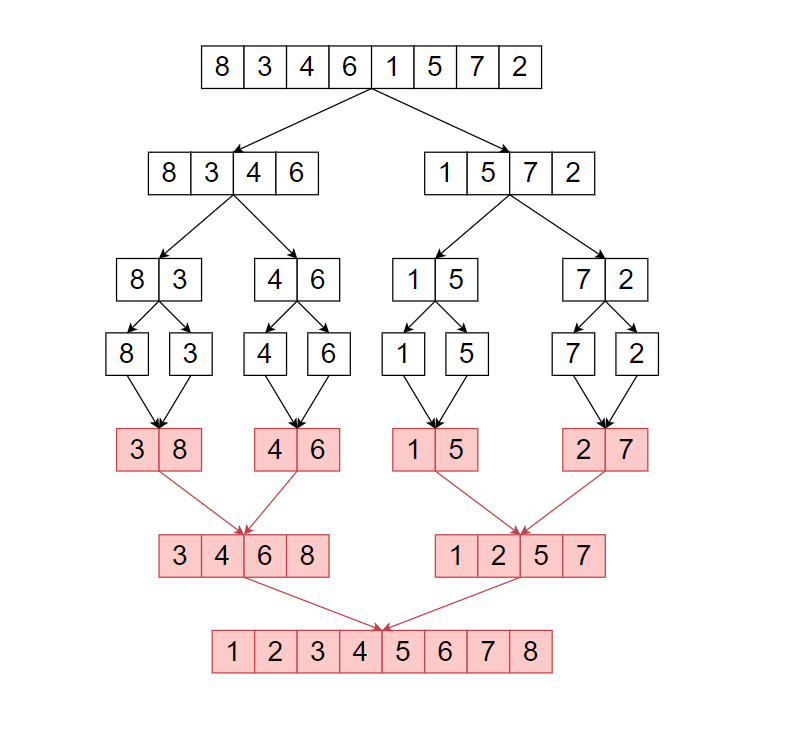
The above illustrates shows how merge sort works.
Note :
It is compulsory to use the ‘Merge Sort’ algorithm.
Problem approach
int a, b;
a = a ^ b;
b = a ^ b;
a = a ^ b;
and
Then I implemented Merge Sort, which follows the divide and conquer approach:
Divide the array into two halves
Recursively sort both halves
Merge the sorted halves
This reduced the time complexity to:
O(n log n)
The interviewer was satisfied with this optimized solution.
03
Round
Easy
HR Round
Duration10 minutes
Interview date3 Dec 2025
Coding problem1
The HR round focused on self-introduction, career goals, strengths and weaknesses, and willingness to relocate. Questions were also asked about why I wanted to join the company, where I saw myself in the next five years, and my comfort with different locations and work environments. The interviewer also assessed my communication skills and confidence level.
1. HR Questions
In the HR round, questions were asked about self-introduction, strengths and weaknesses, career goals, reasons for joining the company, willingness to relocate, and where I see myself in the next five years. The interviewer also focused on assessing communication skills, confidence, and basic behavioral aspects.
Problem approach
Answered in a simple, honest, and confident manner without overcomplicating responses.
Highlighted skills, a learning attitude, and flexibility (including willingness to relocate and adapt).
Maintained good communication, clarity, and positive body language throughout the interview.


Here's your problem of the day 
Solving this problem will increase your chance to get selected in this company
Skill covered: Programming
How do you remove whitespace from the start of a string?
Choose another skill to practice
Similar interview experiences
SDE - 1
3 rounds | 5 problems
Interviewed by Mphasis pvt limited
 Selected
1720 views

0 comments

0 upvotes
SDE - 1
4 rounds | 5 problems
Interviewed by Mphasis pvt limited
 Selected
 1490 views
0 comments
0 upvotes
SDE - 1
3 rounds | 6 problems
Interviewed by Mphasis pvt limited
 Selected
 1652 views
0 comments
0 upvotes
SDE - 1
3 rounds | 5 problems
Interviewed by Mphasis pvt limited
 Selected
 1016 views
0 comments
0 upvotes
Companies with similar interview experiences

SDE - 1
5 rounds | 12 problems
Interviewed by Amazon
 Selected
 117552 views
24 comments
0 upvotes
SDE - 1
4 rounds | 5 problems
Interviewed by Microsoft
 Selected
 60143 views
5 comments
0 upvotes
SDE - 1
3 rounds | 7 problems
Interviewed by Amazon
 Selected
 36138 views
7 comments
0 upvotes