





Myntra pvt ltd interview experience Real time questions & tips from candidates to crack your interview
SDE - 1
Myntra pvt ltd


3 rounds | 5 Coding
problems

 Selected
 Interview preparation journey

Preparation
Duration: 3
Topics: Data Structure, Algorithm, System Design, Dynamic Programming, DBMS

Tip 1 : Revise DSA at least 1 month and simultaneously practice problem from GFG or leetcode
Tip 2 : Try to practice leetcode problem as much as possible (all levels).
Tip 3 : Always try to get multiple solution (optimize solution) and read other’s optimized solutions as well.
Application process
Where: Referral
Eligibility: No Idea
Tip 1 : crisp and clear
Tip 2 : always mention your contribution and skills

Interview rounds
01
Round
Easy
Video Call
Duration60 Minutes
Interview date6 Oct 2020
Coding problem2
It was in the afternoon after lunch. The interviewer talked very friendly . He started by introducing himself and then asked about me. Then he gave me one easy level problem . I know about the problem so I told him the optimise approach for the problem. Then he asked one more easy level problem.
1. Longest Consecutive Sequence
Moderate
40m average time
70% success

0/80
Asked in companies



You are given an unsorted array/list 'ARR' of 'N' integers. Your task is to return the length of the longest consecutive sequence.
The consecutive sequence is in the form ['NUM', 'NUM' + 1, 'NUM' + 2, ..., 'NUM' + L] where 'NUM' is the starting integer of the sequence and 'L' + 1 is the length of the sequence.
Note:
If there are any duplicates in the given array we will count only one of them in the consecutive sequence.
For example-
For the given 'ARR' [9,5,4,9,10,10,6].

Output = 3
The longest consecutive sequence is [4,5,6].
Follow Up:
Can you solve this in O(N) time and O(N) space complexity?
Problem approach
I use Hashmap to store the number. Then traverse the array and check the number in hashmap in forward and backward direction and also remove that number from hashmap. Count the forward and backward length. The complexity of this solution is O(N) for both time and space
2. Clone Linked List with Random Pointer
Easy
10m average time
90% success
0/40
Asked in companies



Given a linked list having two pointers in each node. The first one points to the next node of the list, however, the other pointer is random and can point to any node of the list or null. The task is to create a deep copy of the given linked list and return its head. We will validate whether the linked list is a copy of the original linked list or not.
A deep copy of a Linked List means we do not copy the references of the nodes of the original Linked List rather for each node in the original Linked List, a new node is created.
For example,
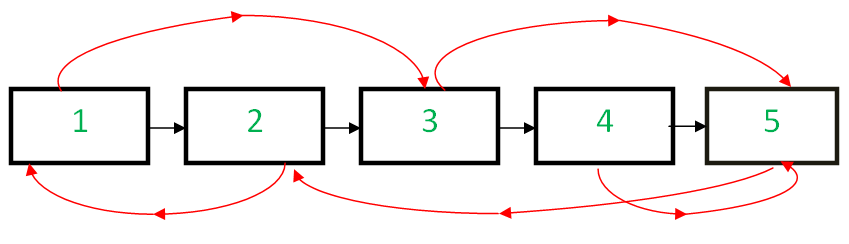
Random pointers are shown in red and next pointers in black.
Problem approach
First create a copy of link list using hashmap, then using hashmap fill all the random pointers
02
Round
Easy
Video Call
Duration60 Minutes
Interview date6 Oct 2020
Coding problem2
It start after 1 hr gap from 1st round. The level of problems are easy to medium
1. Buy and Sell Stock
Hard
0/120
Asked in companies


You are Harshad Mehta’s friend. He told you the price of a particular stock for the next ‘n’ days.
You are given an array ‘prices’ which such that ‘prices[i]’ denotes the price of the stock on the ith day.
You don't want to do more than 2 transactions. Find the maximum profit that you can earn from these transactions.
Note
1. Buying a stock and then selling it is called one transaction.

2. You are not allowed to do multiple transactions at the same time. This means you have to sell the stock before buying it again.
Example:
Input: ‘n’ = 7, ‘prices’ = [3, 3, 5, 0, 3, 1, 4].

Output: 6

Explanation:
The maximum profit can be earned by:
Transaction 1: Buying the stock on day 4 (price 0) and then selling it on day 5 (price 3).
Transaction 2: Buying the stock on day 6 (price 1) and then selling it on day 6 (price 4).
Total profit earned will be (3 - 0) + ( 4 - 1) = 6.
Problem approach
Simple linear order solution. Just traverse the array and compare ith value with (i-1)th value. If it is greater than zero. Add it into profit
2. Buy and Sell Stock - III
Hard
10m average time
90% success
0/120
Asked in companies



Given an array "prices". In "prices" the ith element is the price of the stock on the ith day. Your task is to find maximum profit at the end of the ith day. You may complete at max 2 transactions.
You can perform a transition with these conditions -
1. Not allowed to engage in more than 1 transaction at a time, which means if you have bought stock then you can buy another stock before selling the first stock.

2. If you bought a stock at ‘X’ price and sold it at ‘Y’ price then the profits ‘Y - X’.
Note:
It is not compulsory to perform an exact '2' transaction.
03
Round
Easy
Video Call
Duration120 minutes
Interview date9 Oct 2020
Coding problem1
This round is taken by the hiring manager of finance engineer team. It cover my projects , designing, DBMS, java basics
1. Design Question
Design coffee vending machine
Problem approach
Tip 1 : use OOPs concept carefully
Tip 2 : your code will be scalable
Tip 3 : try to explain your approach. Do not sit ideal.


Here's your problem of the day 
Solving this problem will increase your chance to get selected in this company
Skill covered: Programming
How do you remove whitespace from the start of a string?
Choose another skill to practice
Similar interview experiences
SDE - 1
2 rounds | 3 problems
Interviewed by Myntra pvt ltd
Rejected

5216 views

0 comments

0 upvotes
SDE - 1
2 rounds | 4 problems
Interviewed by Myntra pvt ltd
Rejected
2261 views
0 comments
0 upvotes
SDE - 1
3 rounds | 5 problems
Interviewed by Myntra pvt ltd
Selected 2700 views
0 comments
0 upvotes
SDE - 1
3 rounds | 3 problems
Interviewed by Myntra pvt ltd
 Selected
 3051 views
0 comments
0 upvotes
Companies with similar interview experiences
SDE - 1
5 rounds | 12 problems
Interviewed by Amazon
 Selected
 117552 views
24 comments
0 upvotes
SDE - 1
4 rounds | 5 problems
Interviewed by Microsoft
Selected 60143 views
5 comments
0 upvotes
SDE - 1
3 rounds | 7 problems
Interviewed by Amazon
 Selected
 36138 views
7 comments
0 upvotes